

The Polyetheramine market across China and Singapore remained under pressure through June and July 2026, with both markets following a similar downward trend before stabilising towards the end of the review period.
Softer feedstock costs, cautious downstream procurement, and comfortable regional supply outweighed steady demand from epoxy, coatings, construction chemicals, and composite manufacturers.
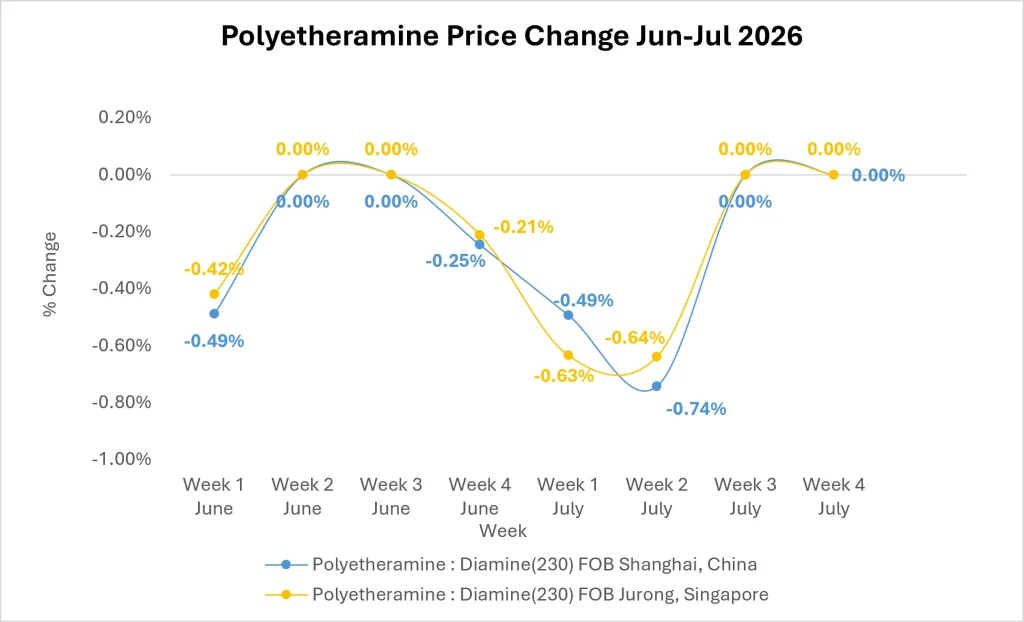
Source: Price Watch™ Polyetheramine
The China and Singapore markets tracked a closely aligned downward trend through the review period, softening through June and into mid-July before flattening over the second half of the month.
Polyetheramine Market Tracks Softer Feedstock Costs
Weaker upstream propylene oxide and ammonia-linked feedstock costs set the tone for the decline, compounded by cautious epoxy resin offtake and thin restocking activity from coatings and construction chemical converters.
Singapore registered marginally sharper corrections than China, particularly in early July, given its greater exposure to regional trading volumes and freight-linked cost pass-through, while China’s decline unfolded more gradually.
This parallel softness coincided with easing Middle East-linked geopolitical tensions, which had earlier pressured crude and naphtha costs.
As shipping routes and feedstock pricing normalized, the risk premium embedded in upstream costs unwound, removing a key source of upward pressure on Polyetheramine values and shifting both markets toward a calmer, fundamentals-led pricing environment.
Value-Chain Impact
- Epoxy resin and curing agent formulators leaned toward hand-to-mouth procurement, deferring bulk purchases on expectations of further feedstock softness.
- Coatings and construction chemical producers prioritized cost optimization over inventory build-up, trimming forward coverage given sustained price declines through June and July.
- Composite and wind-energy resin manufacturers maintained steady but conservative offtake, with little urgency to add volumes given ample regional availability.
China and Singapore Show Similar Trends with Regional Differences
- China exhibited a stair-step decline, alternating softness and brief stabilization, consistent with intermittent demand-recovery attempts that failed to gain traction.
- Singapore showed sharper early-July corrections before aligning with China’s flatter trend later in the month, reflecting convergence in regional supply-demand balances.
- Weakness across both markets was underpinned by soft upstream propylene oxide and ammonia-linked feedstock costs, alongside subdued restocking from downstream epoxy and coatings converters.
Polyetheramine Market Outlook
Looking ahead over the next three months, Polyetheramine prices across China and Singapore are expected to stay range-bound to softly biased, with limited upside unless propylene oxide or ammonia feedstock costs firm meaningfully or downstream epoxy, coatings, and wind-energy composite demand shows a decisive seasonal pickup.
Continued cautious buying and adequate regional supply should keep the market in a consolidation phase near term.
One key issue being closely monitored is whether the current divergence between FOB and import-market behaviour represents a temporary logistics-driven distortion or a more persistent structural shift in how Polyetheramine prices are transmitted across regions.
Keep this development on your Price Watch™ radar as supply chain reliability, import dependency, and downstream consumption patterns continue to define Polyetheramine market behaviour in 2026.
Follow Price Watch™ on LinkedIn for real-time Polyetheramine market insights, Polyetheramine price trends, supply chain intelligence, and global commodity updates.