

The global styrenics market continued to strengthen from last week, but the underlying story extends beyond regional price increases. Rising crude oil and benzene prices are now setting the tone for contract settlements and spot negotiations, allowing producers to recover margins despite only a modest improvement in downstream demand.
The latest price momentum originated from upstream energy markets after fresh military exchanges between the United States and Iran, including attacks on vessels attempting to transit the Strait of Hormuz and a strike on an oil facility in Kuwait.
Although crude oil retreated from its recent highs, geopolitical uncertainty continues to maintain a significant risk premium, keeping benzene prices elevated and reinforcing cost support throughout the styrenics value chain.
Feedstock Support Outweighs Cautious Buying in Asia
Styrene Monomer prices across Asia increased as higher benzene costs and firmer crude oil values strengthened producer pricing power. While downstream demand remained uneven across regional markets, selective replenishment buying and tighter spot availability encouraged sellers to raise offers.
The market remained characterized by cautious procurement, with buyers continuing to purchase only immediate requirements rather than rebuilding inventories. Nevertheless, stronger feedstock economics and reduced product availability provided sufficient support for a sustained recovery in SM prices.
Margin Recovery Drives Higher Styrene Offers in the US
The US Styrene Monomer market recorded a week of price gains as rising benzene values significantly increased production costs. Rather than demand leading the market higher, producers successfully recovered margins by reducing pricing flexibility and maintaining firmer offers. Downstream buying interest remained relatively subdued, but higher feedstock costs limited opportunities for discounts, shifting pricing leverage back toward suppliers.
US polystyrene export prices also strengthened during the week as producers focused on securing margins amid escalating raw material costs. Improving international pricing sentiment further supported export offers, although domestic downstream consumption remained measured.
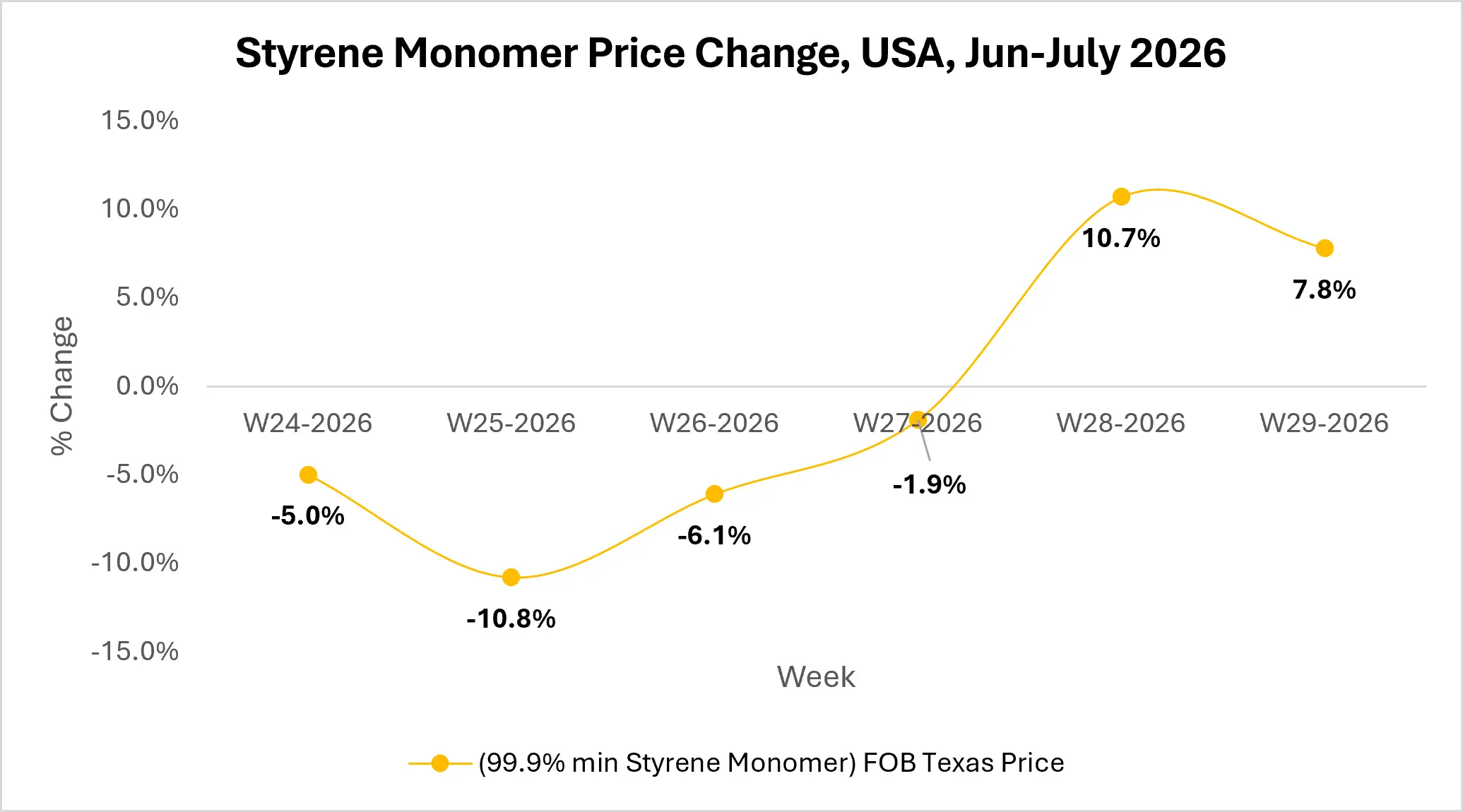
Source: Price Watch™ Styrene Prices
Higher Costs Offset Weak Polymer Demand in Europe
European Styrene Monomer prices also advanced, supported by stronger benzene values, elevated energy costs, and tighter spot market conditions. Lower operating rates and relatively limited trade availability reduced market flexibility, allowing producers to implement higher offers despite cautious purchasing activity among converters.
However, the disconnect between Styrene monomer and its derivative markets remained evident. European polystyrene prices declined during the week as weak demand and conservative inventory management prevented producers from fully passing through higher Styrene Monomer costs.
Maintenance activity continues to influence global supply dynamics. Chiba Styrene Monomer (DENKA) is expected to restart its 270,000 metric tons per year Styrene Monomer unit by the end of July following a turnaround that began in late May.
Meanwhile, INEOS Styrolution has restarted its 560,000 metric tons per year Styrene Monomer facility in Bayport, Texas, after completing maintenance that commenced at the end of March.
While these restarts will gradually improve overall production capacity, their immediate impact on market pricing is expected to remain limited. An often-overlooked factor is that producers typically prioritize fulfilling contractual obligations before releasing additional spot cargoes.
As a result, spot market liquidity remains relatively constrained despite improving operating rates, making prices more sensitive to fluctuations in benzene and crude oil.
The styrenics market has entered a phase where upstream energy markets are exerting greater influence than downstream demand.
Consensus across the industry suggests that crude oil and benzene will remain the principal pricing drivers through the third quarter, while polymer demand continues to lag behind monomer cost inflation.
Will persistent geopolitical risks keep crude oil and benzene elevated long enough to establish a higher pricing floor for Styrene Monomer contracts during Q3? 2026. Stay tuned with Price Watch™ for more updates.
Follow Price Watch™ on LinkedIn for real-time petrochemical market insights, styrenics trends, supply chain intelligence, and global commodity updates.