

The synthetic rubber trade has been thrown into fresh turmoil over the past two weeks, and this time the pressure is not confined to Asia.
Iran’s naval command re-closed the Strait of Hormuz on 12 July after striking a vessel accused of bypassing an approved route, and only a fragile pause in the fighting has taken hold since.
At almost the same time, Europe’s own feedstock lifeline has been squeezed by falling river levels, disrupting the barge logistics that key chemical sites depend on.
Source: Price Watch™ SBR Prices
Middle East Tensions Tighten Feedstock Availability
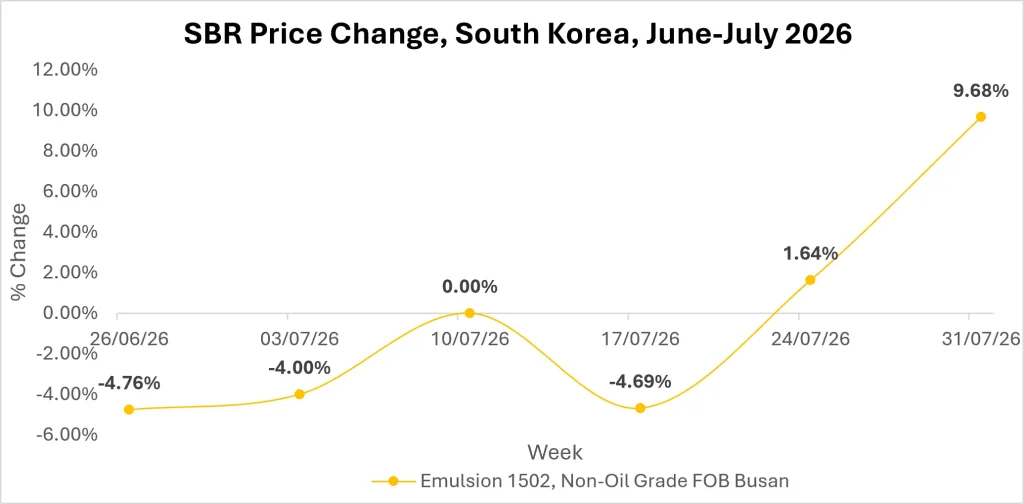
In Asia, the picture remains the most volatile. After nearly two weeks of renewed US strikes on Iranian targets, a pause took hold late last week, but shipping traffic through the strait is still running far below pre-conflict levels, and restoring full physical flows of naphtha and butadiene is expected to take weeks even if the calm sticks.
China’s largest state-run producer raised its listed butadiene price by roughly a thousand yuan a tonne in the final week of July alone.
Europe Faces a Different Supply Challenge
Europe is facing a different but equally real supply threat.
Rhine water levels fell sharply through the second half of July, disrupting barge logistics that feed major chemical sites along the river, including LyondellBasell’s Wesseling complex in Germany, where a force majeure on butadiene was already flagged the week before.
On its own half-year results call on 29 July, BASF’s chief executive told investors that further force majeures and shortages could not be ruled out if low water persists.
North America Benefits, But New Risks Remain
North America, by contrast, is currently benefiting from the chaos elsewhere. LyondellBasell’s second-quarter results, announced on 31 July, showed its Americas olefins and polyolefins business posting sharply better margins as butadiene-linked co-product pricing firmed on tighter global availability.
Hormuz traffic remains well below pre-conflict levels, the conflict has now spread to affect Red Sea shipping too, and that crude, feedstock and polymer prices have all moved higher over the past few weeks as a result.
With Atlantic hurricane season now underway, Gulf Coast crackers that feed US butadiene, SBR and PBR output remain an added wildcard.
Synthetic Rubber Market Outlook
The near-term picture stays fragile rather than settled. The pause holding around the strait could unravel with a single fresh incident, low water on key European rivers could still trigger further force majeures on butadiene and its derivatives, and hurricane season carries its own risk for Gulf Coast supply any one of which would tighten the market further just as quickly as it eased.
Barring a durable calm on all three fronts at once, offers across SBR, PBR, NBR and the rest of the synthetic rubber slate are likely to stay firm through August. Buyers should expect a market that keeps moving week to week rather than settling.
Follow Price Watch™ on LinkedIn for real-time synthetic rubber market insights, price trends, supply chain intelligence, and global commodity updates.