

Most nutraceutical investors track brand multiples, supplement category growth and consumer wellness trends. Very few track what happens three layers upstream, where a single Chinese company controls 41% of the global production of an ingredient that sits inside virtually every product in their portfolio.
That ingredient is Vitamin B6 (PYRIDOXINE), and what is happening to its market in 2026 is one of the cleaner case studies available right now in how concentration risk, commodity pricing, and geopolitics interact inside a supply chain most equity analysts never open.
A Highly Concentrated Supply Base Creates Structural Risk
China leads the global Vitamin B6 (PYRIDOXINE) market, with the top five manufacturers – Tianxin Pharmaceutical, DSM, Huazhong Pharmaceutical, Hegno, and Guangji Pharmaceutical -collectively controlling around 90% of global production.
Tianxin alone holds a 41% production market share, making it not just the largest producer in the world but the single most consequential company in a market that most of its end customers have never heard of.
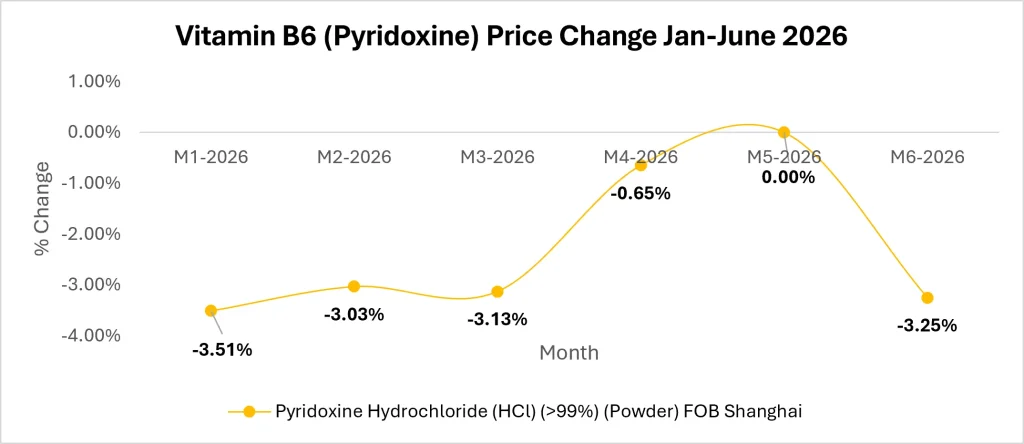
Source: Price Watch™ Vitamin B6 (PYRIDOXINE) Prices
Growing Demand Meets Rising Supply Chain Uncertainty
Animal nutrition accounts for 81% of global Vitamin B6 (PYRIDOXINE) sales, with poultry, swine, fish, and companion animal feed all dependent on pyridoxine to support amino acid metabolism and growth performance.
The pharmaceutical and nutraceutical sectors absorb most of what remains, with Vitamin B6 (PYRIDOXINE) appearing as a standard ingredient in virtually every multivitamin formulation on the market. All of that demand runs through a production base that is for practical purposes, a single geography.
Feedstock Risks Are Increasing Production Costs
The recent supply shock risk now has a new vector that did not exist a year ago. On February 28, 2026 Iran announced the closure of the Strait of Hormuz following US-Israeli airstrikes, and as the world’s largest methanol consumer, China relies on Iranian methanol for over 50% of its supply.
Methanol is a core synthesis feedstock for pyridoxine production, and its disruption feeds directly into the cost base of every Chinese manufacturer in the market.
Oil prices jumped more than 10% in early Asian trading following the Hormuz closure, and several global chemical producers issued supply-risk notifications covering methanol, sulfur, propylene, and ammonia simultaneously.
The Vitamin B6 (PYRIDOXINE) market has not yet translated that feedstock pressure into visible price increases – DSM-Firmenich’s Q2 2026 outlook described Vitamin B6 (PYRIDOXINE) as showing a stable trend after a period of softness but a market that is already running thin on producer margins, absorbing higher input costs and watching new entrants undercut pricing is not a market with much buffer left.
Vitamin B6 Market Outlook
The global Vitamin B6 market is forecast to grow from USD 550 million in 2025 to USD 900 million by 2030 a trajectory that looks straightforward on a slide deck.
Three forces – a Middle East conflict tightening feedstock supply into China, domestic oversupply and new entrants breaking pricing floors within it, and a European regulatory push demanding diversification away from it – are all pressing on the same supply chain at the same time, in contradictory directions.
The bigger question now arises – when the low prices that buyers have come to rely on are themselves a symptom of instability rather than a sign of health, who exactly is building the alternative supply chain that Europe is now legally required to have?
Follow Price Watch™ on LinkedIn for real-time Vitamin B6 market insights, Vitamin B6 price trends, supply chain intelligence, and global commodity updates.