C9 Solvent Price Trend and Forecast

UNSPC code: 12191501
|
Weekly Update
|
Historical Data Since 2015
|
Forecast for 2026

c9 solvent Price Trends by Country

inIndia
krSouth Korea

Global c9 solvent Spot Market Prices, Trend Analysis and Forecast

Price Watch™ provides real-time price assessments and price forecasts for C9 Solvent across top trading regions:   

C9 Solvent Regional Coverage C9 Solvent Grade and Country Coverage C9 Solvent Pricing Data Coverage Explanation
Asia-Pacific C9 Solvent Pricing Analysis C9 Solvent Water White (Aromatic Wt% ≥ 99%) FOB Prices at Busan Port, South Korea Weekly Price Update of C9 Solvent Real-Time Export Prices from Busan Port, South Korea to Global Markets
C9 Solvent Water White (Aromatic Wt% ≥ 99%) CIF Prices at Nhava Sheva Port, India, Importing from South Korea Weekly Price Update of C9 Solvent Real-Time Import Prices at Nhava Sheva Port, India, Importing from South Korea
C9 Solvent Water White (Aromatic Wt% ≥ 99%) Ex-Mumbai Domestic Prices, India Weekly Price Update of C9 Solvent Real-Time Domestic Prices in Mumbai, India

Note: In assessments structured as CIF [Importing Port] (Exporting Country), the country mentioned in brackets indicates the primary origin of supply (exporting country), while the named port refers to the destination port in the importing country. Other Incoterms (FOB, FD, EXW, etc.) should be interpreted in accordance with standard international trade definitions.

C9 Solvent Price Trend Q1 2026

The first quarter of 2026 saw a remarkable rebound, with rising prices seen on a quarter-on-quarter average basis, driven by improved demand for downstream applications as well as tightness in supplies. cC9 solvent price trend increases are quite significant in March, driven largely by supply chain disruptions in crude oil production and movement following geopolitics in the Middle East region.

Such disruptions in transport affected not only shipping costs but also feedstock availability and logistics, resulting in tight spot supply and intense buying activity, thus fueling further price volatility. Upstream movements play a key role in shaping c9 solvent price trend nonetheless, the price trend is highly exposed to geopolitical risks and supply chain disruptions.

South Korea: C9 Solvent Export prices FOB Busan, South Korea; Grade- Industrial Grade Water White (Aromatic Wt. 99% min)

During Q1 2026, the C9 solvent price in South Korea has maintained stability in its quarterly average due to supply-demand equilibrium and stable feedstock prices in the first weeks of the quarter. The C9 solvent price in South Korea is relatively stable due to consistent procurement and storage management.

In South Korea, C9 solvent price trend in March 2026, there is an unprecedented increase up to 6-7%. This growth in the price is attributed mainly to the Iran-Israel conflict and supply and trade disruptions of crude oil in the global market.

The conflict has affected important crude oil transport routes such as the Strait of Hormuz. March’s sharp rise in the price has emphasized the connection between crude oil movements and the price of C9 solvents.

India: C9 Solvent import prices CIF Nhava Sheva, India; Grade- Industrial Grade Water White (Aromatic Wt. 99% min)

According to Price-Watch™, in Q1 2026, C9 solvent price trend in India increased by 5.00% on a quarterly average, supported by improved downstream demand and tightening supply conditions. The C9 solvent price in India showed further momentum in March, surging sharply by 14.00%, primarily driven by significant disruptions in global crude oil supply and trade flows due to the Iran–Israel conflict.

These disruptions impacted key energy shipping routes, leading to higher freight costs, constrained feedstock availability, and logistical bottlenecks in the aromatics supply chain. In India, C9 solvent price trend in March 2026 highlights the strong linkage between crude oil dynamics and C9 solvent pricing, while underscoring the market’s sensitivity to geopolitical risks, supply chain disruptions, and fluctuations in upstream feedstock flows.

C9 Solvent Price Trend Analysis: Q4 2025

The quarter ended with prices dropping modestly, driven by low demand in the paint, coating, and adhesive industries and steady prices for aromatics feedstocks. The market participants adopted a prudent approach to purchasing, helped by adequate stock positions, preventing further price hikes.

While December saw a slight improvement with a marginal fall in prices due to year-end stock management and restocking, the market mood is still weak, with balanced supply and demand dynamics.

South Korea: C9 Solvent Export prices FOB Busan, South Korea; Grade- Industrial Grade Water White (Aromatic Wt. 99% min)

As per the fourth quarter of 2025, the C9 solvent price in South Korea showed a fall by 4.50% on an average basis, which can be attributed largely to the lower demand from downstream applications such as coatings, paints, and adhesives, along with the stable to soft aromatics feedstocks.

In South Korea, C9 solvent price in December 2025 have witnessed a slight decline of 2.00%. The overall the C9 solvent price trend in South Korea during December shows that cautionary purchasing methods and ample supply have restrained the prices despite the bearish market sentiments.

India: C9 Solvent import prices CIF Nhava Sheva, India; Grade- Industrial Grade Water White (Aromatic Wt. 99% min)

In Q4 2025, C9 solvent price trend in India declined by 2.00% on a quarterly average, reflecting subdued demand from downstream sectors such as paints, coatings, and adhesives, along with relatively stable aromatics feedstock costs.

In India C9 solvent price in December 2025 moderated, recording a smaller decline of 1.50%, indicating slight stabilization driven by year-end inventory adjustments and limited restocking activity.

Overall, the C9 solvent price trend in India in December highlights how cautious procurement, sufficient import availability, and comfortable inventory levels helped partially limit price erosion, even as market sentiment remained soft due to weak consumption and adequate supply.

In Q3 2025, the global C9 solvent market exhibited a mixed pricing pattern, with some regions showing minor upward adjustments while others experienced more pronounced declines, resulting in an overall downward trend. Weaker demand from key downstream sectors particularly paints, coatings, adhesives, and rubber processing across several regions including East Asia and Europe contributed to the softening prices.

Additionally, ample supply availability, reduced feedstock costs from pyrolysis gasoline (Pygas), and subdued buying sentiment in export markets like Southeast Asia and Africa further weighed on prices.

South Korea: C9 Solvent Export prices FOB Busan, South Korea, Grade- Industrial Grade Water White (Aromatic Wt. 99% min).

In Q3 2025, C9 solvent prices in South Korea declined by approximately 3%, reflecting a softening in regional demand and improved supply availability. C9 solvent price trend in South Korea decrease was primarily driven by ample inventory levels, coupled with reduced procurement activity from downstream industries such as coatings, adhesives, and rubber processing.

Additionally, stable to slightly lower feedstock prices, particularly from reformate and pyrolysis gasoline (Pygas), contributed to easing production costs for C9 solvent price in South Korea in September 2025. Competitive pricing from other Northeast Asian suppliers also pressured domestic producers to adjust prices downward.

Despite the price dip, overall market fundamentals remained balanced, with no major supply disruptions. However, if demand picks up in the coming quarter particularly from the export or construction sectors C9 solvent prices may recover moderately, depending on upstream cost trends and refinery output levels.

India: C9 Solvent import prices CIF Nhava Sheva, India, Grade- Industrial Grade Water White (Aromatic Wt. 99% min).

According to PriceWatch, in Q3 2025, C9 solvent price trend in India, particularly on a CIF Nhava Sheva and Ex-Mumbai basis remained relatively stable, despite fluctuations in global solvent markets.

A key factor supporting this C9 Solvent price in India stability was the moderation in FOB prices from key exporting countries in Asia, including South Korea and China, which helped offset cost pressures. Simultaneously, the recent stabilization of the USD/INR exchange rate reduced volatility in import costs, creating a more predictable pricing environment for Indian buyers.

While demand from downstream sectors such as paints, coatings, and resins remained steady, abundant supply and competitive offers in the regional market kept price movements limited. As a result, despite broader market softening in parts of Asia. In September 2025 C9 solvent price trend in India held firm, supported by currency stability and easing upstream FOB values.

According to the PriceWatch, In Q2 2025, C9 Solvent prices on an FOB Busan, South Korea basis experienced a noticeable decline over the quarter. The price drop was primarily driven by softer demand from downstream industries such as coatings, adhesives, and paints, coupled with stable to ample supply levels. Producers maintained consistent output, leading to sufficient availability in the market, while buyers adopted a cautious procurement approach amid ongoing economic uncertainties.

Freight rates remained relatively steady, indicating that the decline was mainly demand-driven rather than logistics-related. By the end of the quarter, C9 Solvent prices stood at USD 790 per ton FOB Busan, reflecting a bearish market sentiment and subdued buying activity. 

According to the PriceWatch, in Q2 2025, C9 Solvent prices on a CIF India basis experienced a decline driven by weakened demand and steady supply conditions. Downstream sectors such as coatings, adhesives, and paints maintained cautious buying amid ample inventory levels and economic uncertainties. Importers faced competitive offers from key exporting regions, which added to the downward pressure on prices.

Freight rates remained relatively stable, suggesting that the price drop was primarily influenced by soft market demand rather than logistical factors. By the end of the quarter, C9 Solvent prices on a CIF India basis reflected a bearish trend, highlighting subdued buying interest and a well-supplied market environment.

According to the PriceWatch, in Q2 2025, C9 Solvent prices on an Ex-India basis experienced a decline, driven by softening demand from key domestic industries such as coatings, adhesives, and printing inks. Local suppliers maintained steady production levels, resulting in ample availability and increased competition within the market.

Buyers adopted a cautious approach to procurement amid economic uncertainties and sufficient inventory stocks, which put additional downward pressure on prices. Feedstock costs remained relatively stable, indicating that the price decrease was mainly demand-driven. Overall, the Ex-India market for C9 Solvent trended lower throughout the quarter, reflecting a bearish sentiment amid subdued consumption and balanced supply conditions.

In Q1 2025, C9 Solvent prices experienced a modest increase, rising from USD807 in January to USD 820 in March, a 1.16% increase. This slight upward movement was driven by slightly improved demand as industries started to recover post-winter.

The price increase in March 2025 could be attributed to a mild recovery in the global market, along with a temporary stabilization in feedstock prices. Although the market remained relatively weak, this uptick reflected a small rebound in demand and slight adjustments in supply-demand balance. 

In Q1 2025, Ex-Mumbai C9 Solvent prices saw a recovery, increasing from INR 82,677.5/ton in December 2024 to INR 86,650/ton by March 2025, reflecting a 4.77% increase. This rebound was driven by a slight uptick in demand as industries began to recover from the seasonal slowdown. Key sectors, including paints and coatings, showed signs of improved consumption, leading to higher buyer inquiries.

Additionally, feedstock prices stabilized, providing a more balanced cost structure for manufacturers. The recovery in prices reflected the shifting dynamics as demand picked up, although the market remained cautious. 

C9 Solvent Price Trend Analysis: Q4 2024

In Q4 2024, C9 Solvent prices dropped from USD 835 in October to USD 800 in December, representing a 4.48% decline. This continued downward movement was influenced by reduced crude oil prices, which kept feedstock costs lower and eased production expenses.

Demand stagnation from end-user industries, including the paint and coatings sector, played a significant role in the price drop. The low inquiries and lack of large orders continued to impact prices negatively. Sellers in the region were reporting flat market conditions, with few changes in buyer behaviour. 

In Q4 2024, Ex-Mumbai C9 Solvent prices continued their downward trend, falling from INR 84,500/ton in October to INR 82,677.5/ton by December, representing a 2.01% decrease. This decline was mainly driven by the ongoing reduction in crude oil feedstock costs, which helped ease production expenses but did not stimulate a rebound in demand.

The market remained weak, with stagnant consumption in the paints sector and limited demand from other end-users. As the year ended, fewer large orders and low buyer interest contributed to the continued pressure on prices. 

In Q3 2024, C9 Solvent prices saw a further decline, dropping from USD850 in July to USD 810 in August, and continuing the downward trend with USD840 in September. This represents a 4.70% decrease over the quarter. The decline in Q3 2024 was influenced by lower demand in the market, coupled with a saturated supply, especially in the APAC region.

Sellers in South Korea noted fewer large orders and low buyer inquiries, further impacting the price trend. However, a slight uptick of 3.70% was observed in September, possibly due to a temporary market adjustment or minor recovery in demand. 

During Q3 2024, Ex-Mumbai C9 Solvent prices exhibited a slight decline, dropping from INR 86,000/ton in July to INR 84,500/ton in September, reflecting a 1.75% decrease. The market remained largely stagnant, with low demand persisting in the paint and coatings industries, key drivers of consumption for C9 solvents.

The slight decline in prices was also influenced by ongoing weak inquiries from major exporters like South Korea. Although the market did not experience sharp declines, the continued lack of significant demand led to a gradual price erosion throughout the quarter. 

In Q2 2024, C9 Solvent prices continued their downward trend, dropping from USD880 in April to USD850 by June, a 3.41% decrease. This was due to reduced crude oil feedstock costs, which eased production expenses for manufacturers and further pushed prices lower.

Additionally, demand from end-user industries remained stagnant, with paint consumption and other industrial demands not showing significant growth. The stable yet low demand from sectors like paints and coatings, along with lower buyer inquiries in regions like South Korea, contributed to the sustained price decline. 

In Q2 2024, C9 Solvent prices experienced a modest decline from INR 86,000/ton in April to INR 85,000/ton in June, marking a 1.16% drop. This was due to the continued easing of production costs driven by falling crude oil prices, as well as muted demand in the market.

Key end-user sectors such as paints and coatings continued to show weak consumption, with fewer large orders and lower overall activity. Despite this, the market saw some price stabilization, as the balance between supply and demand remained relatively consistent, although still on the lower end of the spectrum. 

In Q1 2024, C9 Solvent prices saw a decline from USD930 in January to USD880 in February, representing a 5.38% decrease. This drop was primarily driven by declining crude oil prices, which had a direct impact on feedstock costs, making production of C9 solvent cheaper.

By March, prices remained stable at USD880, indicating a plateau after the initial drop. The market was influenced by lower demand from end-user industries, including the paint and coatings sector, which had reduced consumption. 

In the first quarter of 2024, C9 Solvent prices started at INR 90,000/ton but experienced a decline by the end of March, reaching INR 86,000/ton. This drop of 3.33% was primarily driven by falling crude oil prices, which reduced feedstock costs, and weak demand from key sectors like paints and coatings.

With limited buyer inquiries and subdued consumption, particularly in South Korea, the market faced continued pressure. The balance between supply and demand remained skewed towards lower prices, contributing to the overall decline. 

Technical Specifications of C9 Solvent Price Trends

Product Description

C9 Solvent is a high-purity aromatic hydrocarbon solvent primarily composed of C9 aromatic compounds such as trimethylbenzenes and ethyltoluene. It is a clear liquid with a strong aromatic odour, known for its excellent solvency power, slow evaporation rate, and compatibility with resins, oils, and polymers. Widely used in paints, coatings, adhesives, printing inks, and agrochemical formulations, C9 Solvent enhances flow, adhesion, and drying properties. It is typically supplied in drums or bulk and should be handled with appropriate safety precautions due to its flammable nature.

Identifiers and Classification:

  • CAS No – 64742-95-6
  • HS Code – 27075000
  • Molecular Formula – CH3C4H7O
  • Molecular Weight (in gm/mol) – 120.2 g/mol


C9 Solvent Synonyms:

  • Aromatic Naphtha (C9)
  • C9 Aromatic Solvent
  • Aromatic Hydrocarbon Solvent C9


C9 Solvent Grades Specific Price Assessment:

  • Industrial Grade Water White (Aromatic Wt. 99% min)


C9 Solvent Global Trade and Shipment Terms

  • Quotation Terms: 15-20 MT (Global), 10-15 MT (Ex-Mumbai)
  • Packaging Type: 200 Kg Drum


Incoterms Referenced in C9 Solvent Price Reporting

Shipping Term  Location  Definition 
FOB Busan  Busan, South Korea  C9 Solvent Export price from South Korea 
CIF Nhava Sheva (South Korea)  Nhava Sheva, India  C9 Solvent import price in India from South Korea 
Ex-Mumbai  Mumbai, India  Domestically Traded C9 Solvent price in Mumbai 

*Quotation Terms refers to the quantity range specified for the C9 Solvent being quoted or offered in a commercial transaction.

**Packaging Type refers to standard packaging size commonly used for C9 Solvent packing, ease of handling, transportation, and storage in industrial and commercial applications.


Key C9 Solvent Manufacturers and their brands

Brand Name  Manufacturer 
C9 Aromatic Solvent  Godo Chemical Corporation 
C9 Solvent  Korea petroleum 
C9 Solvent  GS Caltex 
C9 Solvent  YNCC 

C9 Solvent Industrial Applications

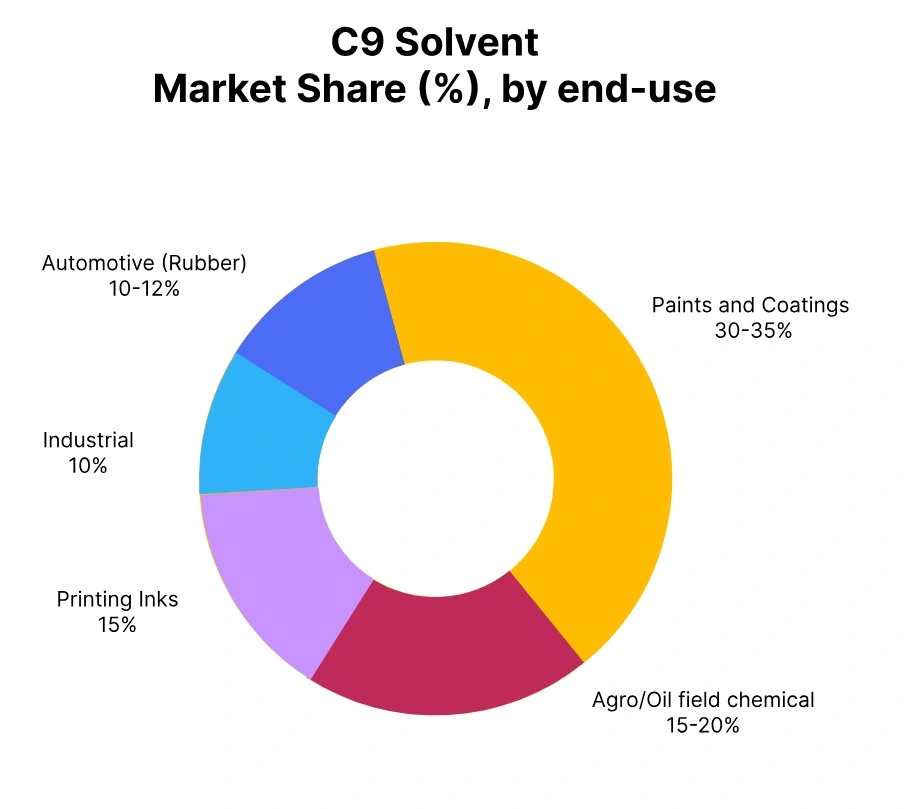
C9 Solvent market share end use

Historically, several events have caused significant fluctuations in C9 Solvent prices

  • Russia-Ukraine Conflict (2022-Present): Disruptions in European crude oil production led to increased costs and global price volatility. 
  • Israel-Hamas Conflict (2023): The recent escalation in the Israel-Hamas conflict has introduced additional uncertainty in Middle Eastern supply chains, potentially impacting global crude oil prices and, consequently, the pricing of C9 Solvent Disruptions in this region can affect supply routes and increase volatility in markets worldwide. 
  • COVID-19 Pandemic (2020): Demand plummeted initially but rebounded as packaging needs surged. 
  • Geopolitical Tensions (2018-2019): U.S.-China trade wars caused price instability due to disrupted supply chains. 


These events underscore the C9 Solvent market’s vulnerability to global disruptions and highlight the need for continuous monitoring of supply-demand dynamics.
 

Why Price Watch™?

Price Watch™ is your trusted resource for tracking global c9 solvent price trends. Our platform delivers real-time data and expert analysis, offering deep insights into the key factors driving price fluctuations in the c9 solvent market. By monitoring critical events such as geopolitical tensions, supply chain disruptions, and economic shifts, Price Watch™ keeps you fully informed of market dynamics.

In addition, Price Watch™ provides detailed forecasts and updates on production capacities, enabling you to anticipate market changes and make well-informed decisions. With Price Watch™, you gain a competitive edge in understanding all the elements that influence c9 solvent prices worldwide. Stay ahead of the curve with Price Watch’s™ reliable, accurate, and timely c9 solvent market data.

Track Price Watch's™ c9 solvent price assessment on a weekly basis since 2015 onwards, along with short-term forecasts, and get access to the detailed report in a downloadable format.

C9 Solvent Market Price Trend published by Price Watch™ reflect prevailing spot market conditions, derived from independent research, verified trade inputs, and proprietary market intelligence as of the publication date. Prices are published on the specified Incoterm and represent indicative base market levels, exclusive of applicable taxes, VAT, duties, tariffs, and other statutory charges. Actual transaction values may vary depending on volume, credit terms, contractual structure, and other negotiated conditions. Market prices are inherently subject to volatility, liquidity dynamics, regulatory changes, and evolving trade activity. The information provided is for reference and benchmarking purposes only and does not constitute an offer, recommendation, or guarantee of transactional outcomes. Users should exercise independent commercial judgment and assess their specific contractual, regulatory, tax, and application requirements before making business decisions. Price Watch™ assumes no liability for decisions taken based on this information.

The pricing of C9 Solvent is influenced by several factors, including raw material costs such as crude oil, naphtha fluctuations in supply and demand within industries like paints, coatings, and adhesives, as well as external elements like geopolitical events, trade tariffs, and energy prices. These factors combine to create variability in pricing depending on global economic conditions.

Regional production plays a significant role in C9 Solvent pricing. Regions with high production, like Asia-Pacific, tend to have more competitive pricing due to local availability, whereas regions that rely on imports, such as North America and Europe, often face higher costs due to transportation fees, import duties, and potential supply chain disruptions.

The latest pricing trends for C9 Solvent often reflect fluctuations in the cost of raw materials and changes in global supply chains. To secure better rates, procurement heads can consider locking in long-term contracts with suppliers, monitoring global price trends and indices, and optimizing bulk purchasing strategies to take advantage of volume discounts.

C9 solvent is a hydrocarbon solvent derived from the C9 fraction of crude oil, containing mostly aromatic compounds like toluene, xylenes, and trimethylbenzenes, and is widely used in paints, coatings, adhesives, rubber processing, and chemical intermediates due to its strong solvency and moderate evaporation rate. Its price matters because it is a significant raw material cost for these industries, so fluctuations directly affect product costs and profit margins. Additionally, as a petrochemical derivative, C9 solvent prices reflect broader crude oil trends, supply-demand dynamics, and global market conditions, making it an important economic indicator for manufacturers and industrial buyers. Price-Watch™ tracks these prices to help businesses and consumers understand and stay updated with the market trends.

C9 Solvent prices vary by region and delivery basis. Prices are typically quoted per metric ton and change based on supply, demand, feedstock costs, and production capacity. Price-Watch™ provides real-time price assessments across different global markets to help buyers and sellers make informed decisions.

The C9 solvent market has recently been relatively stable to slightly soft in many regions, with prices influenced by a balance of supply and moderate demand from paints, coatings, adhesives, and rubber industries. Its price is primarily affected by crude oil and feedstock costs, since it is derived from petroleum fractions, as well as inventory levels, trade flows, and regional industrial activity. Seasonal buying patterns, logistics issues, and regulatory factors targeting aromatic hydrocarbons or VOCs can also cause short-term fluctuations. Overall, the market trend reflects cautious downstream demand and steady production, with any significant price movements closely tied to changes in crude oil prices or supply constraints.

The largest consumers of C9 solvent are industries that rely on its strong solvency and aromatic content, with paints and coatings, adhesives and sealants, and rubber and tire manufacturing leading global demand. It is used as a thinner and carrier in paints, to adjust viscosity in printing inks, for polymer compounding in rubber, and as a raw material in chemical intermediates and resins. The paints, coatings, and adhesives sectors account for the majority of consumption, while construction materials and specialty chemical applications also use significant volumes, making C9 solvent a key input across multiple high-volume industrial processes.

C9 solvent is produced from the C9 fraction of crude oil or naphtha during petroleum refining. When crude oil is distilled, it separates into different fractions based on boiling points, and the C9 fraction contains hydrocarbons with nine carbon atoms, mostly aromatic compounds like toluene, xylenes, and trimethylbenzenes. This fraction can be further refined, blended, or purified to create C9 solvent suitable for industrial use in paints, adhesives, rubber processing, and chemical production. Essentially, it’s a petrochemical derivative, making its availability and price closely linked to crude oil production and refining capacity.

According to recent global export data, South Korea is the largest exporter of C9 solvent in the world, accounting for the highest number of export shipments and a significant portion of total global C9 solvent exports. Price-Watch™ tracks production levels, export flows and trade patterns to help businesses understand global supply chains and identify sourcing opportunities.

Currently, the global supply of C9 solvent is sufficient to meet demand, with production generally keeping pace with consumption across major markets. Inventories are ample in many parts of Asia-Pacific, supporting stable or slightly soft prices, while Europe also maintains a balanced supply with modest price support. Some regions, such as the Middle East, experience tighter availability that can influence local pricing, but overall, refineries and producers adjust output to match industrial demand from paints, coatings, adhesives, and rubber manufacturing. Long-term forecasts indicate growing demand, yet current production and trade flows are adequate to meet global needs. Price-Watch™ monitors these supply-demand imbalances to alert the market about potential shortages or surpluses.

C9 solvent comes in different grades based on aromatic content, purity, and end-use requirements, including industrial grade for general adhesives and paints, high-aromatic grade for stronger solvency in resins and coatings, technical/purity grade for chemical intermediates or sensitive applications like printing inks, and customized blends tailored for specific performance needs. Prices differ because higher aromatic content, greater purity, and specialized specifications require more refining and processing, making high-aromatic and technical grades more expensive, while standard industrial grades are cheaper due to larger production volumes and lower processing costs.

When demand for C9 solvent suddenly increases, the immediate effect is a rise in its price due to higher competition for the same supply, potentially causing temporary shortages. In the short term, supply is relatively fixed, so the price spike can be sharp, but over time, producers may increase production to meet demand, gradually stabilizing prices. Higher costs can also affect downstream industries that use C9 solvent, prompting them to seek substitutes or raise product prices. Additionally, market speculation may amplify short-term volatility, while the price signal encourages more efficient use and investment in production capacity. Price-Watch™ captures these market dynamics in real-time.

Energy prices have a direct and significant impact on C9 solvent costs because its production is energy-intensive. C9 solvent is derived from petroleum or naphtha streams in refineries, so higher crude oil or natural gas prices increase the raw material and processing costs. When energy costs rise, manufacturers spend more on distillation, cracking, and purification processes, which pushes up the production cost of C9 solvent. Conversely, lower energy prices reduce production expenses, allowing suppliers to offer C9 solvent at lower prices. Additionally, energy price volatility can lead to fluctuations in solvent pricing, affecting both short-term market stability and long-term contract negotiations. This is why prices track broader petrochemical feedstock trends and regional energy costs, a relationship that Price-Watch™ analyses in its price assessments & market reports.

Regional price differences for C9 solvent arise from variations in supply, demand, and local costs. Areas near refineries or petrochemical hubs generally have lower prices due to easier access and lower transportation costs, while remote regions face higher shipping and logistics expenses. Local demand levels, industrial activity, energy costs, and government factors such as taxes, tariffs, and environmental regulations also influence prices. Additionally, currency fluctuations for imported solvent can further affect costs, meaning that even with a global reference price, local conditions create noticeable regional variations. Price-Watch™ tracks prices across all major regions to highlight these differences.

Current industry data and price tracker forecasts indicate that C9 solvent prices are likely to remain relatively stable to slightly soft in the near term, with only limited upside expected unless there’s a meaningful improvement in downstream demand or tightening of supply. In North America and parts of Asia, balanced supply and ample inventories have kept price momentum muted, and oversupply with weak coatings/industrial demand has pressured prices, especially in APAC. In Europe, selective restocking and some seasonal recovery in coatings demand may support moderate gains, but overall, the outlook remains range bound into early 2026. Longer term forecasts suggest modest upside potential if seasonal demand improves or if refinery maintenance reduces supply, but without stronger downstream demand or significant crude/oil feedstock cost increases, sharp price rises aren’t widely expected in the immediate period. Price-Watch™ regularly publishes detailed forecasts that project price movements for the next 12 months based on comprehensive analysis of supply additions, demand growth in key industries, seasonal patterns, and macroeconomic indicators. Our forecasts help businesses anticipate market conditions and plan accordingly.

Absolutely. Accurate forecasting allows you to time your purchases better, negotiate contracts more effectively, and budget more accurately. If Price-Watch™ forecasts predict a price increase in three months, you might choose to stock up now or lock in long-term contracts at current rates, potentially saving thousands of dollars.

Events like natural disasters, cracker or extraction unit accidents, feedstock supply disruptions, planned and unplanned cracker turnarounds, geopolitical tensions affecting crude oil and petrochemical markets, transportation and logistics disruptions, trade disputes, automotive industry strikes or production changes, or economic downturns affecting tire and automotive sectors can cause supply shortages and price spikes. Hurricane impacts on U.S. Gulf Coast petrochemical facilities, major cracker outages in Asia or Europe, Middle East geopolitical tensions, automotive production shutdowns (as during COVID-19), and force majeure declarations at production facilities, for instance, have created significant market volatility. Price-Watch™ provides timely alerts when such events affect the market.

Price-Watch™ collects data from manufacturers, distributors, and buyers worldwide to publish regular price assessments, market reports, and forecasts. Our transparent methodology and comprehensive coverage make us a trusted source for understanding fair pricing and market trends in the Butadiene industry, covering industrial-grade polymer specifications across multiple delivery bases and regional markets.