Isobutanol Price Trend and Forecast

UNSPC code: 12191501
|
âźł Weekly Update
|
Historical Data Since 2015
|
Forecast for 2026

isobutanol Price Trends by Country

myMalaysia
saSaudi Arabia
deGermany
thThailand
usUnited States
nlNetherlands
krSouth Korea
inIndia

Global isobutanol Spot Market Prices, Trend Analysis and Forecast

Iso Butanol Price Trend Q3 2025

In Q3 2025, the global isobutanol market experienced mild fluctuations, with prices varying within a 1-4% range during the July-September quarter. These fluctuations were driven by steady feedstock costs, including propylene and iso-butyraldehyde, which stayed relatively stable despite some shifts in crude oil prices and global petrochemical production.

Demand from key downstream industries, particularly in the automotive, paints, coatings, and plasticizers sectors, played a significant role in supporting market stability. As supply chain disruptions and increasing freight costs placed some upward pressure on prices, the overall impact was mitigated by steady production levels and capacity expansions in major manufacturing regions.

Therefore, the iso-butanol market exhibited moderate price movements, with expectations of continued stability in the upcoming quarter. The outlook is optimistic, supported by sustained demand from industrial sectors and gradual improvements in global supply chains.

Malaysia

(Iso-butanol export prices FOB Klang, Malaysia, Grade- Industrial Grade (99.5% min).

According to Price-Watch, In Q3 2025, Isobutanol prices in Malaysia went up by 1.70% compared to Q2 2025. Iso-butanol price trend in Malaysia was driven by steady demand from the automotive and coatings sectors, which experienced moderate production activity.

The rise in prices was influenced by higher feedstock costs, particularly from upstream propylene, and tightening regional supply conditions. Increased freight charges added to the upward pressure on prices. Iso-butanol prices in September 2025 in Malaysia remained on an upward trajectory, reflecting a strong domestic market.

Moving forward, the market is expected to remain stable, with price increases being contingent upon feedstock price fluctuations and sustained demand from key industries.

Saudi Arabia

(Iso-butanol export prices FOB Dammam, Saudi Arabia, Grade- Industrial Grade (99.5% min).

In Q3 2025, Isobutanol prices in Saudi Arabia decreased by 7.17% compared to Q2 2025. Iso-butanol price trend in Saudi Arabia was primarily impacted by reduced demand from key industries, including automotive and plastics, which saw production slowdowns.

Though production levels were stable, the market faced oversupply conditions, contributing to the significant price decline. Rising freight costs and lower export volumes added further downward pressure on the market.

Iso-butanol prices in September 2025 in Saudi Arabia remained on a downward trend, influenced by weaker market conditions. The outlook for the next quarter suggests continued challenges unless there is a recovery in downstream demand and export markets.

Germany

(Iso-butanol export prices FOB Hamburg, Germany, Grade- Industrial Grade (99.5% min).

In Q3 2025, Iso-butanol prices in Germany decreased by 6.53% compared to Q2 2025. Iso-butanol price trend in Germany was influenced by lower demand from the automotive and coatings industries, which faced challenges from reduced production and global supply chain disruptions.

Feedstock costs, particularly for propylene, remained volatile, contributing to the price decline. The impact of rising freight costs further compounded the downward pressure on prices. Iso-butanol prices in September 2025 in Germany were still lower, mirroring ongoing market softness.

The outlook for the next quarter remains uncertain, with potential for increased price reductions if demand from key industries does not recover.

Netherlands

(Iso-butanol export prices FOB Rotterdam, Netherlands, Grade- Industrial Grade (99.5% min).

Iso-butanol prices in the Netherlands went down by 5.89% in Q3 2025 compared to Q2 2025. Isobutanol price trend in the Netherlands was impacted by weaker demand from industrial sectors such as automotive and chemicals, which experienced production slowdowns.

The global oversupply of Iso-butanol and higher freight costs continued pressured the market, leading to a decrease in prices. Despite these challenges, the domestic market showed some resilience.

Iso-butanol prices in September 2025 in the Netherlands continued to dip, following the trend from the previous quarter. The outlook for Q4 2025 suggests continued price pressure unless demand picks up in key sectors like automotive and coatings.

USA

(Iso-butanol export prices FOB Houston, USA, Grade- Industrial Grade (99.5% min).

According to Price-Watch, in Q3 2025, Iso butanol prices in the USA went up by 1.24% compared to Q2 2025. Iso-butanol price trend in the USA was primarily supported by steady demand from the automotive and pharmaceutical sectors, which saw stable production levels despite challenges in global supply chains.

The increase in prices was driven by higher feedstock costs, particularly from propylene, which played a crucial role in production costs. Additionally, rising freight costs added further upward pressure on the market.

Isobutanol prices in September 2025 in the USA remained on an upward trajectory, influenced by the stable demand from key industries and feedstock price fluctuations. Moving forward, prices are expected to maintain moderate increases unless supply chain disruptions continue.

Thailand (CIF from Malaysia)

(Iso-butanol Import prices CIF Laem Chabang, Thailand, Grade- Industrial Grade (99.5% min).

In Q3 2025, Iso-butanol prices in Thailand went up by 1.74% compared to Q2 2025. Iso-butanol price trend in Thailand was supported by strong demand from the automotive and coatings sectors, which saw production maintain steady levels.

The price increase was also driven by higher feedstock costs, particularly for propylene, and regional supply tightening. Freight costs remained stable, but they contributed to the upward pressure on prices.

Iso-butanol prices in September 2025 in Thailand remained on an upward trajectory, reflecting steady demand. The market outlook for Q4 2025 suggests that prices will continue to rise unless there are significant changes in global feedstock conditions or demand.

South Korea (CIF from Malaysia)

(Iso-butanol Import prices CIF Busan, South Korea, Grade- Industrial Grade (99.5% min).

Iso-butanol prices in South Korea increased by 1.75% in Q3 2025 compared to Q2 2025. Iso-butanol price trend in South Korea was pushed by consistent demand from the automotive and coatings industries, which maintained production in spite of global uncertainties. The rise in prices was also influenced by higher feedstock costs and supply chain constraints. Additionally, stable freight costs played a role in maintaining the price increase.

Iso-butanol prices in September 2025 in South Korea continued their upward trend, mirroring strong market demand and tighter supply conditions. Moving forward, the market is expected to remain stable with moderate price increases, driven by demand from key sectors.

Ex-Kandla

(Iso-butanol Ex-prices Ex-Kandla, India, Grade- Industrial Grade (99.0% min).

In Q3 2025, Iso-butanol prices at Ex-Kandla decreased by 2.09% compared to Q2 2025. Iso-butanol price trend in India was primarily impacted by less demand from the automotive and coatings industries, which faced slowdowns in production.

Additionally, higher freight costs and the global oversupply of Iso-butanol put pressure on prices. Despite sustained production levels, the lack of strong demand from downstream industries led to the price decline.

Isobutanol prices in September 2025 at Ex-Kandla remained on a downward trend, following the market conditions from the previous quarter. The outlook for Q4 2025 remains uncertain, with potential for further price fluctuations depending on demand recovery.

Isobutanol Price Trend Analysis: Q2 2025

According to PriceWatch, In Q2 2025, Malaysia’s Isobutanol prices increased by 7.14%, reaching 860 USD per MT. This increase was driven by higher demand in CIF countries like Thailand and South Korea, where consumption in the automotive and coatings sectors picked up after the seasonal slowdown.

Feedstock prices for propylene and butane remained relatively stable, but the stronger regional demand pushed prices higher. In contrast, Germany’s Isobutanol prices decreased by 2.06%, falling to 1037 USD per MT. This decline was largely attributed to slower demand in Germany’s domestic market and a weaker demand from its key CIF countries, including South Korea and Thailand.

According to PriceWatch, Germany’s market faced downward pressure due to lower consumption in key industrial sectors like coatings and plastics. Isobutanol prices reflects the opposing trends, with Malaysia showing growth while Germany saw a slight decline in Q2 2025. 

According to the PriceWatch, In Q2 2025, India’s CIF prices for Isobutanol increased by 6.89%, reaching 920 USD per MT. This rise was driven by stronger demand in India’s downstream sectors, particularly in coatings and plastics, as these industries ramped up production after the seasonal slowdown.

Malaysia, as the key exporter to India, saw a slight uptick in exports, responding to the recovering demand from India. Additionally, feedstock costs for propylene and butane remained relatively stable, supporting price growth.

India’s Ex-Kandla prices also increased by 3.50%, reaching 986 USD per MT, reflecting positive domestic market activity despite global challenges. The PriceWatch price index shows a positive price trend in both CIF and domestic markets in India.

The PriceWatch price chart highlights the rebound in India’s Isobutanol prices following the previous quarter’s decline, with India’s market showing resilience due to strong demand across key sectors. 

In Q1 2025, the FOB price of Isobutanol from Malaysia decreased by 6.03%, reaching 803 USD per MT, continuing the downward trend from the previous quarter (Q4 2024) where a 6.01% drop was observed. This decline can be attributed to weaker demand from downstream industries, particularly in South Korea and Thailand, both major CIF importers of Malaysian Isobutanol. Seasonality plays a role in reducing demand for Isobutanol as the paint and coatings industry experiences lower activity during the winter months.

On the other hand, Saudi Arabia’s price saw a slight increase of 5.85%, indicating a recovery in the export market, likely driven by stronger demand from the automotive and chemicals industries. The USA observed a price drop of 4.76%, reflecting a seasonal lull and weaker domestic consumption, especially in the production of automotive coatings and plastics.

Meanwhile, Germany and Netherlands experienced price increases (6.71% and 7.53%, respectively), potentially due to increased demand for higher-grade Isobutanol in the European chemical sectors. The rise in European prices could also be linked to supply constraints and increased export opportunities as demand rebounds in the post-holiday season. 

In Q1 2025, Iso Butanol prices in India are projected to face downward pressure, with CIF prices dropping by 5.62% to 861 USD per MT compared to the previous quarter. The reduction is largely driven by a slowdown in demand from downstream industries such as paints, coatings, and adhesives, compounded by a weaker overall economic environment in India.

This decline is further exacerbated by the continued volatility in crude oil prices, which impacts the production cost of feedstocks like propylene, directly affecting Iso Butanol production costs. Ex-Kandla prices are also expected to fall by 6.24%, from 1016 USD per MT in Q4 2024 to 953 USD per MT, influenced by sluggish demand, particularly in the automotive and construction sectors.

Logistical bottlenecks at ports and rising freight costs, alongside a weak domestic currency, add to the pressure on local market prices. Despite Malaysia maintaining a steady export flow to India, delays in feedstock availability and production constraints in the region may affect overall supply, contributing to a more restrained market outlook for Q1 2025. 

Isobutanol Price Trend Analysis: Q4 2024

In Q4 2024, Malaysia’s Isobutanol prices decreased by 6.01% compared to the previous quarter, with prices dropping to 855 USD per MT. This decline can be attributed to reduced export demand from Thailand and South Korea, possibly due to their domestic oversupply and inventory build-up during the earlier part of the year.

Saudi Arabia’s price fell by 13.96%, which reflects a significant slowdown in demand from the global chemical and plastic sectors. The dip in price could also stem from an oversupply issue following the high prices in Q2 and Q3 in 2024. The USA witnessed a slight increase of 0.90%, likely a response to a small uptick in demand from the automotive and consumer goods industries, which continued to push for Isobutanol for coatings and adhesives.

Germany saw a modest decline of 2.41%, possibly due to seasonal shifts in chemical production and demand for solvents. Netherlands experienced a substantial price drop of 6.60%, which might be linked to reduced European market demand for solvents used in coatings during the colder months. 

Iso Butanol prices in India experienced a sharp decline in Q4 2024, with CIF prices dropping by 6.97% to 912 USD per MT, compared to 984 USD per MT in Q1 2024. This price reduction was mainly attributed to a dip in demand from downstream sectors like automotive coating and adhesives, as the sector struggled to recover from the effects of earlier slowdowns in manufacturing activities.

Additionally, the decline in crude oil prices globally and its impact on feedstock costs played a role in reducing production costs for upstream suppliers. At Ex-Kandla, prices decreased significantly by 10.83%, moving from 1231 USD per MT in Q1 2024 to 1016 USD per MT in Q4 2024. The sharp drop was further influenced by seasonal demand fluctuations, as industries typically reduce consumption during the latter part of the year in anticipation of lower activity.

The Indian Rupee’s strength during the quarter somewhat mitigated these declines but failed to offset the broader market sentiment of reduced consumption. Malaysia’s steady exports to India were balanced by domestic production challenges, but Indian demand weakened due to the economic slowdown, causing a mismatch in supply and demand dynamics. 

In Q3 2024, Malaysia experienced a slight price increase of 2.60%, reaching 909 USD per MT, which could be attributed to improved demand from Thailand and South Korea, where the chemical and coatings sectors typically see moderate seasonal growth. Saudi Arabia saw a price reduction of 4.25%, likely driven by the stabilization of market conditions following a strong price surge in Q2 2024.

The decrease might also indicate a reduction in exports due to weakening demand from downstream sectors such as construction and automotive manufacturing. The USA showed a small increase of 0.72%, indicating a recovery in demand for Isobutanol as industrial applications picked up.

Germany saw a mild reduction of 1.22%, possibly driven by fluctuations in upstream feedstock costs or temporary disruptions in production. Similarly, Netherlands saw a minor decline of 2.91%, potentially reflecting lower regional demand for solvents and chemicals during this period. 

In Q3 2024, Iso Butanol prices in India saw a slight uptick of 0.61%, moving from 975 USD per MT in Q2 2024 to 981 USD per MT. This increase can be attributed to the recovery in demand from industries such as automotive coatings and paints, which typically experience higher demand in the mid-year months. The uptick was supported by a rebound in fuel blending requirements and improved consumption in the chemical sector.

However, at Ex-Kandla, prices declined by 8.97%, from 1252 USD per MT in Q2 2024 to 1140 USD per MT in Q3 2024, driven by weaker domestic demand and higher inventory levels in anticipation of the upcoming festival season. Feedstock availability remained stable, but rising freight costs and logistical constraints impacted supply-side dynamics.

Malaysia continued to provide a steady export supply, but shipping delays and global logistical issues meant that price adjustments were less responsive to the rising demand in India. The combination of local and global factors created a mixed market outlook, with CIF prices slightly improving, while domestic prices at Ex-Kandla struggled due to the seasonal slowdown. 

Q2 2024 marked a period of price increase for Saudi Arabia, where Isobutanol prices surged by 26.13%, reflecting stronger demand from the automotive and coatings sectors, particularly in emerging markets. The spike in Saudi exports could also be influenced by favorable feedstock prices and increased industrial activity. Malaysia observed a sharp decrease of 3.92%, with prices dropping to 886 USD per MT, potentially driven by reduced exports to South Korea and Thailand as these countries likely saw a slowdown in their downstream industries.

In contrast, Germany and Netherlands saw increases of 4.86% and 4.64%, respectively, which could be attributed to higher demand for high-quality Isobutanol in the European chemical and pharmaceutical sectors. Meanwhile, the USA experienced a price drop of 3.65%, which may be due to reduced consumption in its domestic market following high prices in Q1. 

In Q2 2024, Iso Butanol prices in India (CIF) fell by 0.89%, moving from 984 USD per MT in Q1 2024 to 975 USD per MT. This price decrease was influenced by a combination of reduced demand from the automotive and construction sectors during the monsoon season and higher feedstock prices, which strained margins for producers. The impact of seasonality was particularly evident, as manufacturing activity in construction slowed down, leading to lower consumption of paints and coatings.

At Ex-Kandla, however, prices rose by 1.73%, from 1252 USD per MT in Q1 2024 to 1252 USD per MT in Q2 2024, largely due to the strengthening of domestic production and reduced imports in anticipation of summer demand. Despite the monsoon’s impact, local production rates remained steady, and logistical factors, such as improved port handling, helped maintain price stability.

Malaysia’s steady export levels to India helped balance the supply, though there were some minor delays in shipments. Despite a mixed price movement, the overall market remained constrained, with demand-side pressures offsetting any significant upward movement in Ex-Kandla prices. 

In Q1 2024, Malaysia’s Isobutanol price showed a moderate increase of 0.60%, reaching 922 USD per MT, which can be attributed to stable demand from Thailand and South Korea, especially in industrial applications like paints and coatings. The increase was relatively subdued, reflecting a typical seasonal demand lull after the year-end holidays.

Saudi Arabia’s price surged significantly by 17.74%, primarily driven by higher demand from its key export markets. The rise also likely reflects a tight supply and strong export performance, despite the global economic uncertainties. In the USA, prices dropped by 3.39%, influenced by a decrease in consumption following the winter season and reduced demand in key markets such as automotive coatings.

Germany saw a decline of 4.03%, likely due to lower industrial demand post-holiday season and supply chain disruptions, while Netherlands also recorded a drop of 3.83%, reflecting similar trends in Europe during the colder months. 

Iso Butanol prices in India saw a notable increase in Q1 2024, with CIF prices rising by 2.79%, from 957 USD per MT in Q4 2023 to 984 USD per MT. This price increase was primarily driven by a seasonal uptick in demand as downstream industries, particularly automotive and coatings, began to ramp up production post-holiday season.

Additionally, rising feedstock prices, especially for propylene, contributed to the higher production costs, which were passed down the supply chain. Ex-Kandla prices saw a significant increase of 12.91%, moving from 1090 USD per MT in Q4 2023 to 1231 USD per MT.

This price hike was influenced by the recovery in domestic demand, the rebuilding of inventory, and supply chain adjustments as the Indian economy saw a brief recovery from the previous quarter’s slowdown. Feedstock availability from domestic refineries helped ensure a steady supply, although challenges in global freight rates and logistical inefficiencies pushed prices upward.

Malaysia continued to supply Iso Butanol to India, although slight delays in exports and production constraints in Malaysian refineries played a role in price volatility. Overall, the first quarter saw a resurgence in market activity, driven by both seasonal demand and upstream feedstock price increases. 

Technical Specifications of Isobutanol Price Trends

Product Description

Iso-butanol is a branched-chain alcohol produced from propylene via the hydroformylation process. It is commonly used as a solvent in paints, coatings, and varnishes due to its excellent solvency power, low volatility, and ability to improve the application properties of coatings. Iso-butanol also plays a significant role as a key intermediate in the production of plasticizers, butyl acrylates, and butyl glycol, which are essential in the manufacturing of plastics and textiles.

Additionally, it is used in the production of synthetic rubber and as a feedstock for the chemical industry. Iso-butanol is increasingly being produced from bio-based feedstocks, supporting its position as a sustainable alternative in various applications. It is also used in the fragrance, food, and pharmaceutical industries for its ability to enhance product stability and shelf-life.

Identifiers and Classification:

  • CAS No – 78-83-1
  • HS Code – 29051490
  • Molecular Formula – C4H10O
  • Molecular Weight (in gm/mol) – 74.12


Iso-butanol Synonyms:

  • Isobutyl Alcohol
  • 2-Methyl-1-Propanol
  • Isopropyl carbinol


Iso-butanol Grades Specific Price Assessment:

  • Industrial Grade (99.5% min)
  • Industrial Grade (99% min)


Iso-butanol Global Trade and Shipment Terms

  • Quotation Terms: 25-28 MT
  • Packaging Type: ISO Tank


Incoterms Referenced in Iso-butanol Price Reporting

Shipping Term  Location  Definition 
FOB Klang  Klang, Malaysia  Iso-butanol Export price from Malaysia 
FOB Dammam  Dammam, Saudi Arabia  Iso-butanol Export price from Saudi Arabia 
FOB Hamburg  Hamburg, Germany   Iso-butanol Export price from Germany 
FOB Rotterdam  Rotterdam, Netherlands  Iso-butanol Export price from Netherlands 
FOB USA  Houston, USA  Iso-butanol Export price from USA 
CIF Laem Chabang (Malaysia)  Laem Chabang, Thailand  Iso-butanol import price in Thailand from Malaysia 
CIF South Korea (Malaysia)  Busan, South Korea  Iso-butanol import price in South Korea from Malaysia 
CIF Nhava Sheva (Malaysia)  Nhava Sheva, India   Iso-butanol import price in India from Malaysia 
Ex-Kandla  Kandla, India   Domestically Traded Iso-butanol price in Kandla 

*Quotation Terms refers to the quantity range specified for the Iso-butanol being quoted or offered in a commercial transaction.

**Packaging Type refers to standard packaging size commonly used for Iso-butanol packing, ease of handling, transportation, and storage in industrial and commercial applications.

Key Iso-butanol Manufacturers

Manufacturer 
PETRONAS Chemicals Group Berhad 
SABIC 
BPCL 
BASF  
Eastman  
DOW 

Isobutanol Industrial Applications

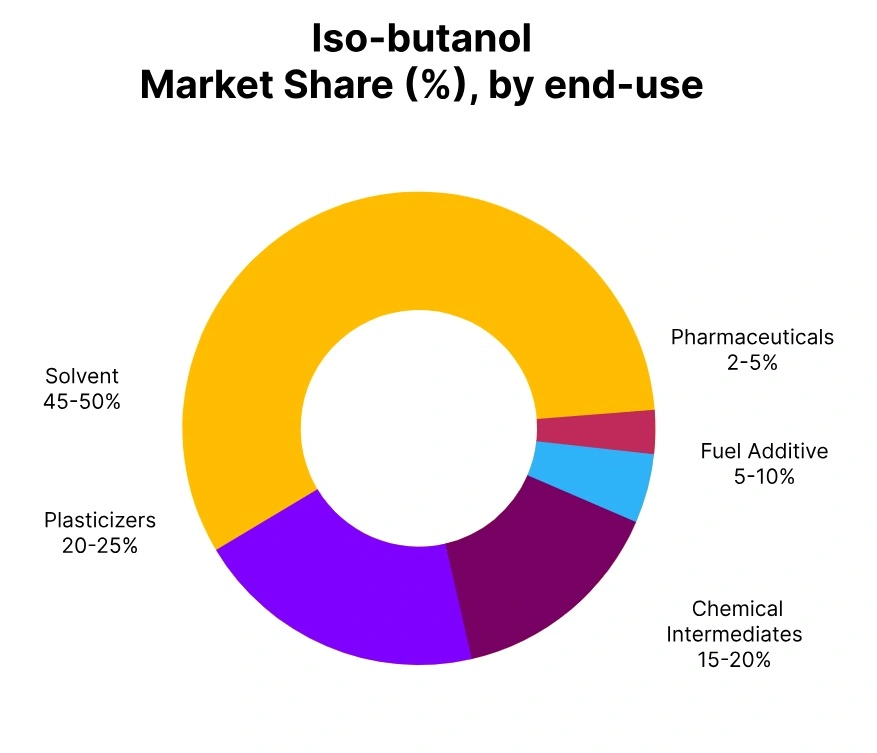
Iso-Butanol Market Share End Use

Historically, several events have caused significant fluctuations in Isobutanol prices

  • Russia-Ukraine Conflict (2022-Present):  

Energy Supply Disruptions: The conflict has severely impacted natural gas and crude oil supplies from the region, which are critical to the production of isobutanol. Rising energy costs have driven up production expenses, causing price increases. 

Raw Material Shortages: Sanctions on Russia and disrupted trade routes have led to shortages of key raw materials, such as propylene, essential for producing isobutanol. This supply strain has further pushed prices higher in various markets. 

Logistical Challenges: The conflict has disrupted global logistics, increased transportation costs and creating delays in shipments, especially in Europe. This has affected the availability of isobutanol and contributed to price volatility. 

Market Uncertainty: Geopolitical instability has created uncertainty in the global chemical markets, prompting stockpiling and increased demand from buyers concerned about supply disruptions, further driving price fluctuations. 

  • COVID-19 Pandemic (2020):  

Supply Chain Disruptions: Lockdowns and restrictions led to production halts, factory closures, and transportation delays, disrupting the supply of isobutanol. This caused supply shortages, which pushed prices higher in many regions. 

Decreased Demand in Key Industries: Industries that use isobutanol, such as coatings, chemicals, and solvents, saw reduced demand during the early months of the pandemic. This led to a temporary drop in prices as industrial activity slowed. 

Post-Lockdown Recovery: As economies began to reopen, demand for isobutanol surged, especially in sectors like construction and manufacturing. This increase in demand, coupled with limited supply, caused a sharp rise in prices. 

Rising Production Costs: Increased operational costs due to safety measures, raw material shortages, and higher transportation expenses further contributed to price fluctuations. 

  • Geopolitical Tensions (2018-2019):  

U.S.-China Trade War: The trade war resulted in tariffs on chemicals, including raw materials like propylene, which are crucial for isobutanol production. These tariffs increased production costs and disrupted supply chains, causing price volatility in the global market. 

Sanctions and Political Instability: Sanctions imposed on key regions like Iran and Russia, major players in the energy and petrochemical industries, affected the availability of feedstocks required for isobutanol production. This led to supply shortages and price hikes. 

Energy Price Volatility: Geopolitical tensions in oil-producing regions caused fluctuations in global energy prices, which directly impacted the cost of isobutanol production. As crude oil and natural gas prices rose, the costs of producing and transporting isobutanol also increased, leading to pricing instability. 

These events underscore the isobutanol market’s vulnerability to global disruptions and highlight the need for continuous monitoring of supply-demand dynamics. 

Why PriceWatch?

PriceWatch is your trusted resource for tracking global isobutanol price trends. Our platform delivers real-time data and expert analysis, offering deep insights into the key factors driving price fluctuations in the isobutanol market. By monitoring critical events such as geopolitical tensions, supply chain disruptions, and economic shifts, PriceWatch keeps you fully informed of market dynamics.

In addition, PriceWatch provides detailed forecasts and updates on production capacities, enabling you to anticipate market changes and make well-informed decisions. With PriceWatch, you gain a competitive edge in understanding all the elements that influence isobutanol prices worldwide. Stay ahead of the curve with PriceWatch’s reliable, accurate, and timely isobutanol market data.

Track PriceWatch's isobutanol price assessment on a weekly basis since 2015 onwards, along with short-term forecasts, and get access to the detailed report in a downloadable format.

Data Collection and Sources​

  • Real-Time Market Data: PriceWatch aggregates real-time pricing data from a diverse range of sources, including global commodity exchanges, industry reports, and proprietary databases. This ensures that our assessments reflect the most current market conditions. 
  • On-the-Ground Intelligence: Our team gathers insights directly from key market participants, including producers, suppliers, traders, and end-users, across major isobutanol production hubs. This ground-level intelligence is crucial for understanding localized market dynamics. 
  • Supply Chain Monitoring: We track the entire isobutanol supply chain, from raw material availability (e.g., propylene, syngas, glycerol and methanol) to production and distribution channels. This includes monitoring feedstock prices, production capacities, and transportation logistics.

Event Tracking and Impact Analysis​

  • Geopolitical Tensions: PriceWatch continuously monitors global geopolitical developments, such as conflicts or trade disputes, which can significantly impact isobutanol prices. Our analysis includes potential disruptions to supply chains and their immediate and long-term effects on pricing. 
  • Natural Disasters and Climate Events: We assess the impact of natural disasters, such as hurricanes or winter storms, on isobutanol production facilities, particularly in vulnerable regions like the U.S. Gulf Coast. These events are factored into our price forecasts and supply outlooks. 
  • Economic Shifts: PriceWatch evaluates macroeconomic trends, including global economic growth, inflation rates, and sector-specific demand (e.g., plasticizers, fuel additive), to predict shifts in isobutanol demand and corresponding price movements.

Production Capacity and Supply Analysis

  • Current Production Monitoring: We maintain a comprehensive database of global isobutanol production facilities, tracking their operational status, maintenance schedules, and output levels. This allows us to assess current supply availability accurately. 
  • Future Capacity Projections: Our research includes detailed forecasts of upcoming isobutanol production capacities, factoring in new plant constructions, expansions, and technological advancements. This helps in predicting future supply trends and potential price stabilization. 

Demand Forecasting

  • Sectoral Demand Analysis: PriceWatch provides in-depth analysis of demand trends across key sectors, including packaging, automotive, and construction. We track year-on-year demand growth and project future consumption patterns based on economic indicators and industry developments. 
  • Global Demand Dynamics: Our methodology considers regional demand variations and how they influence global isobutanol pricing. This includes understanding the impact of shifts in manufacturing bases, trade policies, and environmental regulations. 

Pricing Model Development

  • Dynamic Pricing Models: PriceWatch utilizes advanced econometric models to forecast isobutanol prices, incorporating real-time data, historical trends, and projected market conditions. Our models are continuously refined to enhance accuracy and predictive power. 
  • Scenario Analysis: We conduct scenario-based assessments to evaluate potential future market conditions. This includes best-case, worst-case, and most likely scenarios, helping our clients prepare for a range of market outcomes.

Reporting and Client Support

  • Comprehensive Reports: Our clients receive detailed reports that include current price assessments, future price forecasts, and in-depth analysis of market drivers. These reports are designed to be actionable, providing clear insights and recommendations. 
  • Ongoing Support: PriceWatch offers continuous updates and personalized support to our clients, ensuring they have the most up-to-date information to make informed decisions. Our experts are available to discuss specific market developments and provide tailored advice. 


This research methodology ensures that PriceWatch delivers the most accurate, timely, and actionable isobutanol pricing assessments, helping our clients stay ahead of market trends and make informed business decisions.

Isobutanol Market Price Trend provided by PriceWatch is a base price and excludes VAT/Taxes, discounts, or offers. The information herein is accurate to the best of our knowledge as of the date indicated and is provided solely for the convenience of our customers as a reference for isobutanol. PriceWatch disclaims any warranties or representations regarding the accuracy of results derived from this information. It is the sole responsibility of the user to assess the suitability of the product for their specific application. This document does not constitute an endorsement to use the product in violation of any applicable patent rights.

The pricing of isobutanol is influenced by several factors, including fluctuations in the cost of raw materials like propylene, energy prices, and overall market demand. Supply chain disruptions, transportation costs, and geopolitical factors, such as trade tariffs and sanctions, also play a role in determining prices. Additionally, seasonal demand from key industries like coatings, chemicals, and solvents can impact price trends.

Regional availability significantly influences isobutanol pricing. In regions with abundant production capacities, such as Asia-Pacific, prices may be more competitive due to local supply. On the other hand, regions that rely on imports, like Europe or North America, may face higher prices due to transportation costs, import tariffs, and potential supply shortages. The balance between regional supply and industrial demand creates pricing variability across markets.

Isobutanol pricing trends can be affected by factors such as feedstock prices, global demand, and supply chain disruptions. Procurement teams can secure better rates by monitoring market trends, negotiating long-term contracts with reliable suppliers, and leveraging bulk purchasing to gain volume discounts. Staying updated with industry reports and price indices will help in making informed purchasing decisions.