Linear Alkyl Benzene Sulphonic Acid (labsa) Price Trend and Forecast

Weekly Update
|
Historical Data Since 2015
|
Forecast for 2026

linear alkyl benzene sulphonic acid (labsa) Price Trends by Country

inIndia
brBrazil
phPhilippines
lkSri Lanka

Global linear alkyl benzene sulphonic acid (labsa) Spot Market Prices, Trend Analysis and Forecast

Price-Watch™ provides real-time price assessments and price forecasts for Linear Alkyl Benzene Sulphonic Acid (LABSA) across top trading regions:   

Linear Alkyl Benzene Sulphonic Acid (LABSA) Regional Coverage Linear Alkyl Benzene Sulphonic Acid (LABSA) Grade and Country Coverage Linear Alkyl Benzene Sulphonic Acid (LABSA) Pricing Data Coverage Explanation
Asia-Pacific Linear Alkyl Benzene Sulphonic Acid (LABSA) Pricing Analysis Grade: LABSA 90%, Ex-Gandhidham Prices, India Weekly Price Update on Linear Alkyl Benzene Sulphonic Acid (LABSA) Real-Time Domestic Prices of Ex-Gandhidham, India
Grade: LABSA 90%, Ex-Kolkata Prices, India Weekly Price Update on Linear Alkyl Benzene Sulphonic Acid (LABSA) Real-Time Domestic Prices of Ex-Kolkata, India
Grade: LABSA 96%, Ex-Kolkata Prices, India Weekly Price Update on Linear Alkyl Benzene Sulphonic Acid (LABSA) Real-Time Domestic Prices of Ex-Kolkata, India
Grade: LABSA 90%, Ex-West India Prices, India Weekly Price Update on Linear Alkyl Benzene Sulphonic Acid (LABSA) Real-Time Domestic Prices of Ex-West India, India
Grade: LABSA 90%, Ex-East India Prices, India Weekly Price Update on Linear Alkyl Benzene Sulphonic Acid (LABSA) Real-Time Domestic Prices of Ex-East India, India
Grade: LABSA 96%, Ex-East India Prices, India Weekly Price Update on Linear Alkyl Benzene Sulphonic Acid (LABSA) Real-Time Domestic Prices of Ex-East India, India
Grade: LABSA 90%, FOB Prices at Mundra Port, India Weekly Price Update on Linear Alkyl Benzene Sulphonic Acid (LABSA) Real-Time Export Prices from Mundra Port, India to Global Markets
Grade: LABSA 90%, CIF Prices at Manila Port, Philippines, Importing from India Weekly Price Update on Linear Alkyl Benzene Sulphonic Acid (LABSA) Real-Time Import Prices at Manila Port, Philippines, from India
Grade: LABSA 90%, CIF Prices at Colombo Port, Sri Lanka, Importing from India Weekly Price Update on Linear Alkyl Benzene Sulphonic Acid (LABSA) Real-Time Import Prices at Colombo Port, Sri Lanka, from India
North America Linear Alkyl Benzene Sulphonic Acid (LABSA) Pricing Analysis Grade: LABSA 90%, CIF Prices at Santos, Brazil, Importing from India Weekly Price Update on Linear Alkyl Benzene Sulphonic Acid (LABSA) Real-Time Import Prices at Santos, Brazil, from India

Linear Alkyl Benzene Sulphonic Acid (LABSA) Price Trend Q1 2026

During Q1 2026, LABSA prices across all monitored markets have exhibited an exceptionally sharp bullish reversal, driven by the acute transmission of LAB feedstock cost escalation stemming from geopolitical uncertainties surrounding the USA-Israel vs Iran conflict into LABSA production economics, alongside firm recovering downstream demand from detergent and surfactant manufacturing sectors globally. Indian domestic ex-works markets have recorded extraordinary quarterly appreciation, with Ex-Kolkata 90% and FOB Mundra posting the highest quarterly gains.

International CIF markets in Brazil, Philippines, and Sri Lanka have also posted strong quarterly appreciation, tracking the sharp recovery in Indian origin pricing. March 2026 has brought an unprecedented acceleration across all monitored markets, with multiple Indian domestic grades surging significantly on a monthly basis, recording the most acute monthly price escalation observed across any monitored chemical product during the period. The LABSA price trend across all monitored regions has reflected the extraordinary and accelerating influence of conflict-driven LAB feedstock cost escalation throughout the quarter.

India: Linear Alkyl Benzene Sulphonic Acid Domestically Traded price in India, LABSA 90% & 96%

According to Price-Watch™ , in Q1 2026, LABSA price in India has recorded extraordinary quarterly appreciation driven by the acute passthrough of sharply rising LAB feedstock costs stemming from geopolitical uncertainties surrounding the USA-Israel vs Iran conflict into LABSA sulphonation production economics. Ex-Kolkata 90% has posted the highest quarterly gains at approximately 40.9%. The LABSA price trend in India has reflected the direct and forceful transmission of LAB feedstock cost escalation into sulphonation production costs, compounded by robust downstream demand from detergent and surfactant manufacturing sectors sustaining firm domestic procurement throughout the quarter.

LABSA prices have remained firmly elevated as producers have adjusted pricing to reflect dramatically higher input costs. In March 2026, LABSA prices in India have recorded unprecedented monthly appreciation, with Ex-Kolkata 90% surging sharply by around 111%, as cumulative conflict-driven LAB feedstock cost escalation reached peak intensity and drove extraordinary domestic LABSA pricing during the month.

Brazil: Linear Alkyl Benzene Sulphonic Acid (LABSA) Imported Prices CIF Santos from India, Brazil, LABSA 90%

In Q1 2026, LABSA price in Brazil has recorded a sharp increase of approximately 34%, reflecting the passthrough of sharply rising Indian FOB prices into the Brazilian import market under CIF Santos terms as geopolitical uncertainties surrounding the USA-Israel vs Iran conflict have driven acute LAB feedstock cost escalation at the Indian production level, transmitting forcefully into export pricing and subsequently into Brazilian import valuations throughout the quarter.

The LABSA price trend in Brazil has been shaped by the direct transmission of Indian export price escalation into CIF Santos import valuations, with downstream demand from cleaning and detergent manufacturing sectors sustaining procurement activity despite significantly elevated import costs. LABSA prices in Brazil have remained firmly elevated as import-dependent market dynamics have left buyers with limited ability to mitigate the full extent of origin-side cost escalation. In March 2026, LABSA price in Brazil has surged sharply by around 98%, as cumulative Indian LAB feedstock cost escalation drove an extraordinary acceleration in Indian export pricing that transmitted forcefully into Brazilian CIF Santos import valuations during the month.

Philippines: Linear Alkyl Benzene Sulphonic Acid (LABSA) Imported Prices CIF Manila from India, Philippines, LABSA 90%

In Q1 2026, LABSA price in the Philippines has recorded a sharp increase of approximately 36%, reflecting the passthrough of sharply rising Indian FOB prices into the Philippine import market under CIF Manila terms as geopolitical uncertainties surrounding the USA-Israel vs Iran conflict have driven acute LAB feedstock cost escalation at the Indian production level and transmitted into Philippine import valuations throughout the quarter.

The LABSA price trend in the Philippines has been shaped by the direct and forceful transmission of Indian export price escalation into CIF Manila import valuations, with downstream demand from cleaning and detergent manufacturing sectors sustaining consistent procurement despite sharply elevated import costs. LABSA prices in the Philippines have remained firmly elevated throughout the quarter. In March 2026, LABSA price in the Philippines has surged sharply by around 101%, as cumulative Indian LAB feedstock cost escalation drove an extraordinary acceleration in Indian export pricing that transmitted forcefully into Philippine CIF Manila import valuations during the month.

Sri Lanka: Linear Alkyl Benzene Sulphonic Acid (LABSA) Imported Prices CIF Colombo from India, Sri Lanka, LABSA 90%

In Q1 2026, LABSA price in Sri Lanka has recorded a sharp increase of approximately 36.2%, posting the strongest quarterly appreciation among all monitored international CIF markets as geopolitical uncertainties surrounding the USA-Israel vs Iran conflict have driven acute LAB feedstock cost escalation at the Indian production level, transmitting directly and forcefully into Sri Lankan CIF Colombo import valuations throughout the quarter.

The LABSA price trend in Sri Lanka has been shaped by the direct transmission of sharply rising Indian export pricing into CIF Colombo import valuations, with downstream demand from cleaning, detergent, and surfactant manufacturing sectors sustaining procurement activity despite significantly elevated import costs. LABSA prices in Sri Lanka have remained firmly elevated as import-dependent market dynamics have sustained strong upward price transmission. In March 2026, LABSA price in Sri Lanka has surged sharply by around 102%, as cumulative Indian LAB feedstock cost escalation drove an extraordinary acceleration in Indian export pricing that transmitted forcefully into Sri Lankan CIF Colombo import valuations during the month.

Linear Alkyl Benzene Sulphonic Acid (LABSA) Price Trend Analysis: Q4 2025

During Q4 2025, Linear Alkyl Benzene Sulphonic Acid (LABSA) prices across Indian domestic markets have exhibited a broadly stable to marginally bullish trend, with modest quarterly gains recorded across all domestic ex-works grades driven by firm downstream demand from detergent and cleaning product manufacturing sectors. Export and international CIF markets have posted mild quarterly declines, with Brazil recording the steepest quarterly correction while the Philippines and Sri Lanka have remained near-flat.

December 2025 has brought continuation of the domestic positive trend alongside marginal further softening in international markets. The LABSA price trend across all monitored regions has reflected the divergence between firm Indian domestic demand fundamentals and softer international market conditions throughout the quarter.

India: Linear Alkyl Benzene Sulphonic Acid (LABSA) Domestically Traded and Export Prices, India, LABSA 90% & 96%

According to Price-Watch™ , in Q4 2025, LABSA price in India has posted modest but consistent quarterly gains, with Ex-Kolkata 90% gaining approximately 1.9%. The LABSA price trend in India at the domestic level has reflected firm downstream demand from detergent, cleaning product, and surfactant manufacturing sectors sustaining consistent upward price momentum throughout the quarter. LABSA prices in India have remained broadly supported as local producers have maintained pricing discipline amid steady consumption. In December 2025, LABSA prices in India have continued their positive trajectory, with Ex-Kolkata 90% gaining approximately 2.5%, as firm domestic demand sustained upward pricing momentum during the month.

Brazil: Linear Alkyl Benzene Sulphonic Acid (LABSA) Imported Prices CIF Santos from India, Brazil, LABSA 90%

In Q4 2025, LABSA price in Brazil has recorded a moderate decline of approximately 2.2%, reflecting the passthrough of competitive Indian FOB pricing into the Brazilian import market under CIF Santos terms, as broadly stable global LABSA supply conditions have weighed on import valuations alongside moderate downstream demand from cleaning and detergent manufacturing sectors throughout the quarter.

The LABSA price trend in Brazil has been shaped by competitive Indian export pricing transmitting into CIF Santos import valuations, with buyers maintaining cautious procurement patterns amid a broadly favorable cost environment. LABSA prices in Brazil have remained under mild downward pressure as global supply conditions have provided buyers with negotiating leverage. In December 2025, LABSA price in Brazil has edged lower by around 1.9%, as continued competitive Indian export pricing and subdued downstream demand sustained mild downward pressure on Brazilian CIF import valuations during the month.

Philippines: Linear Alkyl Benzene Sulphonic Acid (LABSA) Imported Prices CIF Manila from India, Philippines, LABSA 90%

In Q4 2025, LABSA price in the Philippines has recorded a mild decline of approximately 1.3%, reflecting the passthrough of competitive Indian FOB pricing into the Philippine import market under CIF Manila terms, as broadly stable global LABSA supply conditions have provided buyers with favorable procurement leverage during the quarter.

The LABSA price trend in the Philippines has been shaped by the consistent transmission of Indian export pricing into CIF Manila import valuations, with downstream demand from cleaning and detergent sectors remaining steady but insufficient to drive meaningful upward price movement. LABSA prices in the Philippines have remained under contained downward pressure throughout the period. In December 2025, LABSA price in the Philippines has edged marginally lower by around 1%, as near-flat Indian export pricing and stable demand conditions kept Philippine import valuations essentially unchanged during the month.

Sri Lanka: Linear Alkyl Benzene Sulphonic Acid (LABSA) Imported Prices CIF Colombo from India, Sri Lanka, LABSA 90%

In Q4 2025, LABSA price in Sri Lanka has recorded the most contained quarterly decline among all monitored international CIF markets at approximately 1%, reflecting the passthrough of competitive Indian FOB pricing into the Sri Lankan import market under CIF Colombo terms, with the relatively contained correction supported by steady downstream demand from cleaning and detergent manufacturing sectors throughout the quarter.

The LABSA price trend in Sri Lanka has reflected a broadly stable procurement environment where consistent Indian supply flows have met steady domestic demand without notable supply tightening. LABSA prices in Sri Lanka have remained near-flat with limited downward movement throughout the period. In December 2025, LABSA price in Sri Lanka has edged marginally higher by around 0.4%, as modest year-end procurement activity provided slight upward support to Sri Lankan CIF Colombo import pricing during the month.

In Q3 2025, the global Linear Alkyl Benzene Sulphonic Acid (LABSA) market showed a generally firm trend, supported by strong demand from detergent and cleaning product manufacturers. In South Asia, domestic prices surged across key hubs amid tight supply and high consumption levels, reflecting robust performance in downstream sectors. South American import prices also strengthened as buyers sourced cargoes from South Asia to offset limited local production and maintain steady supply.

In Southeast Asia, the region saw a mild upward adjustment supported by stable industrial and cleaning sector demand, while markets in South Asia remained steady with balanced supply-demand conditions and consistent trade flows within the region. Overall, the LABSA market maintained positive momentum during the quarter, underpinned by resilient end-use demand and stable logistics across major trade regions.

India: Linear Alkyl Benzene Sulphonic Acid (LABSA) Domestically Traded Price in India, Grades: LABSA 90%, LABSA 96%.

According to Price-Watch, in Q3 2025, LABSA price in India has increased significantly across domestic hubs, driven by robust demand from detergent and cleaning product manufacturers. In September 2025, LABSA prices in India have gone up by 0.81% compared to the previous month. Ex-Gandhidham, Ex-Kolkata, Ex-West India, and Ex-East India prices for LABSA have ranged between USD 1300–1600 per metric ton, with quarterly increase of 5.62% to 11%.

Market participants have cited supply constraints and strong downstream consumption as reasons for the firming prices. Producers have maintained high utilization rates, while buyers have competed for available cargoes to ensure steady supply lines. The strong upward momentum has reflected resilient end-use sector activity, consistent with the overall LABSA price trend in India.

Brazil: Linear Alkyl Benzene Sulphonic Acid (LABSA) Imported Price in Brazil from India, Grade: LABSA 90%.

In Q3 2025, LABSA price in Brazil has posted a gain, fuelled by ongoing demand from detergent and industrial cleaning sectors. In September 2025, LABSA prices in Brazil have declined slightly by 0.37% compared to the previous month. CIF Santos prices have ranged from USD 1300–1500 per metric ton, up by 2.41% quarter on quarter.

Brazilian buyers have opted for Indian cargoes to secure supply as regional production has remained constrained. Logistic flows have been stable, and buyers have maintained steady procurement to meet end-use requirements, reflecting positive market dynamics and the prevailing LABSA price trend in Brazil.

Philippines: Linear Alkyl Benzene Sulphonic Acid (LABSA) Imported Price in Philippines from India, Grade: LABSA 90%.

LABSA price in the Philippines has recorded an increase in Q3 2025, driven by stable demand from cleaning and industrial sectors. In September 2025, LABSA prices in the Philippines have edged down by 0.23%, compared to the previous month. CIF Manila prices for LABSA 90% have risen 1.20% from the previous quarter, trading between USD 1200–1400 per metric ton.

Consistent flows from Indian suppliers have ensure secure supply, while buyers’ inventories have remained adequate to meet ongoing consumption. Overall, trading activity has remained stable, aligning with the LABSA price trend in the Philippines.

Sri Lanka: Linear Alkyl Benzene Sulphonic Acid (LABSA) Imported Price in Sri Lanka from India, Grade: LABSA 90%.

In Q3 2025, LABSA price in Sri Lanka has shown slight change amid balanced supply and demand dynamics. In September 2025, LABSA prices in Sri Lanka have fallen slightly by 0.31% compared to the previous month. CIF Colombo prices have held stable between USD 1200–1400 per metric ton, reflecting a marginal quarterly gain of 0.14%.

End-use sectors have continued to source regular volumes from Indian producers, ensuring uninterrupted production across the country’s detergent industry. Overall, the market has remained steady with buyers and sellers maintaining steady trading relationships, reflecting the LABSA price trend in Sri Lanka.

In Q2 2025, Linear Alkyl Benzene Sulphonic Acid (LABSA) prices fluctuated in response to dynamic procurement patterns and downstream cleaning sector performance in Sri Lanka. April 2025 saw an initial uptick in prices driven by active restocking from detergent and hygiene product manufacturers amid early summer demand.

However, May registered a brief correction as buyers slowed purchases due to sufficient inventory levels and some logistical delays in Colombo port operations. By June 2025, demand rebounded as Sri Lanka’s cleaning and institutional hygiene sectors picked up momentum, supported by reopening of schools and public institutions post-holidays.

Additionally, strong buying activity was observed in other destinations like Brazil and the Philippines, which helped stabilize Indian LABSA export sentiment. As importers looked to secure volumes ahead of monsoon disruptions, prices saw renewed strength toward the quarter’s end. According to PriceWatch, LABSA prices were assessed at USD 1324/MT CIF Colombo.

The Indian Linear Alkyl Benzene Sulphonic Acid (LABSA) market witnessed a mixed trend in Q2 2025. April 2025 began on a weaker note as prices declined due to moderate demand from institutional cleaning product manufacturers and delayed restocking activity in Eastern India.

However, Linear Alkyl Benzene Sulphonic acid (LABSA) market sentiment rebounded in May and strengthened further in June. Improved buying momentum from regional detergent manufacturers especially in East and North India was a key driver.

Higher consumption of household cleaning agents during the peak summer months supported consistent uptake. Meanwhile, prices for the 90% grade across regions such as Gandhi Dham, Kolkata, and West India also firmed up toward the quarter’s close.

With supportive demand from both organized and unorganized cleaning sectors, and limited oversupply concerns, the 96% LABSA market ended the quarter on a firmer note. According to PriceWatch, Linear Alkyl Benzene Sulphonic Acid (LABSA) prices were assessed at USD 1516/MT Ex-Kolkata.

Linear Alkyl Benzene Sulphonic Acid (LABSA) prices demonstrated volatility across Asian and South American origins in Q1 2025. Philippines, under CIF port Manila (India) terms, saw an initial price rise in January due to increased demand from surfactant manufacturers and bulk restocking by Indian importers.

However, prices declined in February as inventory pressure and subdued detergent manufacturing slowed offtake. March again witnessed a price rebound amid renewed procurement and tighter vessel availability. Sri Lanka followed a similar up-down-up trend, influenced by regional supply shifts and steady downstream demand.

In contrast, Brazil (CIF Santos, India) showed a consistent price drop across all three months, reflecting slower shipments and weak competitive interest from Indian buyers. The quarter ended with prices at USD 1310/MT, CIF Manila (India), Philippines.

Throughout Q1 2025, LABSA prices in India followed a firm upward trajectory across major regions, driven by renewed demand from the detergent, surfactant, and cleaning chemical industries. With the start of the financial year, manufacturers actively restocked inventories to meet Q2 demand projections.

Procurement activities were especially strong in Gandhi Dham, West, and East India, where 90% grade saw consistent buying interest. Feedstock Linear Alkyl Benzene remained costlier, supporting finished product pricing. However, the 96% grade in Kolkata and East India saw limited offtake due to previous overstocking and soft local demand.

Export-oriented traders at FOB Mundra also reported stronger overseas inquiries, lending further support. The quarter reflected stable operational conditions and rising consumption in household and institutional cleaning segments. By March-end, the market remained supported across segments, with LABSA 90%, Ex-Kolkata closing at USD 1308/MT.

Linear Alkyl Benzene Sulphonic Acid (LABSA) Price Trend Analysis: Q4 2024

During Q4 2024, LABSA 90% prices showed mixed regional dynamics. In Brazil, prices under CIF Santos (India) terms trended downward throughout the quarter. The decline was primarily due to reduced procurement from Indian buyers amid ample stock levels and subdued cleaning product demand. Meanwhile, Philippines and Sri Lanka, both under CIF port Manila (India) and CIF Colombo (India) terms respectively, witnessed increasing prices in October and December.

This uptrend was driven by seasonal restocking ahead of year-end holidays and steady demand from the personal care and household cleaner segments. However, the Philippines saw a brief dip in November due to shipping delays and high inventories. The quarter concluded with LABSA 90% prices at USD 1350/MT, CIF Santos (India), Brazil.

LABSA prices in India saw mixed trends during Q4 2024, influenced by regional variations in demand and inventory adjustments. In Gandhidham and West India, 90% grade prices rose steadily as demand surged from institutional cleaning and textile industries. Meanwhile, Kolkata and East India saw weaker performance for the 96% grade, attributed to high base inventories and slower off-take from mid-sized detergent manufacturers.

Market sentiment improved in December with festive and year-end restocking. Feedstock prices remained stable, but strategic buying in Western and port-adjacent regions contributed to the firm tone.

Export demand from FOB Mundra improved marginally, helping offset slower domestic movement in a few eastern hubs. Despite these mixed signals, the quarter ended on a stronger note, with LABSA 90%, Ex-Gandhidham closing at USD 1285/MT.

At the outset of Q3 2024, the price of LABSA exhibited a downward trend in the APAC region. This trend was influenced by several key factors, including inadequate cost support from the feedstock LAB market, as the prices of raw material LAB declined, further reducing production costs and resulting in a bearish market outlook.

Conversely, in Europe, prices remained stable during the first month of Q3 2024, attributed to a narrow gap between demand and supply. Following the decline, the price of LABSA FOB Shanghai is currently approximately USD 1354 per metric ton.

In Q3 2024, LABSA prices in India were marked by volatility as contrasting trends emerged across regions. July saw patchy demand due to monsoon disruptions and weak off-take in Kolkata and East India. Some recovery was observed in August with increased cleaning chemical consumption in urban areas, but September ended on a bearish note due to excessive inventory and lacklustre export orders.

The 96% grade, largely traded in East and Kolkata markets, remained under pressure throughout the quarter. Meanwhile, procurement in Gandhidham and West India fluctuated with inconsistent manufacturing schedules among mid-sized buyers.

Feedstock costs were relatively stable, but operational constraints and weak consumer spending in rural zones limited growth. Most regions reported gradual price declines by quarter-end. The quarter closed lower, with LABSA 96%, Ex-Kolkata settling at USD 1343/MT.

In Q2 2024, the Asian LABSA market experienced significant price fluctuations due to changes in consumer demand and inventory levels. In China, prices dropped by about 2%, reflecting a slight decline in demand as manufacturers adjusted their purchasing strategies in response to higher stock levels and shifting consumption patterns in end-user sectors. In contrast, the North American market faced challenges, with LABSA prices falling by 7% compared to the previous quarter.

This decline was due to weakened demand from key industries, as manufacturers dealt with excess inventory and rising production costs, leading to a more cautious procurement approach. Meanwhile, the European market showed a more positive trend, with pricing fundamentals improving significantly and LABSA prices increasing by approximately 8% during the same period.

LABSA prices in India registered steady gains throughout Q2 2024 as seasonal demand strengthened, particularly from household cleaning and FMCG sectors. The 90% grade saw strong traction in Kolkata, West, and East India, supported by higher production of liquid detergents during the summer months.

Anticipation of monsoon-related logistics disruptions in Q3 further encouraged stockpiling. Feedstock Linear Alkyl Benzene costs edged higher due to firm crude trends, which added cost pressure across production hubs. Exporters at FOB Mundra recorded better international interest, mainly from Southeast Asian buyers, further tightening domestic availability.

The 96% grade in East India showed signs of softness initially but later aligned with the broader uptrend. Overall, demand fundamentals remained supportive with stable supply chains and firm institutional procurement. The quarter concluded with LABSA 90%, Ex-Kolkata priced at USD 1275/MT.

In the APAC region, the Global LABSA market exhibited mixed trend influenced by varying end-user demand and the availability of the commodity. In South Korea, prices experienced a downward trajectory by around 3.5% in Q1 2024 compared to Q4 2023, reflecting a combination of reduced demand from key sectors and increased inventory levels that led to a surplus in the market.

This decline suggests a temporary easing in the urgency for procurement as manufacturers recalibrate their production schedules in response to market conditions. Conversely, the price dynamics in China showed a more optimistic trend, with prices rising by 4% during the same period. This increase was attributed to stronger end-user demand, particularly from the detergent and personal care industries.

LABSA prices in Q1 2024 showed mild fluctuations across India as markets adjusted post-year-end slowdowns. In early January, cautious procurement and inventory drawdowns weighed on prices in Gandhidham and East India. However, rising demand from cleaning product manufacturers and recovery in institutional consumption boosted sentiment by February.

The 90% grade saw more stability across West and Kolkata markets, where detergent production gradually picked up. Meanwhile, 96% grade demand remained subdued in East India due to lack of large-volume buyers. Feedstock prices for LAB remained within a stable range, with no significant cost pressure.

Traders at FOB Mundra saw steady inquiries but avoided bulk commitments due to price uncertainty. While regional differences persisted, overall market tone improved toward quarter-end, supported by better downstream performance. The quarter wrapped up on a stable note, with LABSA 90%, Ex-Gandhidham closing at USD 1258/MT.

Technical Specifications of Linear Alkyl Benzene Sulphonic Acid (labsa) Price Trends

Product Description

Linear Alkyl Benzene Sulphonic Acid (LABSA) is a sulfonated derivative of Linear Alkyl Benzene (LAB) characterized by its strong surface activity and chemical stability. It exhibits excellent detergency, foaming capacity, and wetting properties, along with high solubility in water and good compatibility with other chemical agents. Known for its controlled active matter content, high purity, and biodegradability. LABSA combines performance efficiency with environmental responsibility, making it a versatile and reliable compound in various chemical formulations.

Identifiers and Classification:

  • CAS No – 27176-87-0
  • HS Code – 34021190
  • Molecular Formula – C18H30SO3H
  • Molecular Weight[g/mol] – ~284 to 360 g/mol


Linear Alkyl Benzene Sulphonic Acid (LABSA) Synonyms:

• Linear Alkylbenzene Sulfonic Acid

• Dodecylbenzene Sulfonic Acid

• Sulfonic Acids, C10–C13 Alkyl Derivatives

• LAB Sulphonic Acid

• LABSA (common abbreviation)

• C10–C13 Alkylbenzene Sulfonic Acid

• C12 Alkylbenzene Sulfonic Acid

• Dodecylbenzenesulfonic Acid (DDBSA)


Linear Alkyl Benzene Sulphonic Acid (LABSA) Grades Specific Price Assessment:

  • LABSA 90%, LABSA 96%


Linear Alkyl Benzene (LAB) Global Trade and Shipment Terms

  • Quotation Term (Product & Country Specific): 25-28 MT
  • Packaging Type (Product & Country Specific): 200 Kg Drum


Incoterms Referenced in LABSA Price Reporting

Shipping Term  Location  Definition 
Ex-Gandhidham  Gandhidham, India  Domestically traded LABSA price in Gandhidham 
Ex-Kolkata  Kolkata, India  Domestically traded LABSA price in Kolkata 
Ex-West India  West India  Domestically traded LABSA price in West India 
Ex-East India  East India  Domestically traded LABSA price in East India 
FOB Mundra  Mundra, India  LABSA export price from India 
CIF Santos (India)  Santos, Brazil  LABSA import price in Brazil from India 
CIF Manila (India)  Manila, Philippines  LABSA import price in Philippines from India 
CIF Colombo (India)  Colombo, Sri Lanka  LABSA import price in Sri Lanka from India 

*Quotation Terms refers to the quantity range specified for the LABSA being quoted or offered in a commercial transaction.

**Packaging Type refers to standard packaging size commonly used for LABSA packing, ease of handling, transportation, and storage in industrial and commercial applications.

Linear Alkyl Benzene Sulphonic Acid (LABSA) Manufacturers and their brands

Brand Name  Manufacturer 
Nipol®  New India Detergents Pvt Ltd 
NA  Indian Phosphate Ltd. (IPhL) 
NA  M.N. Surfactants Pvt. Ltd. 
Buna SE  Standard Surfa Chem India Pvt. Ltd. (SSCI) 
Europrene  Fogla Group (Fogla Corp) 
KER  Eastman 
NA  BASF AG 
NA  Kao Chemicals 
INDIAPOL  Tianjin Sanhuan Chemical 
Reflex Stylamer  Jiangsu Kangxiang Group Company 

Linear Alkyl Benzene Sulphonic Acid (labsa) Industrial Applications

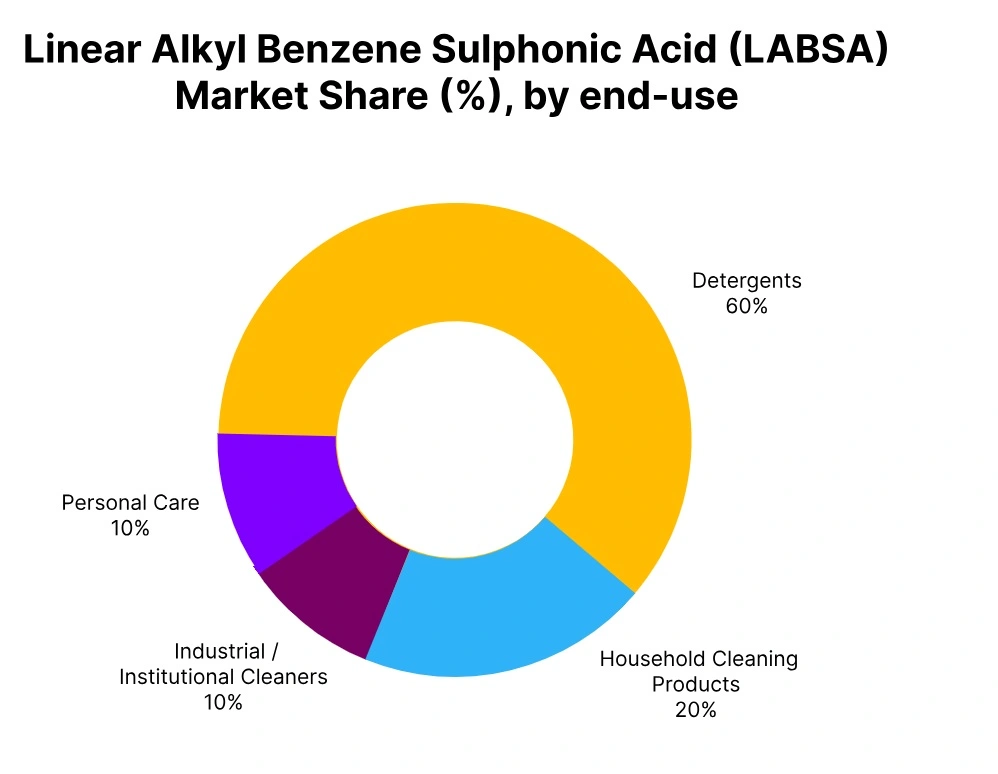
LABSA market share end use

Historically, several events have caused significant fluctuations in Linear Alkyl Benzene Sulphonic Acid (labsa) prices

Crude Oil Price Volatility & Sulphur Feedstock Tightness (2021 – Present) 

As crude oil prices fluctuated post-pandemic, feedstock prices for LABSA especially LAB and Sulphuric acid became unstable. Global shipping bottlenecks, container shortages, and rising freight rates further strained supply chains. At the same time, growing detergent and cleaning product demand in both industrial and household sectors intensified raw material consumption. These pressures collectively pushed LABSA prices higher and made procurement unpredictable, especially in countries relying on imports of either LAB or sulphur.

Russia-Ukraine Conflict (2022 – Ongoing) 

The geopolitical tension in Eastern Europe significantly affected global energy prices, which in turn impacted the cost of LABSA’s upstream raw materials primarily Linear Alkyl Benzene (LAB) and Sulphuric acid. High crude oil prices raised the cost of LAB, while trade sanctions and disrupted logistics chains affected the import of sulphur and sulphuric acid. These factors drove up production costs, causing sharp upward price trends for LABSA in key markets like India, the Middle East, and Southeast Asia.

COVID-19 Pandemic (Since 2020) 

The pandemic led to severe disruptions in supply chains and manufacturing across the globe. LABSA production was affected by temporary plant shutdowns and labour shortages. However, demand surged due to increased consumption of cleaning agents, disinfectants, and household detergents products where LABSA is a critical surfactant. This dual effect of constrained supply and spiking demand resulted in volatile price movements and periodic shortages in the global and domestic markets.

Why Price Watch™?

Price Watch™ is your trusted resource for tracking global linear alkyl benzene sulphonic acid (labsa) price trends. Our platform delivers real-time data and expert analysis, offering deep insights into the key factors driving price fluctuations in the linear alkyl benzene sulphonic acid (labsa) market. By monitoring critical events such as geopolitical tensions, supply chain disruptions, and economic shifts, Price Watch™ keeps you fully informed of market dynamics.

In addition, Price Watch™ provides detailed forecasts and updates on production capacities, enabling you to anticipate market changes and make well-informed decisions. With Price Watch™, you gain a competitive edge in understanding all the elements that influence linear alkyl benzene sulphonic acid (labsa) prices worldwide. Stay ahead of the curve with Price Watch’s™ reliable, accurate, and timely linear alkyl benzene sulphonic acid (labsa) market data.

Track Price Watch's™ linear alkyl benzene sulphonic acid (labsa) price assessment on a weekly basis since 2015 onwards, along with short-term forecasts, and get access to the detailed report in a downloadable format.

Linear Alkyl Benzene Sulphonic Acid (labsa) Market Price Trend published by Price Watch™ reflect prevailing spot market conditions, derived from independent research, verified trade inputs, and proprietary market intelligence as of the publication date. Prices are published on the specified Incoterm and represent indicative base market levels, exclusive of applicable taxes, VAT, duties, tariffs, and other statutory charges. Actual transaction values may vary depending on volume, credit terms, contractual structure, and other negotiated conditions. Market prices are inherently subject to volatility, liquidity dynamics, regulatory changes, and evolving trade activity. The information provided is for reference and benchmarking purposes only and does not constitute an offer, recommendation, or guarantee of transactional outcomes. Users should exercise independent commercial judgment and assess their specific contractual, regulatory, tax, and application requirements before making business decisions. Price Watch™ assumes no liability for decisions taken based on this information.

The price of LABSA is influenced by several factors, including the cost of raw materials like Linear Alkyl Benzene (LAB), which is derived from petrochemicals such as benzene and olefins. Fluctuations in crude oil prices, supply-demand dynamics, and production costs in the chemical industry also play a major role.

Additionally, changes in transportation and logistics costs, regulatory restrictions, and environmental compliance can further affect the pricing. Understanding these factors helps procurement heads anticipate price shifts and manage their budget more effectively.

Global demand significantly impacts LABSA pricing. As LABSA is a key ingredient in detergents and cleaning products, rising demand from industries such as household cleaning, personal care, and industrial cleaning boosts the need for LABSA.

When demand spikes, especially in fast-growing markets like Asia-Pacific, it can lead to supply shortages and higher prices. Procurement heads should monitor global market trends to predict demand-driven price changes and secure contracts accordingly to avoid paying a premium.

Procurement teams can secure the best pricing for LABSA by building strong relationships with suppliers, negotiating long-term contracts to lock in stable prices, and diversifying their supplier base to reduce dependency on a single source.

Keeping an eye on market trends, such as feedstock price movements and global demand shifts, allows procurement heads to time their purchases more strategically. Collaborating with suppliers to ensure a reliable and cost-effective supply chain is also key in securing favourable LABSA pricing.

Linear Alkyl Benzene Sulphonic Acid (LABSA) is one of the most widely used anionic surfactants and the key raw material for household and industrial detergents. It is produced by sulfonating Linear Alkyl Benzene (LAB) and is used in laundry powders, liquid detergents, dishwashing liquids, and cleaning agents. Since LABSA is directly linked to everyday cleaning products, its price strongly impacts detergent manufacturing costs and FMCG pricing. Price-Watch™ tracks LABSA prices to help businesses stay informed about market movements, raw material trends, and global supply-demand conditions.

LABSA prices vary based on region, LAB feedstock costs, sulphur availability, production efficiency, and detergent industry demand. Since LABSA is derived from LAB and sulphur-based sulfonation, its pricing is influenced by both petrochemical and sulphur markets. Prices are typically quoted per metric ton and differ across Asia, the Middle East, and Europe depending on supply conditions and freight costs. Seasonal demand from detergent manufacturers also causes short-term fluctuations. Price-Watch™ provides updated LABSA price assessments across major global markets.

LABSA market trends are driven by LAB prices, sulphur availability, and demand from the detergent and cleaning industry. Since LABSA is a downstream derivative of LAB, any movement in crude oil or benzene indirectly affects its pricing. Demand from household cleaning products, industrial cleaners, and textile auxiliaries plays a major role.

Seasonal consumption patterns, especially in developing economies, and FMCG growth strongly influence market direction.

The detergent and cleaning products industry is the largest consumer of LABSA. It is widely used in laundry powders, liquid detergents, dishwashing liquids, industrial cleaners, and institutional cleaning formulations.

Textile processing industries and small-scale chemical manufacturers also use LABSA in surfactant blends. Due to its cost-effectiveness and strong cleaning performance, LABSA remains one of the most widely consumed surfactants globally. Price-Watch™ tracks demand across all major end-use sectors.

LABSA is produced by the sulfonation of Linear Alkyl Benzene (LAB) using sulphur trioxide (SO₃) or oleum in specialized chemical reactors. The process converts LAB into a sulfonic acid form, which is then neutralized by detergent manufacturers to produce surfactants. This makes LABSA an intermediate chemical in the detergent value chain, directly linked to petrochemical feedstocks and sulphur chemistry.

Major LABSA exporters include India, China, Saudi Arabia, and some Southeast Asian countries. India is one of the leading global exporters due to strong detergent chemical manufacturing capacity. Export volumes depend on LAB availability, sulphur supply, production costs, and global detergent demand. Middle Eastern producers also play a key role due to integrated petrochemical operations. Price-Watch™ monitors global trade flows and export competitiveness.

Global LABSA supply is generally stable, but short-term tightness can occur due to fluctuations in LAB or sulfur supply, plant maintenance shutdowns, or sudden increases in detergent demand. Since LABSA production is closely tied to petrochemical and sulphur markets, any disruption in upstream feedstocks can impact availability. Overall, Asia remains the largest production hub, helping balance global supply. Price-Watch™ closely tracks supply-demand dynamics.

LABSA is mainly categorized based on active matter content (commonly 90%–96%), acidity levels, and purity specifications. Higher active matter LABSA provides better cleaning performance and is used in premium detergent formulations, commanding higher prices. Differences in sulfonation technology, raw LAB quality, and production efficiency also affect pricing. Price-Watch™ provides grade-wise insights for better market understanding.

When demand rises sharply—especially during festive seasons or increased FMCG consumption—LABSA prices tend to increase. Supply may tighten due to limited LAB availability or sulphur constraints. Buyers may face longer lead times and reduced spot availability, while producers often prioritize long-term contracts. Freight and logistics pressures can also intensify during high-demand periods. Price-Watch™ captures these real-time market shifts.

LAB and sulphur are the two primary cost drivers for LABSA production. LAB comes from petrochemical feedstocks linked to crude oil, while sulphur is a by-product of oil refining and gas processing. Any increase in either LAB or sulphur prices directly raises LABSA production costs. These changes are often passed down to detergent manufacturers, affecting FMCG pricing. Price-Watch™ analyses feedstock correlations to explain price movements.

Regional LABSA prices vary due to differences in LAB availability, sulphur supply, production capacity, freight costs, import duties, and local detergent demand. Countries with strong petrochemical integration often have lower production costs. Currency fluctuations and seasonal demand cycles also contribute to regional pricing gaps.

LABSA price outlook depends on LAB market trends, sulphur availability, crude oil prices, and global detergent demand. Growth in FMCG consumption, especially in emerging economies, supports long-term demand. However, volatility in crude oil and petrochemical feedstocks may create short-term fluctuations. Price-Watch™ publishes regular forecasts projecting LABSA price direction over the next 12 months.

Yes, LABSA price forecasts are very useful for detergent manufacturers, FMCG companies, and chemical traders. They help in procurement planning, cost control, contract negotiation, and inventory optimization. Forecasting also helps businesses manage risks arising from volatile petrochemical and sulphur markets. Price-Watch™ provides actionable insights for better decision-making.

Global events such as crude oil price shocks, geopolitical tensions, refinery outages, sulphur supply disruptions, and shipping delays can significantly affect LABSA pricing. Since LABSA is part of a petrochemical-sulphur value chain, disruptions in upstream industries quickly impact production costs and availability. Price-Watch™ delivers timely updates on such market-moving developments.

Price-Watch™ collects data from petrochemical producers, detergent manufacturers, traders, and global supply chains to publish transparent LABSA price assessments, market intelligence reports, and forecasts. This helps industry participants stay ahead of market trends, manage procurement risks, and make informed business decisions.