Mineral Turpentine Oil (mto) Price Trend and Forecast

UNSPC code: 12352103
|
Weekly Update
|
Historical Data Since 2015
|
Forecast for 2026

mineral turpentine oil (mto) Price Trends by Country

inIndia
gbUnited Kingdom
aeUnited Arab Emirates
idIndonesia
zaSouth Africa

Global mineral turpentine oil (mto) Spot Market Prices, Trend Analysis and Forecast

Price Watch™ provides real-time price assessments and price forecasts for Mineral turpentine Oil (MTO) across top trading regions:

Mineral Turpentine Oil (MTO) Regional Coverage  Mineral Turpentine Oil (MTO) Grade and Country Coverage  Mineral Turpentine Oil (MTO) Pricing Data Coverage Explanation 
Asia-Pacific Mineral Turpentine Oil (MTO) Pricing Analysis  Mineral Turpentine Oil (MTO) Industrial Density: 770–800 FOB Prices at Nhava Sheva Port, West India  Weekly Price Update on Mineral Turpentine Oil (MTO) Real-Time Export Prices from Nhava Sheva Port, West India to Global Markets 
Mineral Turpentine Oil (MTO) Industrial Density: 770–800 Ex-Mumbai, India  Weekly Price Update on Mineral Turpentine Oil (MTO) Real-Time Domestic Ex-Mumbai Prices in India 
Mineral Turpentine Oil (MTO) Industrial Density: 770–800 Ex-Delhi, India  Weekly Price Update on Mineral Turpentine Oil (MTO) Real-Time Domestic Ex-Delhi Prices in India 
Mineral Turpentine Oil (MTO) Industrial Density: 770–800 CIF Prices at Jakarta, Indonesia. Importing from India  Weekly Price Update on Mineral Turpentine Oil (MTO) Real-Time Import Prices at Jakarta, Indonesia, from India 
Middle East & Africa Mineral Turpentine Oil (MTO) Pricing Analysis  Mineral Turpentine Oil (MTO) Industrial Density: 770–800 CIF Prices at Jebel Ali, UAE. Importing from India  Weekly Price Update on Mineral Turpentine Oil (MTO) Real-Time Import Prices at Jebel Ali, UAE, from India 
Mineral Turpentine Oil (MTO) Industrial Density: 770–800 CIF Prices at Durban, South Africa. Importing from India  Weekly Price Update on Mineral Turpentine Oil (MTO) Real-Time Import Prices at Durban, South Africa, from India 
Europe Mineral Turpentine Oil (MTO) Pricing Analysis  Mineral Turpentine Oil (MTO) Industrial Density: 770–800 CIF Prices at Southampton, United Kingdom. Importing from India  Weekly Price Update on Mineral Turpentine Oil (MTO) Real-Time Import Prices at Southampton, United Kingdom, from India 

Note: In assessments structured as CIF [Importing Port] (Exporting Country), the country mentioned in brackets indicates the primary origin of supply (exporting country), while the named port refers to the destination port in the importing country. Other Incoterms (FOB, FD, EXW, etc.) should be interpreted in accordance with standard international trade definitions

Mineral Turpentine Oil (MTO) Price Trend Q1 2026

During Q1 2026, the Mineral Turpentine Oil (MTO) market has been relatively steady overall, based on stable downstream demand and supply dynamics within various markets. Prices for the early part of the quarter are strong yet moderated.

However, towards the end of March, prices surged, influenced mainly by geopolitical developments and supply issues regarding energy and feedstocks in the global market. The impact is further exacerbated by logistics costs as well as the aggressive restocking by consumers in the market, leading to volatility in pricing.

Overall, the market demonstrates how closely linked the MTO market is to the upstream energy/feedstock markets, and its vulnerabilities to geopolitics and other factors.

India: Mineral Turpentine Oil (MTO) Export prices FOB Nhava Sheva, India; Density: 770-800 kg/m³

According to Price-Watch™ During Q1 2026, the Mineral Turpentine Oil (MTO) price trend in India has continued to exhibit moderate growth, recording a 3% increase based on the average of the quarter, given the steady consumer trends and relatively stable supply-demand balance at the beginning of the quarter.

In India, Mineral Turpentine Oil (MTO) price in March 2026 has been stable due to consistent downstream demand for petrochemicals and polymers that have maintained adequate uptake. Producers have kept their operating levels low to prevent excessive supply.

However, in March, the Mineral Turpentine Oil (MTO) price trend in India has risen sharply by 19%, a notable change in the market trend. The increase is mainly attributed to disruptions in global energy markets caused by geopolitical events and war activities, affecting the supply chain of crude oil and methanol.

Consequently, the high cost of feedstock, logistical difficulties, and disruption in global flows have resulted in lower availability of MTO in the spot market. Increased uncertainty has led to robust stockpiling behavior by consumers, contributing to volatile prices.

March’s rise has highlighted the significant interdependence between MTO pricing and upstream energy and feedstock markets, as well as market sensitivity to geopolitical risk, supply chain interruptions, and shifts in global trade dynamics.

United Kingdom: Mineral Turpentine Oil (MTO) import prices CIF Southampton, United Kingdom; Grade- Density: 770-800 kg/m³

During Q1 2026, there has been a noticeable rise of 1% in the Mineral Turpentine Oil (MTO) price in the UK market. The MTO price trend in the UK has continued to remain stable owing to stable imports and regular consumption.

However, in the United Kingdom, Mineral Turpentine Oil (MTO)  price in March 2026 there has been a sharp rise of 18% owing to disturbances in international energy markets because of political instability and war between US and Iran in the West Asia, which have led to an increase in the cost of feedstocks and difficulty in logistics.

UAE: Mineral Turpentine Oil (MTO) import prices CIF Jebel Ali, UAE: Grade – Density: 770-800 kg/m³

In Q1 2026, the Mineral Turpentine Oil (MTO) price trend in UAE showed a moderate increase of 1% on a quarterly average, driven by stable downstream demand and controlled supply dynamics. The MTO price in UAE remained firm amid consistent consumption patterns and steady import flows.

In UAE, Mineral Turpentine Oil (MTO) price in March 2026 surged sharply by 17%, primarily due to disruptions in global energy markets caused by geopolitical tensions and war-related impacts, which constrained feedstock availability, increased freight costs, and intensified restocking activity, leading to heightened market volatility.

Indonesia: Mineral Turpentine Oil (MTO) import prices CIF Jakarta, Indonesia: Grade – Density: 770-800 kg/m³

In Q1 2026, the Mineral Turpentine Oil (MTO) price trend in Indonesia remained largely stable on a quarterly average, supported by balanced downstream demand and controlled supply conditions. The Mineral Turpentine Oil (MTO) price in Indonesia held firm amid steady consumption patterns and consistent import flows.

However, In Indonesia, MTO price in March 2026 surged sharply by 16%, primarily driven by global supply disruptions and geopolitical tensions affecting energy and feedstock availability, coupled with increased logistics costs, which prompted aggressive restocking and contributed to significant price volatility.

South Africa: Mineral Turpentine Oil (MTO) import prices CIF Durban, South Africa: Grade – Density: 770-800 kg/m³

For the first quarter of 2026, Mineral Turpentine Oil (MTO) prices in South Africa have been stable (i.e., had a constant average price over the quarter) in the first half of the quarter, reflecting both steady downstream demand and well-coordinated supply levels. As a result, the MTO price in South Africa continued to be firm based on balanced market fundamentals and good import flows to support the supply/demand balance.

The Mineral Turpentine Oil (MTO) price in South Korea, on the other hand, shot up an average of 16% from February to March 2026 mainly as a result of global energy market disruptions arising from geopolitical tensions and war impacts limiting the availability of stock and raising logistics costs, along with increased levels of restocking activity creating more uncertainty and volatility in MTO prices.

Mineral Turpentine Oil (MTO) Price Trend Analysis: Q4 2025

During Q4 2025, there are mixed trends observed in the MTO industry, where prices exhibited some declines in terms of their quarterly averages in certain areas owing to conservative downstream demand as well as balanced import supply situations.

Although some areas witnessed some declines in prices owing to declining consumption along with satisfactory inventory levels, other regions have growth rates for the month of December, which is attributable to rising purchases, restocking, and inventory management.

India: Mineral turpentine oil (MTO) Export prices FOB Nhava Sheva, India; Density: 770-800 kg/m³

The MTO price trend in India during Q4 2025 witnessed a solid upward movement in price terms with an increase of 2% per quarter on an average basis owing to stable downstream demand from important segments including olefins and derivatives, in addition to favorable supply position and relatively stable methanol feedstock prices.

The mineral turpentine oil (MTO) price in India showed strong support in Q4 2025 owing to stable purchasing behavior, moderated production levels, and balanced inventory levels among others. The buyers’ behavior remained moderate but stable and helped avoid sharp movements in prices during the period.

In India, MTO price in December 2025 witnessed further improvement with an increase of 3% owing to improved purchasing behavior, year-end inventory management, and effective restocking among downstream segments to gain supplies for the coming fiscal period.

United Kingdom: Mineral turpentine oil (MTO) import prices CIF Southampton, United Kingdom; Grade- Density: 770-800 kg/m³

The mineral turpentine oil price trend in the United Kingdom in the quarter 4 of 2025 has experienced relative stability accompanied by an overall decline of 0.50% in terms of a quarterly average owing to demand stability and steady supply of imports in the country.

The MTO price in the United Kingdom has been affected by prudent purchasing and availability of inventory. In the United Kingdom, MTO price in December 2025 has experienced growth of 2.50% due to improvements in buying behavior and supply constraints among others.

UAE: Mineral turpentine oil (MTO) import prices CIF Jebel Ali, UAE: Grade – Density: 770-800 kg/m³

In Q4 2025, the MTO price trend in UAE remained slightly soft, with a marginal decline of 0.50% on a quarterly average, reflecting balanced demand conditions and steady import supply. The MTO price in UAE is influenced by cautious procurement behaviour and sufficient inventory availability, which limited price movements.

However, In UAE, MTO price in December 2025 increased by 2.00%, supported by improved buying activity, tightening supply, and year-end restocking.

Indonesia: Mineral turpentine oil (MTO) import prices CIF Jakarta, Indonesia: Grade – Density: 770-800 kg/m³

In Q4 2025, the MTO price trend in Indonesia declined by 1%, reflecting softening demand from downstream sectors and steady import supply conditions across the quarter. The MTO price in Indonesia remained under pressure due to cautious procurement and adequate inventory levels, which limited further price movements.

In Indonesia, mineral turpentine oil (MTO) price in December 2025 rebounded by 1.50%, driven by stronger buying activity and year-end inventory adjustments.

South Africa: Mineral turpentine oil (MTO) import prices CIF Durban, South Africa: Grade – Density: 770-800 kg/m³

In Q4 2025, the MTO price trend in South Africa remained stable, supported by balanced demand conditions and consistent import supply across the quarter. The MTO price in South Africa is maintained by steady purchasing activity and sufficient inventory availability, which helped prevent major price fluctuations.

In South Africa, MTO price in December 2025 recorded an increase of 1.00%, driven by stronger buying interest and year-end inventory adjustments.

In Q3 2025, the global mineral turpentine oil (MTO) market showed moderate stability, with prices fluctuating by around 3% due to steady feedstock and energy costs, as well as regional supply chain dynamics. Despite some volatility in upstream markets, strong demand from the automotive and tire industries helped sustain price resilience.

Additionally, ongoing expansions in production capacity and supply chain adjustments further supported market balance. These factors are expected to maintain stable pricing into the next quarter.

India: Mineral Turpentine Oil (MTO) Export prices FOB Nhava Sheva, India, Density: 770-800 kg/m³.

In Q3 2025, Mineral Turpentine Oil (MTO) prices in India rose by approximately 6 to 7%, particularly across key trade locations such as Ex-Mumbai, Ex-Delhi, and FOB Nhava Sheva, driven by a combination of domestic supply constraints, firm downstream demand, and rising logistics costs and disturbance in crude oil due to war conflicts in middle east.

Local production faced disruptions due to scheduled maintenance at several refineries and blending facilities, leading to reduced availability in the domestic market. At the same time, demand from end use sectors like paints and coatings, automotive, and adhesives remained strong, bolstered by seasonal post-monsoon construction activity and consistent growth in manufacturing.

Logistical bottlenecks including port congestion, increased inland freight rates, and transportation delays further compounded pricing pressures, especially for deliveries from western ports to northern regions.

On the export front, limited availability and higher domestic realizations pushed MTO prices trend in India upward. While global MTO markets remained relatively stable with flat feedstock and energy costs. In September 2025, Mineral Turpentine Oil price in Indian market diverged due to regional imbalances and a marginally weaker rupee, which added to import costs.

Looking ahead, with production capacity expected to ramp up and logistical issues potentially easing, prices may stabilize in Q4, although sustained demand and any further disruptions could continue to exert upward pressure.

United Kingdom: Mineral Turpentine Oil (MTO) import prices CIF Southampton, United Kingdom, Grade- Density: 770-800 kg/m³.

In Q3 2025, Mineral Turpentine Oil (MTO) prices in United Kingdom increased by approximately 3%, largely influenced by rising import costs from India, one of its key supply sources. The Mineral Turpentine Oil (MTO) price trend in Indian market saw a hike during the same period, driven by supply constraints, strong downstream demand from sectors like automotive and paints, and elevated logistics costs, particularly from major export hubs such as FOB Nhava Sheva.

Momentum in Mineral Turpentine Oil (MTO) price trend in United Kingdom was transmitted to the UK market, where buyers faced higher landed costs due to both the elevated Indian export prices and increased freight charges. Additionally, a relatively stable yet firm demand in the UK, combined with limited availability from alternative sources, supported the price increase.

The Indian rupee’s marginal depreciation also played a role in raising the effective import cost when priced in local currencies. Going forward, if Indian supply conditions stabilize and freight rates ease. In September 2025, Mineral Turpentine Oil prices in the UK may see a correction, though strong seasonal demand in both regions could keep prices elevated in the short term.

UAE: Mineral Turpentine Oil (MTO) import prices CIF Jebel Ali, UAE: Grade – Density: 770-800 kg/m³.

In Q3 2025, Mineral Turpentine Oil (MTO) prices in UAE, particularly at the Jebel Ali port, rose by approximately 2.25%, primarily due to higher import costs from India, a major supplier to the region.

The Mineral Turpentine Oil (MTO) price trend in UK was settled as India market saw a price increase driven by domestic supply constraints, strong demand from the automotive, coatings, and industrial sectors, and elevated logistics costs from key export points such as FOB Nhava Sheva. These factors directly impacted export prices, leading to increased landed costs for UAE importers.

According to Price-Watch, in September 2025, Mineral Turpentine Oil (MTO) price in UAE market felt the ripple effects of India’s pricing dynamics, compounded by higher freight rates and currency-related cost adjustments. Although the price increase in Jebel Ali was more moderate compared to other markets

Indonesia: Mineral Turpentine Oil (MTO) import prices CIF Jakarta, Indonesia: Grade – Density: 770-800 kg/m³.

In Q3 2025, Mineral Turpentine Oil (MTO) prices in Indonesia, saw a 3% increase, primarily driven by higher import costs from India, which remains a key source of supply for the Indonesian market. The Mineral Turpentine Oil (MTO) price trend in Indonesia hike during the quarter was fuelled by supply limitations, strong downstream demand from sectors like automotive and coatings, and increased logistics and export charges from ports such as FOB Nhava Sheva.

These elevated export prices translated into higher landed costs for Indonesian buyers, despite relatively stable domestic consumption. The impact was further amplified by increased regional freight rates and currency exchange effects.

Although MTO price increase in Indonesia was more moderate compared to India. In September 2025, MTO price in Indonesia underscores the sensitivity of regional markets to upstream cost fluctuations.

South Africa: Mineral Turpentine Oil (MTO) import prices CIF Durban, South Africa: Grade – Density: 770-800 kg/m³.

In Q3 2025, Mineral Turpentine Oil (MTO) prices in South Africa, rose by approximately 3%, mainly due to increased import costs from India, a major supplier to the South African market.

The Mineral Turpentine Oil (MTO) price trend in South Africa rose as Indian market saw rise during the quarter, driven by tight domestic supply, strong demand from key sectors like automotive and paints, and higher export and logistics costs from ports such as FOB Nhava Sheva.

These upstream cost pressures translated into higher landed MTO prices in South Africa, despite relatively steady local demand. Additional factors, including elevated shipping rates along the India Africa trade route and currency exchange movements, further contributed to the price increase.

While the impact in Mineral Turpentine Oil price in South Africa in September 2025 was milder compared to India, the market remains closely tied to external supply dynamics, making it susceptible to fluctuations in global and regional sourcing costs.

According to the Price Watch, in Q2 2025, mineral turpentine oil (MTO) price trend for an Ex-Mumbai basis registered a clear decrease at the end of quarter second price stood at INR 79000 per ton, reflecting a combination of muted demand and stable supply dynamics.

The decline is primarily attributed to cautious buying activity from key downstream sectors such as paints, coatings, and industrial solvents, which operated with sufficient inventories and showed limited urgency in restocking.

This restrained procurement behaviour came amid broader economic uncertainties and a generally soft market sentiment. On the supply side, domestic production remained consistent throughout the quarter, ensuring adequate availability across regional markets.

Additionally, there are no significant changes in feedstock prices or transportation costs, further indicating that the price movement is fundamentally demand-driven. Despite the market being well-balanced in terms of supply, the lack of strong buying interest placed downward pressure on prices.

As a result, mineral turpentine oil (MTO) prices in Mumbai trended lower over the quarter, highlighting a bearish tone shaped by cautious consumption and steady output. This points to a market that, while stable in logistics and production, continues to face headwinds from a demand perspective.

According to the Price Watch, in Q2 2025, mineral turpentine oil (MTO) price trend for FOB India basis experienced a discernible decrease at the end of second quarter price stood at around INR 84000 per ton, driven by a confluence of factors rooted in restrained demand despite steady supply.

Exporters across India reported consistent production levels and ample availability throughout the quarter, indicating no supply-side disruptions. However, international buyers particularly from sectors like paints, coatings, and industrial solvents adopted a cautious procurement strategy amid broader macroeconomic uncertainty and sufficient inventory on hand.

Feedstock and freight costs remained largely unchanged, reinforcing the conclusion that the price pressure is primarily demand-driven rather than cost-related. Consequently, FOB India mineral turpentine oil (MTO) prices softened gradually for most of the quarter, reflecting a mild bearish sentiment in an otherwise structurally sound market.

This pricing trend underscores the influence of global demand sensitivity on Indian exports, even when domestic operational conditions remain stable.

According to the PriceWatch, In Q2 2025, Mineral Turpentine Oil (MTO) price trend for an Ex-Mumbai basis registered a clear decrease at the end of quarter second price stood at INR 79000 per ton, reflecting a combination of muted demand and stable supply dynamics.

The decline was primarily attributed to cautious buying activity from key downstream sectors such as paints, coatings, and industrial solvents, which operated with sufficient inventories and showed limited urgency in restocking.

This restrained procurement behaviour came amid broader economic uncertainties and a generally soft market sentiment. On the supply side, domestic production remained consistent throughout the quarter, ensuring adequate availability across regional markets.

Additionally, there were no significant changes in feedstock prices or transportation costs, further indicating that the price movement was fundamentally demand-driven. Despite the market being well-balanced in terms of supply, the lack of strong buying interest placed downward pressure on prices.

As a result, MTO prices in Mumbai trended lower over the quarter, highlighting a bearish tone shaped by cautious consumption and steady output. This points to a market that, while stable in logistics and production, continues to face headwinds from a demand perspective. 

According to the PriceWatch, In Q22025, Mineral Turpentine Oil (MTO) price trend for FOB India basis experienced a discernible decrease at the end of second quarter price stood at around INR 84000 per ton, driven by a confluence of factors rooted in restrained demand despite steady supply.

Exporters across India reported consistent production levels and ample availability throughout the quarter, indicating no supply-side disruptions. However, international buyers particularly from sectors like paints, coatings, and industrial solvents adopted a cautious procurement strategy amid broader macroeconomic uncertainty and sufficient inventory on hand.

Feedstock and freight costs remained largely unchanged, reinforcing the conclusion that the price pressure was primarily demand-driven rather than cost-related. Consequently, FOB India MTO prices softened gradually for most of the quarter, reflecting a mild bearish sentiment in an otherwise structurally sound market. This pricing trend underscores the influence of global demand sensitivity on Indian exports, even when domestic operational conditions remain stable. 

In Q1 2025, Ex-Mumbai mineral turpentine oil (MTO) prices remained steady, reflecting a continuation of the prior quarter’s trends. January saw prices stabilize at INR 83,000, and February saw a slight rise of 2.41% to INR 85,000, followed by a marginal increase to INR 85,500 in March.

This stability suggests a more balanced market, with prices showing moderate growth despite underlying pressures from fluctuating feedstock costs and a stable demand from key end-user industries like paints and coatings.

The overall price movement indicates a market that is neither overly optimistic nor declining rapidly but rather operating within a steady range.

In Q1 2025, Ex-Mumbai mineral turpentine oil (MTO) prices remained steady, reflecting a continuation of the prior quarter’s trends. January saw prices stabilize at INR 83,000, and February saw a slight rise of 2.41% to INR 85,000, followed by a marginal increase to INR 85,500 in March.

This stability suggests a more balanced market, with prices showing moderate growth despite underlying pressures from fluctuating feedstock costs and a stable demand from key end-user industries like paints and coatings.

The overall price movement indicates a market that is neither overly optimistic nor declining rapidly but rather operating within a steady range. 

Mineral Turpentine Oil (MTO) Price Trend Analysis: Q4 2024

In Q4 2024, Ex-Mumbai saw a sharper decline in prices, particularly in October when prices fell to INR 79,000, a significant 4.82% decrease. However, there was a rebound in November and December, with prices rising to INR 81,000 and then holding steady at INR 83,000 in December, reflecting increases of 2.53% and 2.47%, respectively.

The rebound could be attributed to a slight improvement in feedstock availability and perhaps a recovery in the demand from the industrial sectors, including paints and coatings. Despite the rebound, the overall market was still feeling the pressure of fluctuating raw material prices and external market uncertainties. 

In Q3 2024, Ex-Mumbai showed some signs of stabilization, with prices fluctuating within a narrow range. In July, prices remained steady at INR 84,000 and then increased by 2.38% to INR 86,000 in August. However, by September, the price decreased to INR 83,000, a drop of 3.49%.

This quarter’s price movements were indicative of a generally balanced market, with demand from the paint industry remaining stable. The shifts in price were largely influenced by ongoing volatility in the feedstock market, though overall supply and demand remained balanced. 

In Q2 2024, Ex-Mumbai prices continued to exhibit volatility. In April, the price stood at INR 87,000 per ton, marking a 2.25% decline. This was followed by a brief uptick in May to INR 88,000, a 1.15% increase, but prices again fell to INR 84,000 in June, reflecting a significant 4.55% drop.

The market saw modest fluctuations due to a combination of steady demand from the paints and coatings sector and uncertainty in feedstock prices. Demand remained steady, but price reductions were still necessary to balance the market amid rising costs of raw materials. 

In Q1 2024, Ex-Mumbai Mineral Turpentine Oil prices showed a noticeable downward trend. Starting the year at INR 94,000 per ton in January, prices experienced a consistent decline through the quarter, reaching INR 89,000 by March, representing a decrease of approximately 5.32% over the three-month period.

The decline was attributed to fluctuations in feedstock prices, with a slight softening in demand from key sectors like construction. This trend suggests that although the market began with relatively higher prices, a tightening in demand alongside unstable feedstock prices led to downward adjustments. 

Technical Specifications of Mineral Turpentine Oil (mto) Price Trends

Product Description

Mineral turpentine oil (MTO) is a high-purity petroleum distillate, refined from the volatile fraction of crude oil through advanced distillation and treatment processes. Clear and water white in appearance with low odour, it comprises a balanced mix of paraffinic, naphthenic and aromatic hydrocarbons, offering excellent solvency, moderate evaporation, and compatibility with resins and coatings.

Commonly used as a solvent, thinner, degreaser, and cleaning agent across industries such as paints, varnishes, adhesives, and wood finishes, it is supplied in drums, IBCs, or bulk packaging ISO Tank and meets international physical and chemical standards (e.g. clear visual appearance, defined distillation range, flash point, specific gravity).

Identifiers and Classification:

  • CAS No – 8006-64-2
  • HS Code – 27101990
  • Molecular Formula – C10H16
  • Molecular Weight[g/mol] – 136.23 g/mol


Mineral turpentine Oil (MTO) Synonyms:

  • Turpentine Oil
  • White Spirit/Petroleum Spirit
  • Thinner


Mineral turpentine Oil (MTO) Grades Specific Price Assessment:

  • Density: 770-800 kg/m³ Grade Price Trend


Mineral turpentine Oil (MTO) Global Trade and Shipment Terms

  • Quotation Terms: 25-28 MT
  • Packaging Type: ISO Tank


Incoterms Referenced in Mineral Turpentine Oil (MTO) Price Reporting

Shipping Term  Location  Definition 
Ex Mumbai  Mumbai, India  Domestically Traded MTO price in Mumbai 
Ex Delhi  Delhi, India  Domestically Traded MTO price in Delhi 
FOB Nhava Sheva  Nhava Sheva, India  MTO Export price from India 
CIF Southampton (India)  Southampton, United Kingdom  MTO import price in United Kingdom from India 
CIF Jakarta (India)  Jakarta, Indonesia  MTO import price in Indonesia from India 
CIF Jebel Ali (India)  Jebel Ali, UAE  MTO import price in UAE from India 
CIF Durban (India)  Durban, South Africa  MTO import price in South Africa from India 
     

*Quotation Terms refers to the quantity range specified for the MTO being quoted or offered in a commercial transaction.

**Packaging Type refers to standard packaging size commonly used for MTO packing, ease of handling, transportation, and storage in industrial and commercial applications.

Key Mineral Turpentine Oil (MTO) Manufacturers

Manufacturer 
BPCL 
HPCL 
Nyara Energy 
IOCL 

Mineral Turpentine Oil (mto) Industrial Applications

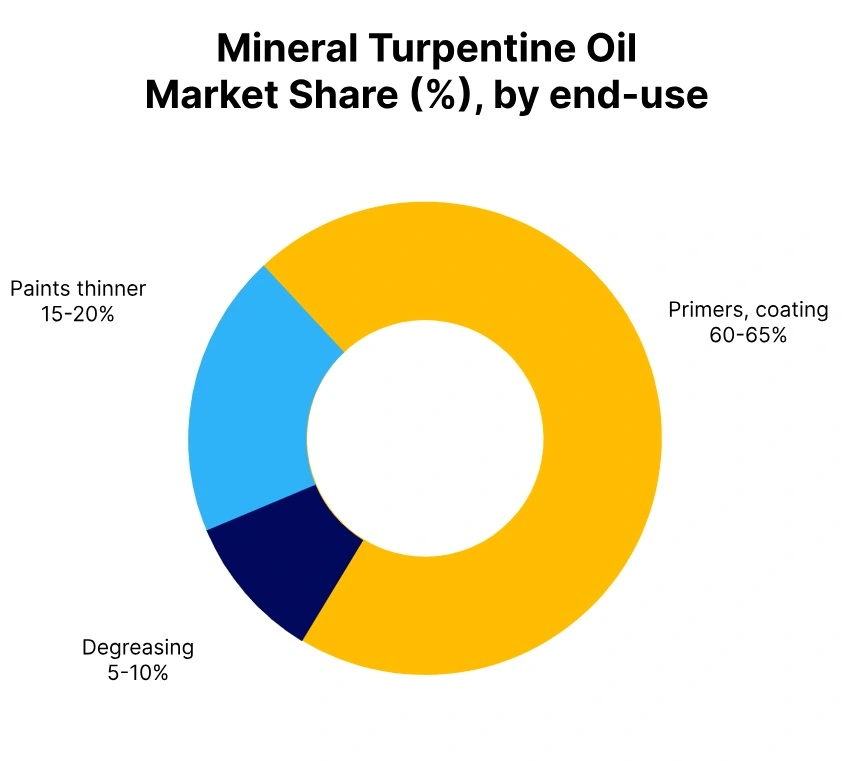
MTO market share end use


Historically, several events have caused significant fluctuations in Mineral Turpentine Oil (mto) prices

  • Israel-Hamas Conflict (2023): The recent escalation in the Israel-Hamas conflict has introduced additional uncertainty in Middle Eastern supply chains, potentially impacting global crude oil prices and, consequently, the pricing of MTO. Disruptions in this region can affect supply routes and increase volatility in markets worldwide. 
  • Environmental Regulations Impact (October 2023): New environmental regulations aimed at reducing the use of high-GWP substances have driven up demand for Mineral Turpentine Oil. This regulatory shift has caused price increases and has impacted the availability of feedstocks used in Mineral Turpentine Oil production. 
  • Crude Oil Market Fluctuations (July 2022): The Russia-Ukraine conflict caused significant fluctuations in crude oil prices, which in turn affected Mineral Turpentine Oil prices. The war disrupted supply chains and contributed to increased production costs for Mineral Turpentine Oil.  
  • Impact of COVID-19 on Supply Chains (September 2021): The ongoing COVID-19 pandemic continued to affect global supply chains, causing disruptions in Mineral Turpentine Oil feedstock supplies and leading to fluctuations in prices. 


These events underscore the Mineral Turpentine Oil market’s vulnerability to global disruptions and highlight the need for continuous monitoring of supply-demand dynamics.
 

Why Price Watch™?

Price Watch™ is your trusted resource for tracking global mineral turpentine oil (mto) price trends. Our platform delivers real-time data and expert analysis, offering deep insights into the key factors driving price fluctuations in the mineral turpentine oil (mto) market. By monitoring critical events such as geopolitical tensions, supply chain disruptions, and economic shifts, Price Watch™ keeps you fully informed of market dynamics.

In addition, Price Watch™ provides detailed forecasts and updates on production capacities, enabling you to anticipate market changes and make well-informed decisions. With Price Watch™, you gain a competitive edge in understanding all the elements that influence mineral turpentine oil (mto) prices worldwide. Stay ahead of the curve with Price Watch’s™ reliable, accurate, and timely mineral turpentine oil (mto) market data.

Track Price Watch's™ mineral turpentine oil (mto) price assessment on a weekly basis since 2015 onwards, along with short-term forecasts, and get access to the detailed report in a downloadable format.

Mineral Turpentine Oil (mto) Market Price Trend published by Price Watch™ reflect prevailing spot market conditions, derived from independent research, verified trade inputs, and proprietary market intelligence as of the publication date. Prices are published on the specified Incoterm and represent indicative base market levels, exclusive of applicable taxes, VAT, duties, tariffs, and other statutory charges. Actual transaction values may vary depending on volume, credit terms, contractual structure, and other negotiated conditions. Market prices are inherently subject to volatility, liquidity dynamics, regulatory changes, and evolving trade activity. The information provided is for reference and benchmarking purposes only and does not constitute an offer, recommendation, or guarantee of transactional outcomes. Users should exercise independent commercial judgment and assess their specific contractual, regulatory, tax, and application requirements before making business decisions. Price Watch™ assumes no liability for decisions taken based on this information.

The pricing of Mineral Turpentine Oil is influenced by several factors, including raw material costs such as crude oil fluctuations in supply and demand within industries like paints, coatings, and adhesives, as well as external elements like geopolitical events, trade tariffs, and energy prices. These factors combine to create variability in pricing depending on global economic conditions.

Regional production plays a significant role in Mineral Turpentine Oil pricing. Regions with high production, like Asia-Pacific, tend to have more competitive pricing due to local availability, whereas regions that rely on imports, such as North America and Europe, often face higher costs due to transportation fees, import duties, and potential supply chain disruptions.

The latest pricing trends for Mineral Turpentine Oil often reflect fluctuations in the cost of raw materials and changes in global supply chains. To secure better rates, procurement heads can consider locking in long-term contracts with suppliers, monitoring global price trends and indices, and optimizing bulk purchasing strategies to take advantage of volume discounts.

Mineral Turpentine Oil (MTO), also commonly referred to as white spirit, is a petroleum-derived organic solvent obtained during the refining of crude oil. It is widely used across industries such as paints and coatings, varnishes, thinners, adhesives, cleaning products, and industrial degreasing due to its strong solvency, controlled evaporation rate, and cost-effectiveness compared to alternative solvents.

MTO plays a crucial role in formulation processes, particularly in decorative and industrial coatings where it helps in improving flow, consistency, and drying performance. The price of Mineral Turpentine Oil is highly significant because it is a bulk commodity solvent that directly influences the cost structure of downstream industries.

Any fluctuation in MTO prices immediately impacts the production cost of paints, coatings, and cleaning agents, thereby affecting profit margins and final product pricing. Additionally, as MTO is derived from crude oil, its pricing is closely linked to global energy markets, making it sensitive to crude price volatility.

Regional price differences further influence sourcing decisions, trade flows, and supply chain strategies for manufacturers. Price Watch™ tracks these price movements to provide transparency and help businesses stay aligned with market trends.

The price of Mineral Turpentine Oil (MTO) is not fixed and varies significantly depending on region, grade specification (such as low aromatic or regular grade), and delivery terms (FOB, CIF, Ex-works).

Prices are typically quoted per metric ton and are influenced by several dynamic factors including crude oil price fluctuations, refinery operating rates, supply-demand balance, and logistics costs.

In regions with strong refining infrastructure, such as Asia and the Middle East, prices tend to be more competitive due to local availability. Conversely, import-dependent regions often experience higher prices due to freight costs and import duties.

Price Watch™ provides real-time price benchmarks and regional comparisons, enabling buyers and sellers to make well-informed procurement and trading decisions.

The global Mineral Turpentine Oil (MTO) market is witnessing steady growth, primarily driven by expanding demand from the paints and coatings industry, construction sector, and industrial cleaning applications.

As urbanization and infrastructure development continue to grow especially in emerging economies the demand for paints, varnishes, and related products is increasing, thereby supporting MTO consumption.

From a pricing perspective, the market tends to fluctuate in response to crude oil price movements, as MTO is a refinery product. Periods of rising crude prices generally lead to higher MTO prices, while stable or declining crude trends can soften the market.

Supply-demand balance also plays a critical role; oversupply due to high refinery output can pressure prices downward, whereas tight supply caused by refinery shutdowns or maintenance can push prices upward.

Other influencing factors include seasonal demand patterns, transportation costs, environmental regulations restricting solvent emissions, and shifts toward low-aromatic or eco-friendly solvent grades.

The largest consumer of Mineral Turpentine Oil (MTO) is the paints and coatings industry, where it is extensively used as a solvent and thinner in both decorative and industrial applications. The construction sector follows closely, as paints and coatings are essential for infrastructure development and maintenance.

Additionally, MTO is widely used in the manufacturing of varnishes, lacquers, and wood finishes, as well as in adhesives and sealants. The automotive industry also consumes significant quantities for refinishing and maintenance applications.

Other notable end-users include cleaning product manufacturers, where MTO is used as a degreasing agent, and various industrial sectors that rely on solvents for equipment cleaning and maintenance. Price Watch™ continuously analyzes demand patterns across these industries to provide insights into consumption trends.

Mineral Turpentine Oil is derived from crude oil during the petroleum refining process. It is typically obtained through fractional distillation, where specific hydrocarbon fractions are separated and further treated to meet desired specifications such as flash point, aromatic content, and purity.

Refineries may also subject MTO to additional processes such as hydrodesulfurization or DE-aromatization to produce higher-grade or environmentally compliant variants.

As a result, the availability of MTO is closely tied to refinery throughput and crude oil processing capacity. Countries with large and advanced refining industries, including the United States, China, India, and Middle Eastern nations, are key producers of MTO.

The global export market for Mineral Turpentine Oil (MTO) is dominated by countries with significant refining capacities. The United States, China, India and major Middle Eastern countries are among the leading exporters due to their ability to produce large volumes at competitive costs.

Export dynamics can shift depending on regional demand, refinery utilization rates, and trade policies. For example, surplus production in Asia may lead to increased exports to Europe or Africa, while supply constraints in one region can trigger higher imports. Price Watch™ monitors global trade flows, export volumes, and supplier activity to help businesses identify reliable sourcing options.

In general, the global supply of Mineral Turpentine Oil is sufficient to meet demand, as it is produced as part of large-scale petroleum refining operations. However, the market can experience temporary imbalances due to fluctuations in refinery output or unexpected disruptions.

Planned maintenance shutdowns, unplanned outages, or reductions in crude processing can tighten supply, while weak industrial demand can lead to surplus availability.

Because MTO production is not always the primary focus of refineries, its supply is indirectly influenced by overall fuel demand and refining economics. Price Watch™ tracks these supply-demand dynamics to identify potential shortages or surpluses in the market.

Mineral Turpentine Oil is available in several grades based on composition, purity, and end-use requirements. Common grades include regular industrial grade, low-aromatic grade, and high-flash grade.

Regular industrial grade is widely used in paints and general cleaning applications and is typically the most economical option. Low-aromatic grades, which contain reduced levels of harmful aromatic compounds, are more expensive due to additional refining and are preferred in applications requiring lower toxicity and environmental compliance.

High-flash grades are used in specialized applications where safety and higher ignition temperatures are required. Price differences arise due to variations in refining processes, quality standards, and regulatory requirements.

When demand for Mineral Turpentine Oil increases sharply often due to a surge in construction activity or industrial production prices tend to rise as supply cannot immediately adjust. Refineries may attempt to increase output, but production adjustments take time and are often constrained by overall refining priorities.

This can lead to short-term supply tightness, higher spot prices, and increased competition among buyers. Distributors may also raise margins, and some buyers may stockpile inventory in anticipation of further price increases, amplifying the upward pressure on prices until the market stabilizes.

Energy prices have a direct and significant impact on the cost of producing Mineral Turpentine Oil, as refining crude oil is an energy-intensive process involving distillation, heating, and chemical treatment.

When energy costs such as electricity, natural gas, and fuel increase, refinery operating expenses rise, leading to higher production costs for MTO. Additionally, transportation and storage costs also increase with higher fuel prices, further influencing final market prices.

Regions with access to cheaper and stable energy sources are typically able to produce MTO at lower costs, making them more competitive in the global market.

Regional price variations for Mineral Turpentine Oil arise from differences in crude oil availability, refining capacity, local demand, and logistics infrastructure.

Regions with strong domestic production and refining capabilities generally offer lower prices due to reduced transportation costs. In contrast, regions that rely heavily on imports face higher prices due to freight charges, port handling costs, and import duties.

Environmental regulations, currency exchange rates, and distributor margins also contribute to pricing differences. Price Watch™ tracks these regional variations to provide a comprehensive view of the global market.

The future price outlook for Mineral Turpentine Oil depends on several interconnected factors, including crude oil price trends, refinery operating rates, and demand from key industries such as construction and automotive.

If global economic growth remains strong and infrastructure development continues, demand for paints and coatings and consequently MTO is expected to rise, supporting higher prices. On the supply side, refinery expansions and stable crude supply can help moderate price increases.

Seasonal demand fluctuations and global trade dynamics will also play a role. Price Watch™ provides detailed forecasts based on these variables to help businesses anticipate market movements.

Yes, accurate price forecasting is a valuable tool for businesses that rely on Mineral Turpentine Oil as a raw material. By understanding future price trends, companies can optimize procurement strategies, negotiate better contracts, and manage inventory more efficiently.

For example, if prices are expected to rise, businesses can secure supply at current rates, while anticipated price declines may encourage delayed purchasing. This strategic approach can result in significant cost savings and improved financial planning.

Global events such as geopolitical tensions, crude oil supply disruptions, refinery shutdowns, and natural disasters can significantly impact the supply and pricing of Mineral Turpentine Oil.

For instance, conflicts in oil-producing regions can drive up crude prices, increasing MTO costs. Similarly, hurricanes or unexpected refinery outages can disrupt supply chains, leading to shortages and price spikes.

Economic downturns can reduce demand, resulting in lower prices. Logistics disruptions, such as shipping delays or port congestion, can further affect availability and pricing.

Price Watch™ is a reliable source for Mineral Turpentine Oil price data, offering comprehensive market intelligence based on inputs from manufacturers, distributors, and buyers worldwide.

It provides regular price assessments, detailed market reports, and forward-looking forecasts, ensuring transparency and helping businesses understand pricing trends, supply-demand dynamics, and regional market conditions.