Mixed Xylene Price Trend and Forecast

Weekly Update
|
Historical Data Since 2015
|
Forecast for 2026
  • Commodity Pricing

mixed xylene Price Trends by Country

cnChina
inIndia
mxMexico
zaSouth Africa
twTaiwan
thThailand
aeUnited Arab Emirates
usUnited States
krSouth Korea

Global mixed xylene Spot Market Prices, Trend Analysis and Forecast

𝐏𝐫𝐢𝐜𝐞 𝐖𝐚𝐭𝐜𝐡™ provides price assessments for Mixed Xylene across top trading regions:

Asia Pacific

  • Mixed Xylene Solvent Grade (>99%) FOB Busan, South Korea
  • Mixed Xylene Solvent Grade (>99%) FOB Kaohsiung, Taiwan
  • Mixed Xylene Solvent Grade (>99%) FOB Laem Chabang, Thailand
  • Mixed Xylene Solvent Grade (>99%) CIF Shanghai (South Korea), China
  • Mixed Xylene Solvent Grade (>99%) CIF Shanghai (USA), China
  • Mixed Xylene Solvent Grade (>99%) CIF Nhava Sheva (Taiwan), India
  • Mixed Xylene Solvent Grade (>99%) Ex-China, China
  • Mixed Xylene Solvent Grade (>99%) Ex-Mumbai, India
  • Mixed Xylene Solvent Grade (>99%) (Bulk) Ex-Mumbai, India


North America

  • Mixed Xylene Solvent Grade (>99%) FOB Houston, USA
  • Mixed Xylene Solvent Grade (>99%) CIF Manzanillo (USA), Mexico


Middle East

  • Mixed Xylene Solvent Grade (>99%) CIF Jabel Ali (Taiwan), United Arab Emirates
  • Mixed Xylene Solvent Grade (>99%) CIF Jabel Ali (Thailand), United Arab Emirates


Southern Africa

  • Mixed Xylene Solvent Grade (>99%) CIF Cape Town (Taiwan), South Africa
  • Mixed Xylene Solvent Grade (>99%) CIF Cape Town (South Korea), South Africa


Note:
In assessments structured as CIF [Importing Port] (Exporting Country), the country mentioned in brackets indicates the primary origin of supply (exporting country), while the named port refers to the destination port in the importing country. Other Incoterms (FOB, FD, EXW, etc.) should be interpreted in accordance with standard international trade definitions.

Mixed Xylene Price Trend Q4 2025

In Q4 2025, global Mixed Xylene markets demonstrated mixed performance with an average quarterly change of approximately -3% to +5% across major trading regions. Asian export hubs experienced modest declines reflecting balanced supply-demand dynamics and steady solvent consumption from paint, coating, and chemical processing sectors.

Import-dependent markets witnessed moderate downward pressure driven by competitive freight conditions and adequate supply availability. The USA recorded upward momentum supported by robust domestic demand, while India demonstrated the quarter’s strongest performance driven by supply tightness and vigorous downstream consumption from pharmaceutical and agrochemical industries.

Overall, the quarter reflected regional supply-demand imbalances, varying feedstock dynamics, and differing consumption patterns influencing pricing structures across global markets as participants navigated evolving industrial requirements and logistics considerations throughout the period.

South Korea: Mixed Xylene Export Prices FOB Busan, South Korea, Grade- Solvent (>99%)

In Q4 2025, Mixed Xylene prices in South Korea experienced slight downward pressure amid balanced regional market conditions and steady demand from solvent applications. Mixed Xylene prices FOB Busan ranged between USD 630-665 per metric ton, recording a 2.50% drop compared to the previous quarter.

Consistent production from petrochemical facilities and moderate consumption from paint, coating, and chemical processing sectors shaped the market trajectory throughout the period. In December 2025, Mixed Xylene prices decreased by 0.31%, influenced by year-end inventory adjustments executed by prudent exporters, pronounced seasonal demand moderation amid holiday slowdowns, and stable regional supply availability progressively maintaining Busan end-year deal structures as calendars closed.

Taiwan: Mixed Xylene Export Prices FOB Kaohsiung, Taiwan, Grade-Solvent (>99%)

In Q4 2025, Mixed Xylene prices in Taiwan witnessed slight downward movement supported by adequate domestic production and steady export demand. Mixed Xylene prices FOB Kaohsiung ranged between USD 680-715 per metric ton, showing a 2.13% dip from the preceding quarter. Balanced supply from integrated refineries and consistent demand from electronics and specialty chemical sectors influenced pricing dynamics throughout the period.

In December 2025, Mixed Xylene prices went down by 0.53%, influenced by strategic year-end contract settlements executed by disciplined producers, pronounced buyer caution amid lunar new year planning, and competitive regional supply pressures progressively tempering Kaohsiung end-year deal structures as calendars closed.

Thailand: Mixed Xylene Export Prices FOB Laem Chabang, Thailand, Grade-Solvent (>99%)

In Q4 2025, Mixed Xylene prices in Thailand experienced modest downward pressure amid stable regional production and consistent export activities. Mixed Xylene prices FOB Laem Chabang ranged between USD 690-740 per metric ton, recording a 2.04% decline compared to the previous quarter. Adequate availability from petrochemical complexes and steady demand from Southeast Asian solvent markets shaped the market fundamentals throughout the period.

In December 2025, Mixed Xylene prices increased by 0.34%, influenced by year-end restocking activities executed by forward-thinking buyers, pronounced regional supply discipline amid controlled production rates, and improved export demand progressively reinforcing Laem Chabang end-year deal structures as calendars closed.

USA: Mixed Xylene Export Prices FOB Houston, USA, Grade-Solvent (>99%)

In Q4 2025, Mixed Xylene prices in the United States demonstrated upward momentum supported by robust domestic demand and steady export activities. Mixed Xylene prices FOB Houston ranged between USD 785-915 per metric ton, showing a 2.00% increase from the preceding quarter. Consistent production from Gulf Coast refineries and strong consumption from paint, coating, and specialty chemical sectors influenced the upward trajectory throughout the period.

In December 2025, Mixed Xylene prices declined significantly by 8.97%, influenced by strategic year-end inventory liquidation executed by pragmatic producers, pronounced seasonal demand slowdowns amid holiday disruptions, and competitive domestic supply abundance progressively softening Houston end-year deal structures as calendars closed.

China: Mixed Xylene Imported Prices CIF Shanghai from South Korea, China, Grade-Solvent (>99%)

In Q4 2025, Mixed Xylene prices in China experienced slight downward pressure amid consistent import flows from South Korean suppliers. Mixed Xylene prices CIF Shanghai ranged between USD 650-690 per metric ton, recording a 2.60% dip compared to the previous quarter. Adequate import availability and moderate consumption from paint, coating, and chemical processing sectors shaped pricing dynamics throughout the period.

In December 2025, Mixed Xylene prices decreased by 0.30%, influenced by year-end procurement completions executed by cost-conscious manufacturers, pronounced inventory optimization amid lunar new year preparations, and stable regional supply availability progressively maintaining Shanghai end-year deal structures as calendars closed.

South Africa: Mixed Xylene Imported Prices CIF Cape Town from Taiwan, South Africa, Grade-Solvent (>99%)

In Q4 2025, Mixed Xylene prices in South Africa witnessed downward movement driven by competitive import pricing from Taiwanese suppliers. Mixed Xylene prices CIF Cape Town ranged between USD 815-855 per metric ton, showing a 3.47% drop from the preceding quarter. Consistent import flows and adequate freight availability meeting domestic solvent market requirements influenced the downward trajectory throughout the period.

In December 2025, Mixed Xylene prices decreased by 0.45%, influenced by year-end inventory adjustments executed by prudent distributors, pronounced seasonal demand moderation amid summer holiday disruptions, and stable maritime logistics costs progressively tempering Cape Town end-year deal structures as calendars closed.

UAE: Mixed Xylene Imported Prices CIF Jabel Ali from Thailand, UAE, Grade-Solvent (>99%)

In Q4 2025, Mixed Xylene prices in UAE experienced modest downward pressure supported by steady import availability from Thai suppliers. Mixed Xylene prices CIF Jabel Ali ranged between USD 750-800 per metric ton, recording a 1.33% decline compared to the previous quarter. Consistent shipping schedules and moderate consumption from regional solvent and chemical processing sectors shaped market fundamentals throughout the period.

In December 2025, Mixed Xylene prices decreased marginally by 0.19%, influenced by year-end procurement completions executed by strategic buyers, pronounced stable freight conditions amid reliable shipping availability, and balanced regional demand progressively maintaining Jabel Ali end-year deal structures as calendars closed.

India: Mixed Xylene Domestically Traded Prices Ex-Mumbai, India, Grade-Solvent (>99%)

In Q4 2025, Mixed Xylene prices in India demonstrated significant upward momentum driven by robust domestic demand and tightened supply conditions. Mixed Xylene prices Ex-Mumbai ranged between USD 785-910 per metric ton, recording a substantial 9.13% increase compared to the previous quarter. Strong consumption from paint, coating, pharmaceutical, and agrochemical sectors coupled with production constraints influenced the upward pricing trajectory throughout the period.

In December 2025, Mixed Xylene prices decreased by 1.55%, influenced by strategic year-end destocking executed by prudent distributors, pronounced seasonal manufacturing slowdowns amid reduced industrial uptake, and improved import availability progressively tempering Mumbai end-year deal structures as calendars closed.

Mixed Xylene Price Trend Analysis: Q4 2025

In Q3 2025, the global Mixed Xylene market exhibited a balanced yet cautious outlook, with price trends shaped by steady feedstock availability and fluctuating demand across end-use sectors. Supply remained consistent as production rates held stable, supported by regular availability of upstream materials such as Reformate and Toluene. While freight rates showed minimal volatility, they had limited impact on overall pricing dynamics.

Procurement activity was driven by short-term buying cycles, with several market participants adopting a wait-and-watch approach due to existing inventory levels. Overall, the Mixed Xylene price trend reflected a mixed sentiment globally, with some markets observing mild gains and others seeing moderate corrections in response to changing demand fundamentals.

South Korea: Mixed Xylene Export prices FOB Busan, South Korea, Solvent Grade (>99%).

In Q3 2025, the Mixed Xylene prices in South Korea under FOB Busan terms saw a marginal increase. The market was supported by stable regional demand and moderate feedstock cost trends for Reformate and Toluene. Steady refinery throughput and balanced domestic availability allowed suppliers to maintain firm pricing levels. The number of inquiries remained consistent throughout the quarter, while moderate export allocations helped stabilize the market.

In September 2025 Mixed Xylene prices down by 0.86% from August. The softening in prices reflected balanced demand conditions in South Korea, along with sufficient availability of feedstock and finished product. The Mixed Xylene price trend in South Korea showed resilience despite minor upstream volatility. Prices were assessed between USD 655–700 per metric ton, marking a 1.32% rise from the previous quarter. Sellers reported healthy contract renewals toward the quarter-end.

Taiwan: Mixed Xylene Export prices FOB Kaohsiung, Taiwan, Solvent Grade (>99%).

In Q3 2025, the Mixed Xylene prices in Taiwan under FOB Kaohsiung terms experienced slight downward pressure due to sluggish export activity and weaker international buying interest. Market participants reported limited arbitrage opportunities, and the number of inquiries declined slightly over the quarter.

Feedstock availability from regional petrochemical hubs remained steady, contributing to stable production output. Despite competitive offers, buying momentum remained subdued, preventing any significant price escalation. In September 2025 Mixed Xylene prices declined marginally showing a month-on-month drop of 0.40%.

The decrease was influenced by steady demand conditions and comfortable stock levels in Taiwan. The Mixed Xylene price trend in Taiwan remained largely flat to slightly negative. Prices hovered between USD 705–730 per metric ton, reflecting a 0.80% quarter-on-quarter change, with traders adopting a cautious procurement stance.

Thailand: Mixed Xylene Export prices FOB Laem Chabang, Thailand, Solvent Grade (>99%).

In Q3 2025, the Mixed Xylene prices in Thailand under FOB Laem Chabang terms registered a sharp decline, influenced by weak export interest and ample domestic availability. Local producers continued to operate at near-normal rates, resulting in excess supply amid soft international demand. The number of spot transactions dropped significantly, and lower regional offtake weighed heavily on market sentiment. Feedstock costs for Toluene and Reformate remained steady, but this did little to offset the bearish outlook.

In September 2025 Mixed Xylene prices, reflecting a 0.73% decrease from the previous month. Thai sellers responded to slightly weakened demand and competitive regional benchmarks by lowering offered prices. The Mixed Xylene price trend in Thailand was distinctly negative, with prices ranging between USD 720–800 per metric ton, representing a 18.21% drop from the previous quarter.

USA: Mixed Xylene Export prices FOB Houston, USA, Solvent Grade (>99%).

According to Price-Watch, in Q3 2025, the Mixed Xylene prices in the USA under FOB Houston terms saw moderate growth, supported by improved domestic blending demand and constrained supply due to refinery maintenance in parts of the Gulf Coast. Market participants noted a slight increase in the number of inquiries from downstream users and traders, particularly in the latter half of the quarter. Strong gasoline blending economics also contributed to the firm tone in the market.

While feedstock availability was stable, logistics and maintenance schedules provided upward momentum. The Mixed Xylene price trend in the USA remained firm, with prices ranging between USD 810–900 per metric ton, indicating a 2.11% increase over the previous quarter.

In September 2025 Mixed Xylene prices increased by 5.50% compared to the previous month. The sharp increase was led by active procurement from downstream industries and a constrained supply scenario in the U.S. domestic market.

China: Mixed Xylene Import prices CIF Shanghai, China, Solvent Grade (>99%).

In Q3 2025, the Mixed Xylene prices in China under CIF Shanghai terms showed a modest upward adjustment, supported by steady inbound freight activity from South Korea. Despite limited fluctuations in shipping costs, the number of inquiries remained stable with no significant surge in buying volumes. The domestic market was relatively balanced due to moderate inventory levels and consistent spot demand.

Meanwhile, FOB offers from South Korean suppliers remained within a competitive range, offering limited room for price negotiation. In September 2025 Mixed Xylen prices registering a marginal decline of 1.18% compared to the previous month. The Mixed Xylene price trend in China reflected mild appreciation, with prices ranging between USD 675–725 per metric ton, indicating a 0.96% increase from the previous quarter.

South Africa: Mixed Xylene Import prices CIF Cape Town, South Africa, Solvent Grade (>99%).

In Q3 2025, the Mixed Xylene prices in South Africa under CIF Cape Town terms witnessed a steady increase, supported by a rise in freight charges from Taiwan and improved demand sentiment. The number of inquiries rose gradually during the quarter, particularly from downstream solvent and chemical distributors seeking fresh cargoes. Although shipping lanes remained largely unaffected, extended lead times added a layer of caution to purchasing strategies.

FOB offers from Taiwanese producers remained steady, encouraging restocking activities toward the end of the quarter. The Mixed Xylene price trend in South Africa remained firm, with values assessed between USD 835–890 per metric ton, reflecting a 1.96% quarterly growth. In September 2025 Mixed Xylene prices reflecting a decline of 2.01% from August. This decrease was largely due to a build-up of material in South Africa, prompting suppliers to reduce offers to maintain shipment flow.

United Arab Emirates: Mixed Xylene Import prices CIF Jebel Ali, UAE, Solvent Grade (>99%).

In Q3 2025, the Mixed Xylene prices in the United Arab Emirates under CIF Jebel Ali terms experienced a significant decline. Freight rates from Thailand remained stable, but soft import demand and abundant inventories led to reduced inquiry levels throughout the quarter. The market was further impacted by high regional availability and limited downstream restocking activity. FOB offers from Thailand dropped slightly as sellers attempted to stay competitive in a bearish environment.

As a result, the Mixed Xylene price trend in the UAE remained under downward pressure, with prices ranging between USD 780–810 per metric ton, showing a 16.78% decline over the previous quarter. In September 2025 Mixed Xylene prices were declining by 0.80% month-on-month. The price drop followed reduced spot demand from Thailand and flexible offers from UAE sellers due to available material in hand.

India: Mixed Xylene Domestic prices Ex-Mumbai, India, Solvent Grade (>99%).

In Q3 2025, the Mixed Xylene prices in India under Ex-Mumbai terms increased steadily due to rising domestic demand and firm regional support. With minimal concerns, local distributors focused on securing inventory amid tightening supply in the western corridor. The number of spot transactions grew during the quarter, driven by consistent feedstock availability, particularly Reformate and Toluene.

Producer offers were firm across most contract volumes, and buyers responded positively to the sustained pricing momentum. The Mixed Xylene price trend in India remained strong, with prices assessed between USD 800–835 per metric ton, registering a 6.50% gain from the previous quarter. In September 2025 Mixed Xylene prices reflecting a drop of 1.00% from previous month. The decrease was attributed to subdued demand from local industries and steady supply conditions.

According to the PriceWatch, In Q2 2025, Mixed Xylene prices on an FOB Busan basis dropped to USD 658.50 per metric ton, reflecting a sharp quarterly decrease of -7.90%. This significant decline was primarily driven by lower feedstock costs, as Crude Oil and Naphtha prices softened amid improved global supply conditions and muted demand.

Additionally, subdued procurement activity from downstream sectors such as solvents, paints, and petrochemicals contributed to the bearish market tone. Export competitiveness from other Asian producers and persistent inventory overhang in regional hubs further pressured prices.

Seasonal demand fluctuations, coupled with logistical ease due to reduced port congestion, also played a role in facilitating faster shipments and higher availability. Ultimately, Q2 concluded with a pronounced downward trend, led by cost-side relief and tepid downstream consumption. 

According to the PriceWatch market report, Mixed Xylene prices in India registered a marginal decline in Q2 2025, with Ex-Mumbai values settling at USD 782.78 per metric ton, reflecting a -3.77% decrease compared to the previous quarter. The drop in Mixed Xylene prices was largely attributed to muted demand from the paints and coatings industries, which typically experience a seasonal slowdown during the early monsoon period, reducing the pace of procurement,  surplus in domestic inventories, coupled with consistent production from key western Indian facilities, added downward pressure on the Mixed Xylene Market, as supply comfortably outpaced demand.

Buyers remained cautious and continued to draw from existing stocks rather than engaging in aggressive spot purchases. Despite steady upstream naphtha and crude prices, the Mixed Xylene price Trend remained soft, indicating a lack of significant cost-push support from raw materials.

According to the Mixed Xylene price Chart, transactional values showed mild but persistent softness throughout the quarter, particularly in May, as sellers adjusted offers downward in response to slow market movement.

With limited volatility in freight and currency markets. Overall, the Mixed Xylene Market during Q2 2025 reflected a bearish outlook, driven by oversupply conditions, seasonal consumption dips, and restrained buying behaviour.

During Q1 2025, the East Asian Mixed Xylene market of South Korea experienced a modest upward trend with prices at USD 715/MT, registering a merger rise of 0.28%. Steady demand from the chemicals, automotive, and coatings sectors, which still depend on Mixed Xylene as a precious raw material, supported the market. Demand was stable with the supply side also facing over-supply of the commodity and thus prices were constant with only marginal increase from the last quarter. 

In Q1 2025, the market stabilized with prices moving slightly higher to $806.99/MT, a 0.09% change from Q4. Though small, this suggested a potential return driven by incremental healing in demand from the solvent and chemical markets. With budgetary budgets rolling over and manufacturing activity incrementally coming back after winter, buyers tentatively re-entered the market.

However, the overall market sentiment was still conservative, with the suppliers closely observing international crude trends and domestic downstream response before adjusting production and price plans. 

Mixed Xylene Price Trend Analysis: Q4 2024

In Q4 2024, South Korea Mixed Xylene prices fell, with the price standing at USD 713/MT, down by a -16.90% from Q3 2024. The drop was caused by several factors on the global market, including a drop in demand by some of the biggest manufacturing industries and the arrival on the market of a massive amount of the commodity.

Mixed Xylene Production was stable, but in the presence of global petrochemical overcapacity and the weakening demand from large markets like North America and Europe, prices were struggling on the downside owing to this. 

In Q4 2024, the downtrend extended, with prices hitting a low of $806.25/MT, another 14.38% drop from Q3. Seasonal factors such as reduced industrial activity during year-end holidays, especially in the coatings and resin sectors, were a major influence. The market was also under pressure from global oversupply levels and weak export demand, especially from long-standing customers in the Middle East and Southeast Asia. Despite expectations of a modest festive pick-up in packaging sectors, overall sentiment was dampened by high stocks and weak inquiry. 

South Korean Mixed Xylene prices during Q3 2024 fell by a modest -2.50% from Q2 2024, and prices were fluctuating around USD 858/MT. Increases in demand were moderated by a symphony of factors that affected the market, with consistent global supply being one of them.

It was a period when the prices stabilized by virtue of excessive levels of abundance of Mixed Xylene in the international market that kept on attaining equilibrium within the demand-supply situation. Even while falling by a microscopic margin, the trend was sustained because the product continued to stay very fashionable within key markets. 

Indian Mixed Xylene prices in Q3 2024 saw a substantial correction as the prices fell to $941.68/MT, a reduction of 11.24% quarter-on-quarter from Q2. The reason for the fall in prices was reduced downstream demand and sudden stockpiling. Downstream segments cut buying owing to the beginning of the monsoon season and outstanding projects in paint and chemicals.

Additionally, domestic refiners had also resumed operations at capacity levels, hence leading to surplus supply. Import parity declined as well during this period, reducing pricing power for domestic sellers. 

South Korean Mixed Xylene prices continued the upward trend in Q2 2024 at $880.3409/MT, 2.56% more than in Q1. Downstream sector demand for applications like automotive and packaging continued to be supported, coupled with increased refining. Industrial production rose worldwide, led most notably by the Asian and European markets.

In addition, the global supply chain began to find strength from previous disruptions, thus leading to improved raw material supply. However, higher freight rates and supply issues, notably in the APAC market, continued to press the market. South Korea continued to be the leading exporter due to firm local demand and reliable refinery operations. 

By Q2 2024, the condition improved moderately, with prices rising to $1060.94/MT, a 4.94% rise from Q1. The rise was supported by growing consumption from the paint, adhesives, and agrochemical sectors, especially ahead of the monsoon season. Export demand also supported the momentum, as Indian suppliers responded to tightening supply in Southeast Asia owing to turnaround schedules in regional refineries.

In addition, a small hardening in the prices of upstream Naphtha and Aromatic crude offered some cost pressure to the Mixed Xylene market during this quarter. 

During Q1 2024, the global Mixed Xylene market revealed a rising trend, with South Korea, being among the major players of the Asia-Pacific (APAC) region, at $858.4037/MT. It increased by 6.78% in comparison to the previous quarter. It was due to the increased demand for the petrochemical industry, for production aims of paraxylene used in the manufacturing of polyester fibres sand plastics.

Mixed Xylene demand surged suddenly with downstream industries such as plastics and textiles picking up. Added to this were increases in crude oil prices and supply disruption by the ever-present geopolitics, also lending support to the price surge. South Korea, being one of the country’s biggest petrochemical export hubs, absorbed higher demands from surrounding states, which kept the market balance. 

In Q1 2024, Indian Mixed Xylene market was mildly bearish as prices settled around $1011.03/MT on average, down 1.87% from the previous quarter. This was mainly due to weak downstream demand from industries such as solvents and dyes, led by ample stocks in domestic depots.

Further, the post-year-end slowdown in industrial consumption and reduced buying interest by bulk buyers brought about a bearish market sentiment. Although foreign prices generally remained firm, the domestic market reflected a cautious tone, hedging between international patterns and domestic demand deficiencies. 

Technical Specifications of Mixed Xylene Price Trends

Product Description:

Mix-xylene is primarily derived from the refining of Crude Oil and is a key intermediate in the production of various chemicals and materials. Its versatility and unique properties make it a valuable raw material in several industries, including petrochemicals, plastics, textiles, and paints.

Identifiers and Classification

  • CAS No – 1330-20-7
  • HS Code – 29024400
  • Molecular Formula – C 8H 10
  • Molecular Weight[g/mol] – 106.16 g/mol


Mixed Xylene Synonyms:

  • 1,4-Dimethyl Benzene
  • Methyl toluene


Mixed Xylene Grades Specific Price Assessment:

  • Solvent Grade (>99%)


Mixed Xylene Global Trade and Shipment Terms

  • Quotation Terms (Product & Country Specific): 25-30 MT, 10-15 MT
  • Packaging Type (Product & Country Specific): Drum (170 Kg)


Incoterms Referenced in Mixed Xylene Price Reporting

Shipping Term  Location  Definition 
 CIF Shanghai (South Korea)  Shanghai, China  Mixed Xylene Import price in China from South Korea 
 CIF Shanghai (USA)  Shanghai, China  Mixed Xylene Import price in China from USA 
 Ex-China  China  Domestically Traded Mixed Xylene price in China 
 CIF Manzanillo (USA)  Manzanillo, Mexico  Mixed Xylene Import price in Mexico from USA 
 CIF Cape Town (Taiwan)  Cape Town, South Africa  Mixed Xylene Import price in South Africa from Taiwan 
 CIF Cape Town (South Korea)  Cape Town, South Africa  Mixed Xylene Import price in South Africa from South Korea 
 FOB Busan  Busan, South Korea  Mixed Xylene Export Price from South Korea 
 FOB Kaohsiung  Kaoshiung, Taiwan  Mixed Xylene Export Price from Taiwan 
 FOB Laem Chabang  Laem Chabang, Thailand  Mixed Xylene Export Price from Thailand 
 CIF Jabel Ali (Taiwan)  Jebel Ali, UAE  Mixed Xylene Import price in UAE from Taiwan 
 CIF Jabel Ali (Thailand)  Jebel Ali, UAE  Mixed Xylene Import price in UAE from Thailand 
 FOB Houston  Houston, USA  Mixed Xylene Export Price from USA 
 CIF Nhava Sheva (Taiwan)  Nhava Sheva, India  Mixed Xylene Import price in India from Taiwan 
 Ex-Mumbai  Mumbai, India  Domestically Traded Mixed Xylene price in Mumbai 
 Ex-Mumbai  Mumbai, India  Domestically Traded Mixed Xylene price in Mumbai 

*Quotation Terms refers to the quantity range specified for the Mixed Xylene being quoted or offered in a commercial transaction.

**Packaging Type refers to standard packaging size commonly used for Mixed Xylene packing, ease of handling, transportation, and storage in industrial and commercial applications.

Key Mixed Xylene Manufacturers

Manufacturer 
Nanshan Group 
Lotte Chemicals 
GS Caltex 
SK Geo Centric 
CPC Corporation 
ThaiOil 
PTT Global Chemical 
IRPC Public Company Limited 
Shell Chemical 
Marathon Petroleum Corporation 
Chevron Phillips Chemical Company LLC 
Reliance Industries 

Mixed Xylene Industrial Applications

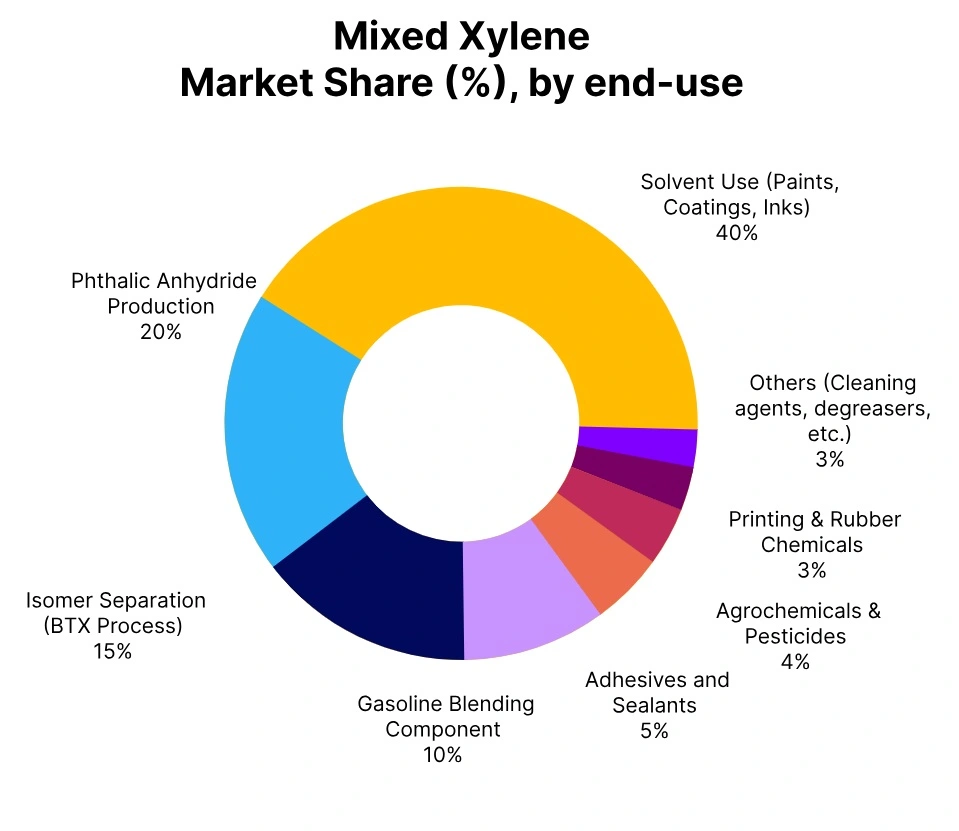
mixed xylene market share end use

Historically, several events have caused significant fluctuations in Mixed Xylene prices

  • Russia-Ukraine Conflict (2022-Present): Ongoing disruptions in energy supplies and production in Europe have led to increased costs and heightened price volatility for mixed xylene globally. 
  • Global Logistics Crisis (2021-Present): Shipping disruptions, including port closures and container shortages, have made transportation difficult. These logistical challenges have resulted in delays and higher costs, contributing to fluctuations in mixed xylene prices. 
  • COVID-19 Pandemic (2020-2022): The initial lockdowns caused a sharp decline in demand. However, as industries reopened, there was a surge in demand for packaging materials and other products, leading to significant price volatility. 
  • Texas Winter Storm (2021): Severe weather in Texas halted production at several petrochemical facilities, causing temporary spikes in mixed xylene prices due to supply shortages. 
  • Geopolitical Tensions (2018-2019): Trade disputes, particularly between the U.S. and China, created uncertainty in global markets, disrupting supply chains and causing price instability for mixed xylene.

Why Price Watch™?

Price Watch™ is your trusted resource for tracking global mixed xylene price trends. Our platform delivers real-time data and expert analysis, offering deep insights into the key factors driving price fluctuations in the mixed xylene market. By monitoring critical events such as geopolitical tensions, supply chain disruptions, and economic shifts, Price Watch™ keeps you fully informed of market dynamics.

In addition, Price Watch™ provides detailed forecasts and updates on production capacities, enabling you to anticipate market changes and make well-informed decisions. With Price Watch™, you gain a competitive edge in understanding all the elements that influence mixed xylene prices worldwide. Stay ahead of the curve with Price Watch’s™ reliable, accurate, and timely mixed xylene market data.

Track Price Watch's™ mixed xylene price assessment on a weekly basis since 2015 onwards, along with short-term forecasts, and get access to the detailed report in a downloadable format.

Mixed Xylene Market Price Trend published by 𝐏𝐫𝐢𝐜𝐞 𝐖𝐚𝐭𝐜𝐡™ reflect prevailing spot market conditions, derived from independent research, verified trade inputs, and proprietary market intelligence as of the publication date. Prices are published on the specified Incoterm and represent indicative base market levels, exclusive of applicable taxes, VAT, duties, tariffs, and other statutory charges. Actual transaction values may vary depending on volume, credit terms, contractual structure, and other negotiated conditions. Market prices are inherently subject to volatility, liquidity dynamics, regulatory changes, and evolving trade activity. The information provided is for reference and benchmarking purposes only and does not constitute an offer, recommendation, or guarantee of transactional outcomes. Users should exercise independent commercial judgment and assess their specific contractual, regulatory, tax, and application requirements before making business decisions. 𝐏𝐫𝐢𝐜𝐞 𝐖𝐚𝐭𝐜𝐡™ assumes no liability for decisions taken based on this information.

The price of Mixed Xylene is influenced by several key factors, including the cost of crude oil, availability of feedstocks like toluene and xylenes, and global demand from industries such as plastics, solvents, and chemicals. Additionally, geopolitical tensions, supply chain disruptions, and seasonal demand fluctuations can also impact pricing. Understanding these factors helps procurement heads make informed purchasing decisions.

To forecast Mixed Xylene prices effectively, it is crucial to analyse market trends, historical price data, and economic indicators. Keeping an eye on crude oil prices and tracking supply-demand dynamics are essential. Utilizing market analysis reports and engaging with industry experts can provide valuable insights. Additionally, employing pricing models that account for various market conditions will help improve the accuracy of your forecasts.

To manage price volatility in Mixed Xylene, procurement heads can adopt several strategies. Long-term agreements with suppliers can help stabilize costs and ensure a consistent supply. Diversifying the supplier base can reduce dependency on any single source. Monitoring market trends and adjusting procurement strategies based on price forecasts can also optimize purchasing. Additionally, considering inventory management techniques, such as stockpiling during lower price periods, can provide a buffer against future price increases.

Mixed Xylene is a blend of aromatic hydrocarbon isomers (Ortho-Xylene, Meta-Xylene, Para-Xylene) along with Ethylbenzene, widely used as an industrial solvent in paints, coatings, adhesives, inks, and cleaning products, as well as a feedstock for chemical production and gasoline blending. Its price directly impacts the cost of architectural and industrial coatings, printing inks, adhesives, agrochemical formulations, laboratory reagents, paint thinners, and fuel additives, making Mixed Xylene pricing a critical factor for coating manufacturers, ink producers, and solvent users worldwide. 𝐏𝐫𝐢𝐜𝐞 𝐖𝐚𝐭𝐜𝐡™ tracks these prices to help businesses and consumers understand and stay updated with the market trends.

Mixed Xylene prices vary by region and grade. Prices are typically quoted per metric ton, per gallon, or per liter and change based on supply, demand, feedstock costs, and refining capacity. 𝐏𝐫𝐢𝐜𝐞-𝐖𝐚𝐭𝐜𝐡™ provides real-time price assessments across different global markets to help buyers and sellers make informed decisions.

Mixed Xylene prices fluctuate due to changes in Crude Oil and Naphtha feedstock costs, refining and reforming production rates, energy price movements, and demand from solvent markets, Para-Xylene (PX) extraction economics, and gasoline blending. Catalytic reforming operations (primary Xylene source), pyrolysis gasoline (pygas) from steam crackers, aromatics extraction and fractionation economics, quality specifications and composition, transportation and logistics costs, seasonal demand patterns in coatings and construction industries, environmental regulations affecting aromatic solvents and VOC emissions, competition with alternative solvents, gasoline octane requirements and blending demand, Para-Xylene extraction rates affecting Mixed Xylene availability, trade policies affecting aromatics, and broader economic conditions further shape price trends, with recent outlooks reflecting volatility driven by crude oil prices, PX demand for polyester, reformate production levels, and coating industry activity.

The biggest buyers of Mixed Xylene are paint and coating manufacturers using it as a solvent and thinner for architectural, industrial, automotive, and protective coatings. Additional significant demand comes from printing ink producers, adhesive and sealant manufacturers, agrochemical formulators (for pesticide and herbicide formulations), cleaning product manufacturers, laboratories and research institutions, paint thinner and solvent blend producers, rubber and leather processing companies, and gasoline blenders using Xylenes as octane enhancers. 𝐏𝐫𝐢𝐜𝐞-𝐖𝐚𝐭𝐜𝐡™ analyses demand patterns across all these industries.

Mixed Xylene is primarily produced through catalytic reforming of Petroleum Naphtha in refineries, where alkanes and cycloalkanes are converted to aromatics (Benzene, Toluene, Xylenes). Additional Xylenes are recovered from pyrolysis gasoline (pygas), a by-product of steam cracking operations. Mixed Xylene is the product remaining after Para-Xylene (and sometimes ortho-Xylene) extraction from the Xylene isomer mixture, or it can be the unfractionated C8 aromatic stream. It is extracted and purified through distillation and aromatics extraction processes at integrated refineries and petrochemical complexes.

Mixed Xylene trade is driven by refining capacity, aromatics production, Para-Xylene extraction economics, and regional solvent demand. South Korea, the United States, China, Singapore, and several Middle Eastern countries including Saudi Arabia and UAE are among significant producers and traders of Mixed Xylenes. European countries including the Netherlands, Belgium, and Spain, along with other Asian producers in India and Thailand, also participate in regional and global trade. Export volumes fluctuate based on refinery operating rates, reformate production levels, Para-Xylene extraction demand (which affects Mixed Xylene availability as a by-product), solvent market conditions, gasoline specifications and blending requirements, freight costs, and regional supply-demand imbalances. 𝐏𝐫𝐢𝐜𝐞-𝐖𝐚𝐭𝐜𝐡™ tracks production levels, export flows and trade patterns to help businesses understand global supply chains and identify sourcing opportunities.

Supply generally matches demand, but regional shortages can occur due to refinery shutdowns, catalytic reformer maintenance, aromatics extraction unit outages, increased Para-Xylene extraction (reducing Mixed Xylene availability), transportation problems, or sudden spikes in coating or solvent demand. Refinery turnarounds, reformer catalyst regeneration, and Para-Xylene plant expansions affecting feedstock allocation can temporarily tighten markets. 𝐏𝐫𝐢𝐜𝐞-𝐖𝐚𝐭𝐜𝐡™ monitors these supply-demand imbalances to alert the market about potential shortages or surpluses.

Mixed Xylene prices vary by grade based on purity, composition, and application requirements. Solvent-grade Mixed Xylene is the most widely traded commercial specification, suitable for paints, coatings, inks, adhesives, thinners, cleaning applications, and general industrial solvent uses, offering consistent quality with controlled aromatic content (typically 98%+ Xylene Isomers and Ethylbenzene), low non-aromatic hydrocarbons, and appropriate evaporation characteristics. This grade meets industry standards for solvent applications while maintaining cost-effectiveness. Higher-purity or isomer-specific grades (with controlled ratios of Ortho, Meta, Para isomers) may command premiums for specialty applications. Technical or commercial grades with slightly lower purity (95-98% aromatics) may be available at discounted prices for less demanding applications or fuel blending. Quality specifications including total aromatic content, non-aromatic content, sulfur levels, water content, color, distillation range, and evaporation rate also influence pricing. ACS reagent-grade or laboratory-grade Xylene commands significant premiums due to stringent purity requirements. 𝐏𝐫𝐢𝐜𝐞-𝐖𝐚𝐭𝐜𝐡™ provides separate price assessments for solvent-grade and other specifications to ensure market transparency.

When Mixed Xylene demand rises quickly, often due to increased coating production during construction booms, strong printing and packaging activity, or seasonal paint demand, prices typically increase. Suppliers may prioritize long-term contract customers, while spot buyers face tighter availability, longer lead times, or premium pricing to secure supplies. Production flexibility is limited by refinery reformer capacity, aromatics extraction economics, Para-Xylene demand affecting Mixed Xylene by-product availability, and competition with gasoline blending which can absorb or release material. 𝐏𝐫𝐢𝐜𝐞-𝐖𝐚𝐭𝐜𝐡™ captures these market dynamics in real-time.

Energy and crude oil costs are dominant factors in Mixed Xylene pricing. When Crude Oil, Naphtha, or refining energy costs rise, Xylene production becomes more expensive. Catalytic reforming is energy-intensive, requiring hydrogen and significant heat input. Mixed Xylene pricing closely tracks crude oil benchmarks and naphtha costs, with refining margins and aromatics extraction economics also playing roles. This is why Mixed Xylene prices correlate strongly with broader petroleum product markets and regional refining economics, a relationship that 𝐏𝐫𝐢𝐜𝐞-𝐖𝐚𝐭𝐜𝐡™ analyses in its price assessments & market reports.

Mixed Xylene prices vary by region based on local refining capacity and reformer operations, crude oil and naphtha availability and costs, energy prices, aromatics extraction and Para-Xylene production levels, coating and solvent industry concentration, gasoline specifications and octane requirements, transportation and logistics expenses, environmental regulations on aromatic solvents and VOC emissions, import/export dynamics and freight costs, and regional supply-demand balances. Regions with surplus reformate or limited Para-Xylene extraction may have more Mixed Xylene availability, while areas with strong solvent demand or heavy PX extraction may face tighter supplies. 𝐏𝐫𝐢𝐜𝐞-𝐖𝐚𝐭𝐜𝐡™ tracks prices across all major regions to highlight these differences.

The Mixed Xylene market outlook depends on factors such as Crude Oil and Naphtha price trends, refinery operating rates and reformer utilization, Para-Xylene demand and extraction economics (affecting Mixed Xylene by-product availability), coating and paint industry demand, construction sector activity, printing and packaging industry trends, gasoline demand and specifications, solvent market conditions, environmental regulations affecting aromatic solvent use and VOC limits, alternative solvent development and adoption, trade flows and regional arbitrage dynamics, capacity additions or closures, and macroeconomic indicators affecting construction, manufacturing, and consumer goods sectors. 𝐏𝐫𝐢𝐜𝐞-𝐖𝐚𝐭𝐜𝐡™ regularly publishes detailed forecasts that project price movements for the next 12 months based on comprehensive analysis of supply additions, demand growth in key industries, seasonal patterns, and macroeconomic indicators. Our forecasts help businesses anticipate market conditions and plan accordingly.

Absolutely. Accurate forecasting allows you to time your purchases better, negotiate contracts more effectively, and budget more accurately. If 𝐏𝐫𝐢𝐜𝐞-𝐖𝐚𝐭𝐜𝐡™ forecasts predict a price increase in three months, you might choose to stock up now or lock in long-term contracts at current rates, potentially saving thousands of dollars.

Events like natural disasters affecting refineries, refinery accidents or fires, catalytic reformer outages, crude oil supply disruptions, geopolitical tensions affecting petroleum markets, Para-Xylene plant expansions or shutdowns affecting Mixed Xylene availability, planned turnarounds, environmental regulatory changes restricting aromatic solvents, trade disputes, transportation disruptions, construction boom-bust cycles, or economic downturns affecting coatings and manufacturing sectors can cause supply shortages and price spikes. Hurricane impacts on refining centers, major reformer outages, crude oil price shocks, polyester/PX demand surges affecting Xylene fractionation, gasoline specification changes, and force majeure declarations at production facilities, for instance, have created significant market volatility. 𝐏𝐫𝐢𝐜𝐞-𝐖𝐚𝐭𝐜𝐡™ provides timely alerts when such events affect the market.

𝐏𝐫𝐢𝐜𝐞-𝐖𝐚𝐭𝐜𝐡™ collects data from manufacturers, distributors, and buyers worldwide to publish regular price assessments, market reports, and forecasts. Our transparent methodology and comprehensive coverage make us a trusted source for understanding fair pricing and market trends in the Mixed Xylene industry, with specific focus on solvent-grade material and other commercial specifications.