Nylon Filament Yarn (nfy) Price Trend and Forecast

Weekly Update
|
Historical Data Since 2015
|
Forecast for 2026
  • Commodity Pricing

nylon filament yarn (nfy) Price Trends by Country

cnChina
inIndia
bdBangladesh
auAustralia
joJordan
rsSerbia

Global nylon filament yarn (nfy) Spot Market Prices, Trend Analysis and Forecast

Price Watch™ provides real-time price assessments and price forecasts for Nylon Filament Yarn across top trading regions:

Nylon Filament Yarn Regional Coverage Nylon Filament Yarn Grade and Country Coverage Nylon Filament Yarn Pricing Data Coverage Explanation
Asia-Pacific Nylon Filament Yarn Pricing Analysis Nylon Filament Yarn POY 85D/24F Semi-dull Undyed FOB Prices at Shanghai Port, China Weekly Price Update on Nylon Filament Yarn POY 85D/24F Semi-dull Undyed Real-Time Export Prices from Shanghai Port, China to Global Markets
Nylon Filament Yarn POY 85D/24F Semi-dull Undyed CIF Prices at Nhava Sheva Port, West India, Importing from China Weekly Price Update on Nylon Filament Yarn POY 85D/24F Semi-dull Undyed Real-Time Import Prices at Nhava Sheva Port, West India, from China
Nylon Filament Yarn POY 85D/24F Semi-dull Undyed CIF Prices at Melbourne Port, Australia, Importing from China Weekly Price Update on Nylon Filament Yarn POY 85D/24F Semi-dull Undyed Real-Time Import Prices at Melbourne Port, Australia from China
Nylon Filament Yarn POY 85D/24F Semi-dull Undyed CIF Prices at Chittagong Port, Bangladesh, Importing from China Weekly Price Update on Nylon Filament Yarn POY 85D/24F Semi-dull Undyed Real-Time Import Prices at Chittagong Port, Bangladesh from China
Middle East and Africa Nylon Filament Yarn Pricing Analysis Nylon Filament Yarn POY 85D/24F Semi-dull Undyed CIF Prices at Aqaba Port, Jordan, Importing from China Weekly Price Update on Nylon Filament Yarn POY 85D/24F Semi-dull Undyed Real-Time Import Prices at Aqaba Port, Jordan from China
Europe Nylon Filament Yarn Pricing Analysis Nylon Filament Yarn POY 85D/24F Semi-dull Undyed CIF Prices at Belgrade Port, Serbia, Importing from China Weekly Price Update on Nylon Filament Yarn POY 85D/24F Semi-dull Undyed Real-Time Import Prices at Belgrade Port, Serbia from China

Nylon Filament Yarn (NFY) Price Trend Q1 2026

During the first quarter of 2026, there has been an extremely strong increase in prices for Global Nylon Filament Yarn due to a reversal of the softness experienced towards the end of 2025. There is strong demand from textile and garment makers for Nylon Filament Yarn together with a stronger restocking drive in leading Asian countries, while higher costs associated with the manufacture of Nylon Filament Yarn due to rising caprolactam prices contributed to upstream support.

Higher oil prices in March due to geopolitical issues helped increase the cost structure, including that of energy and freight and other costs throughout the petrochemical chain. Competing exports are evident, but could not stop the overall rise in prices, which are up nearly 8.00% in March 2026.

China: Nylon Filament Yarn Export prices FOB Shanghai, China; Grade- POY 85D/24F Semi-dull Undyed

Nylon filament yarn prices in China in Q1 2026 exhibited a bullish price movement due to an increase in demand in the downstream sector and higher feedstock costs in the upstream sector. The positive nylon filament yarn price trend in China is caused by bullish market conditions due to increased pricing power by suppliers after a period of heavy discounts in late 2025.

Improved restocking from textile and apparel firms in addition to higher feedstock prices boosted production-based support for prices. Meanwhile, higher oil prices in March 2026 because of geopolitical tensions contributed to higher energy and petrochemical prices, keeping export prices high. In March 2026, Nylon filament yarn prices in China increased by 8.00% under FOB Shanghai terms.

India: Nylon Filament Yarn Import prices CIF Nhava Sheva, India; Grade- POY 85D/24F Semi-dull Undyed

According to Price-Watch™ , in Q1 2026, Nylon Filament Yarn price in India experienced robust growth amid improved demand on the consumer side and high costs related to imports in the reporting period. The Nylon Filament Yarn price trend in India is driven by strong buying activity from fabric and garment producers, as well as restocking in response to softness observed at the end of 2025.

An increase in Chinese export prices also contributed to growing landed cost pressures, while freight and transportation charges rose sharply in March amid higher crude oil prices amid geopolitical concerns. All the above-mentioned factors sustained higher import prices and buoyed market sentiment. In March 2026, Nylon Filament Yarn price in India grew approximately by 11-12% under CIF India terms.

Australia: Nylon Filament Yarn Import prices CIF Melbourne, Australia; Grade- POY 85D/24F Semi-dull Undyed

Nylon Filament Yarn price in Australia in Q1 2026 showed a strong positive trend amid the revival of demand in the downstream sector and improved import cost levels in the quarter. The Nylon Filament Yarn price trend in Australia has been attributed to the healthy consumption by the textile and carpet manufacturers and the stable replenishment following the lower previous quarter.

The stronger pricing for Asian exports helped to support the rise in landed costs, and the higher transportation and logistics costs in March, triggered by rising crude oil prices owing to geopolitical tensions, also contributed to the upward trend. Nonetheless, the growth rate continued to be relatively more restrained compared to the South Asian region because of more stable local demand levels. In March 2026, Nylon Filament Yarn price in Australia gained by 6.00% on a CIF Australia basis.

Bangladesh: Nylon Filament Yarn Import prices CIF Chittagong, Bangladesh; Grade- POY 85D/24F Semi-dull Undyed

In Q1 2026, Nylon Filament Yarn prices in Bangladesh witnessed a firm upward trend, supported by improving downstream textile demand and stronger regional import pricing during the quarter. The Nylon Filament Yarn price trend in Bangladesh reflected higher procurement from local textile manufacturers, alongside renewed restocking activity after the cautious buying patterns seen in late 2025.

Firmer Chinese export offers further reinforced landed cost pressure, while rising freight and fuel expenses in March, driven by crude oil gains linked to geopolitical tensions, added additional upward momentum. These combined factors pushed buyers to accept higher replacement costs, resulting in a stronger market environment. In March 2026, Nylon Filament Yarn prices in Bangladesh increased by around 8.50% under CIF Chittagong, indicating a strongly bullish market environment.

Jordan: Nylon Filament Yarn Import prices CIF Aqaba, Jordan; Grade- POY 85D/24F Semi-dull Undyed

In Q1 2026, Nylon Filament Yarn prices in Jordan witnessed a sharp upward trend, supported by stronger Asian export pricing and improving downstream demand during the quarter. The Nylon Filament Yarn price trend in Jordan reflected renewed purchasing interest from apparel manufacturers, alongside firmer import offers as global supply conditions tightened.

Rising crude oil prices in March, driven by geopolitical tensions, further increased freight and logistics costs, amplifying landed price pressure in the market. Importers continued to follow need-based procurement strategies, but higher replacement costs kept overall sentiment firmly positive. In March 2026, Nylon Filament Yarn prices in Jordan increased by around 10.00% under CIF Jordan, indicating a strongly bullish market environment.

Serbia: Nylon Filament Yarn Import prices CIF Belgrade, Serbia; Grade- POY 85D/24F Semi-dull Undyed

In Q1 2026, Nylon Filament Yarn prices in Serbia witnessed a strong upward trend, supported by improving downstream textile demand and firmer import pricing during the quarter. The Nylon Filament Yarn price trend in Serbia reflected stronger Asian export offers alongside higher freight and logistics-related costs, as March crude oil increases driven by geopolitical tensions pushed overall supply chain expenses higher.

This created sustained upward pressure on landed values, while cautious but steady restocking activity from textile manufacturers helped maintain positive market momentum. In March 2026, Nylon Filament Yarn prices in Serbia increased by around 9-10% under CIF Serbia, indicating a strongly bullish market environment.

Nylon Filament Yarn (NFY) Price Trend Analysis: Q4 2025

The international prices for Nylon Filament Yarn in Q4 2025 experienced a definitive bearish movement, influenced by low demand from the textile and garment sector as well as lower prices for caprolactam-based feedstocks. The bearish trend in the prices of Nylon Filament Yarn is attributed to excess supplies in key Asian exporters, forcing companies to maintain competitive pricing.

Buyers’ attitudes have been conservative, and buying is restricted to short-term needs with no additional stockpiling efforts. While there are instances of varying levels of transportation, these are insufficient to counter the overall negative sentiments in the market. This resulted in prices being lower at the end of the quarter, dropping by approximately 6-7% in December 2025.

China: Nylon Filament Yarn Export prices FOB Shanghai, China; Grade- POY 85D/24F Semi-dull Undyed

The Nylon Filament Yarn price in China in the fourth quarter of 2025 has a strong bearish pattern because of excessive supply and poor demand from the textile and apparel industries. The Nylon Filament Yarn price trend in China is influenced by sluggish orders, excess supply in key exporting regions, and low feedstock costs based on caprolactam.

There is a tendency among exporters to apply heavy discounts in their pricing to keep selling volumes. Buyers are extremely cautious about purchasing products because buying is limited to only what is needed. In December 2025, Nylon Filament Yarn prices in China fell by approximately 6.60% under FOB Shanghai, reflecting strong bearishness in the market.

India: Nylon Filament Yarn Import prices CIF Nhava Sheva, India; Grade- POY 85D/24F Semi-dull Undyed

Nylon Filament Yarn prices in India witnessed bearishness in Q4 2025 due to weak downstream weaving demand and conservative buying behavior in the quarter. In terms of Nylon Filament Yarn price trend in India, restocking activities are relatively moderate from buyers along with adequate supply conditions from Chinese imports that maintained a generally negative mood within the market.

Reduced export prices abroad also contributed to lower landed costs, while freight aid is also inadequate to counteract the overall downturn in the market. Buying practices continued to be cautious, with buyers buying only on a need basis without engaging in any additional stocking. In December 2025, Nylon Filament Yarn price in India witnessed a decline of approximately 5.50% on a CIF India basis, signifying a highly bearish market environment.

Australia: Nylon Filament Yarn Import prices CIF Melbourne, Australia; Grade- POY 85D/24F Semi-dull Undyed

During the fourth quarter of 2025, Nylon Filament Yarn prices in Australia experienced a strongly bearish trend due to low end-demand from converters and carpet makers, in addition to competition from Asia. The Nylon Filament Yarn price trend in Australia has been driven by subdued buyer interest as purchases are made on a just-in-time basis and inventories are kept low for the duration of the quarter.

Export price discounts in China also have a negative impact on prices, along with limited freight support which does not compensate for the overall weak performance. In December 2025, Nylon Filament Yarn prices in Australia the market is under significant pressure resulting in a fall of about 6.00%.

Bangladesh: Nylon Filament Yarn Import prices CIF Chittagong, Bangladesh; Grade- POY 85D/24F Semi-dull Undyed

According to Price-Watch™ , in Q4 2025, Nylon Filament Yarn prices in Bangladesh displayed a strongly bearish trend, influenced by weak domestic demand and ample import availability from Asian suppliers during the quarter. The Nylon Filament Yarn price trend in Bangladesh reflected aggressive competitive selling from exporters, alongside persistent oversupply conditions that kept market sentiment subdued.

Buyers remained highly cautious throughout the period, limiting procurement to minimal requirements and avoiding inventory buildup. These conditions resulted in sustained downward pressure, and in December 2025, Nylon Filament Yarn prices in Bangladesh declined by around 7.30% under CIF Chittagong, indicating a strongly bearish market environment.

Jordan: Nylon Filament Yarn Import prices CIF Aqaba, Jordan; Grade- POY 85D/24F Semi-dull Undyed

In Q4 2025, Nylon Filament Yarn prices in Jordan displayed a strong bearish trend, influenced by weaker export pricing from major supplying regions and subdued downstream demand from apparel manufacturers during the quarter. The Nylon Filament Yarn price trend in Jordan reflected cautious procurement activity, with importers limiting purchases to short-term requirements amid ongoing demand uncertainty.

Competitive international offers further intensified downward pressure, while freight movements provided little offset to the broader decline. As a result, the market remained under sustained pressure, and in December 2025, Nylon Filament Yarn prices in Jordan decreased by around 7.00% under CIF Jordan, indicating a strongly bearish market environment.

Serbia: Nylon Filament Yarn Import prices CIF Belgrade, Serbia; Grade- POY 85D/24F Semi-dull Undyed

In Q4 2025, Nylon Filament Yarn prices in Serbia exhibited a sharp bearish trend, influenced by weak downstream textile demand and ample availability of Asian imports during the quarter. The Nylon Filament Yarn price trend in Serbia reflected persistent buyer resistance to higher offers, with procurement activity remaining limited and largely need-based.

Competitive pricing from suppliers further intensified downward pressure, while subdued restocking kept market momentum weak throughout the period. As a result, sellers are compelled to reduce offers to secure orders, leading to sustained price erosion. In December 2025, Nylon Filament Yarn prices in Serbia declined by nearly 9.00% under CIF Serbia, marking the steepest fall among key markets and indicating a strongly bearish market environment.

In Q3 2025, global Nylon Filament Yarn price trend moved decisively lower, decreasing by about 4–5% as textile and garment sector demand weakened alongside softer Caprolactam feedstock costs. Although product prices declined across the board, regional outcomes diverged due to changes in logistics costs, varied local consumption, and adaptive inventory practices. By September, competitive export activity, cautious procurement routines, and shifting freight rates maintained persistent pressure on the Nylon Filament Yarn (NFY) market, with most participants expecting subdued sentiment to linger into the next quarter.

China: Nylon Filament Yarn (NFY) Export prices FOB Shanghai, China, Grade- POY 85D/24F Semi-dull Undyed.

Nylon Filament Yarn prices in China exhibited a downward price trend in Q3 2025, easing by about 4% compared to Q2. According to Price-Watch, the Nylon Filament Yarn (NFY) price trend in China reflected ample availability from firms running at high operating rates, coinciding with subdued demand from textile and apparel manufacturers.

Weak Caprolactam values and assertive spot offers triggered steeper discounting through the period, while persistently rising inventories and slow order flows motivated Chinese sellers to maintain competitive pricing and consistent market engagement. In September 2025, Nylon Filament Yarn prices in China hovered between USD 1500 and 1550 per metric ton, with a soft trading environment resulting from cautious purchasing and active supplier discounting.

India: Nylon Filament Yarn (NFY) Import prices CIF Nhava Sheva, India, Grade- POY 85D/24F Semi-dull Undyed.

According to Price-Watch, in Q3 2025, Nylon Filament Yarn prices in India demonstrated a gentle downward price trend of 1–2% versus Q2. The Nylon Filament Yarn (NFY) price trend in India was shaped by subdued sentiment across weaving and textile sectors, modest restocking, and freight-related cost support which partially limited the decline.

Market participants adopted prudent inventory strategies, focusing on selective buying and avoiding overstocking despite global surplus. In September 2025, Nylon Filament Yarn prices in India stabilized as buyers executed disciplined procurement against a backdrop of fluctuating currency and ongoing logistics variability.

Australia: Nylon Filament Yarn (NFY) Import prices CIF Melbourne, Australia, Grade- POY 85D/24F Semi-dull Undyed.

Australian Nylon Filament Yarn prices underwent a 2% decrease through Q3 2025, indicating a mild downward price trend. The Nylon Filament Yarn (NFY) price trend in Australia captured competitive Asian supply and continued demand from converters, though higher freight moderated larger drops.

Most textile and carpet producers took a cautious approach to purchasing, focusing on minimizing excess stocks. In September 2025, Nylon Filament Yarn prices in Australia reflected a soft market shaped by defensively managed inventories and persistent competitive pressures.

Bangladesh: Nylon Filament Yarn (NFY) Import prices CIF Chittagong, Bangladesh, Grade- POY 85D/24F Semi-dull Undyed.

Nylon Filament Yarn prices in Bangladesh recorded a 2–3% reduction in Q3 2025, revealing a clearly subdued price trend. The Nylon Filament Yarn (NFY) price trend in Bangladesh resulted from continued robust supply from Asian exporters alongside weak buying momentum in the local textile segment.

Marginal freight hikes barely offset the impact of slow, cautious sourcing by importers, who steered purchasing toward short-term, need-based contracts. In September 2025, Nylon Filament Yarn prices in Bangladesh remained under pressure as flexible contract terms and price deals mirrored overall market restraint.

Jordan: Nylon Filament Yarn (NFY) Import prices CIF Aqaba, Jordan, Grade- POY 85D/24F Semi-dull Undyed.

The Nylon Filament Yarn (NFY) price trend in Jordan detailed a 3–4% drop in Q3 2025, influenced by reduced pricing from major global suppliers and ongoing muted demand from apparel manufacturers. Ample, balanced supply alongside deliberate procurement approaches by local manufacturers continued to shape trading dynamics.

Freight rates held mostly steady, adding to importers’ ability to optimize during a softer quarter. In September 2025, Nylon Filament Yarn prices in Jordan encapsulated a cautious market—deliberate, discount-driven buying curbed inventory build-up and kept sentiment light.

Serbia: Nylon Filament Yarn (NFY) Import prices CIF Belgrade, Serbia, Grade- POY 85D/24F Semi-dull Undyed.

In Serbia, Nylon Filament Yarn prices slipped 4–5% during Q3 2025, leading all reviewed regions with the sharpest quarter-on-quarter drop and maintaining a pronounced downward price trend. The Nylon Filament Yarn (NFY) price trend in Serbia tracked buyers in the textile and weaving sectors who emphasized tight spot purchasing and conservative forward planning as global supply increased, and feedstock prices eased.

September 2025, Nylon Filament Yarn prices in Serbia highlighted aggressive price negotiations, sourcing flexibility from Asia, and a restrained restocking approach, preserving buyer leverage amid persistent market softness.

According to PriceWatch, In the second quarter of 2025 China’s Nylon Filament Yarn FOB prices dropped by 11% as sharp declines in crude oil filtered down to aromatics and key feedstocks like Caprolactam, lowering raw material costs and easing production margins. Continued weak demand from textile mills in Europe and North America led to additional output cuts, while apparel brands delayed purchases to clear older inventories. Energy costs remained soft due to healthy coal and gas supply, and declining freight rates helped reduce export-related expenses, pushing FOB values lower across global markets. 

During the first quarter of 2025, Nylon Filament Yarn FOB prices declined further, settling near USD1835/MT. Weak demand from North American and European buyers kept mills operating at reduced capacity. Soft global apparel orders and conservative restocking among wholesalers anchored yarn values at six-month lows, while stable to slightly higher energy costs added to operational pressures. 

Nylon Filament Yarn (NFY) Price Trend Analysis: Q4 2024

In the fourth quarter of 2024, Nylon Filament Yarn FOB prices fell by nearly 8% due to strategic destocking and rising inland energy tariffs. Converters delayed procurement following the Golden Week holidays, while increases in coal and electricity rates strained mill margins. This sharper price correction reflected China’s proactive approach to inventory management and cost containment. 

Third quarter prices saw a modest increase of around 4%, driven by downstream restocking ahead of autumn winter collections. Mills ramped up operating rates to meet seasonal demand, while a drop in imported Caprolactam costs helped improve producer margins. Stabilizing freight rates out of major Chinese ports also bolstered export competitiveness, positioning China’s FOB levels as a reference for global yarn pricing. 

In the second quarter of 2024, FOB values remained largely stable to slightly down as apparel orders softened and inventories began to accumulate. Producers trimmed output to prevent oversupply, even though feedstock and utility costs stayed elevated. A stronger yuan against the dollar made Chinese Nylon Filament Yarn less competitive internationally, prompting selective price cuts to reduce surplus volumes. 

China’s Nylon Filament Yarn FOB prices increased about 5% in the first quarter of 2024, supported by cautious inventory management and a balanced supply and demand backdrop. Manufacturers ran lean stocks after year-end destocking, which helped absorb elevated Nylon 6 and Caprolactam costs without passing them on. Easing coastal energy tariffs and targeted stimulus for textile exporters underpinned steady offtake, while exporters’ prudent ordering ahead of US and EU demand kept volumes aligned with output. 

Technical Specifications of Nylon Filament Yarn (nfy) Price Trends

Product Description

Nylon Filament Yarn is a synthetic continuous filament yarn produced by melt spinning Nylon 6 or Nylon 66 chips. It is renowned for its high tensile strength, elasticity, abrasion resistance, and lightweight nature, making it ideal for both textile and industrial applications. Available in various forms such as Partially Oriented Yarn (POY), Fully Drawn Yarn (FDY), Draw Textured Yarn (DTY), and Air Textured Yarn (ATY), it offers versatility in fabric construction and end-use performance.

Its key properties include quick drying, excellent stretch and recovery, resistance to mildew and chemicals, and a smooth, lustrous appearance. Nylon Filament Yarn is widely used in activewear, hosiery, swimwear, and lingerie, as well as in industrial products like sewing threads, airbags, ropes, and tire cords, and in home furnishings such as carpets and upholstery.

Identifiers and Classification:

  • CAS No – 25038-54-4
  • HS Code – 54024500
  • Molecular Formula – (C6H11NO)n
  • Molecular Weight (in gm/mol) – 11,000 to 22,000


Nylon Filament Yarn Synonyms:

  • Nylon Yarn
  • Nylon Continuous Filament
  • Nylon Multifilament Yarn
  • Nylon Fibre Yarn


Nylon Filament Yarn (NFY) Grades Specific Price Assessment:

  • POY 85D/24F Semi-dull Undyed


Nylon Filament Yarn (NFY) Global Trade and Shipment Terms

  • Quotation Terms (Product & Country Specific): 20-25 MT
  • Packaging Type (Product & Country Specific): 486 Kg Pallets


Incoterms Referenced in NFY Price Reporting

Shipping Term  Location  Definition 
FOB Shanghai  Shanghai, China  NFY Export price from China 
CIF Nhava Sheva (China)  Nhava Sheva, India  NFY Import price in India from China 
CIF Melbourne (China)  Melbourne, Australia  NFY Import price in Australia from China 
CIF Chittagong (China)  Chittagong, Bangladesh  NFY Import price in Bangladesh from China  
CIF Aqaba (China)  Aqaba, Jordan  NFY Import price in Jordan from China 
CIF Belgrade (China)  Belgrade, Serbia  NFY import price in Serbia from China 

*Quotation Terms refers to the quantity range specified for the NFY being quoted or offered in a commercial transaction.

**Packaging Type refers to standard packaging size commonly used for NFY packing, ease of handling, transportation, and storage in industrial and commercial applications.

Key Nylon Filament Yarn (NFY) Manufacturers

Manufacturer 
Fujjan Eversun Jinjiang Co., Ltd 
Hyosung 
NILIT 

Nylon Filament Yarn (nfy) Industrial Applications

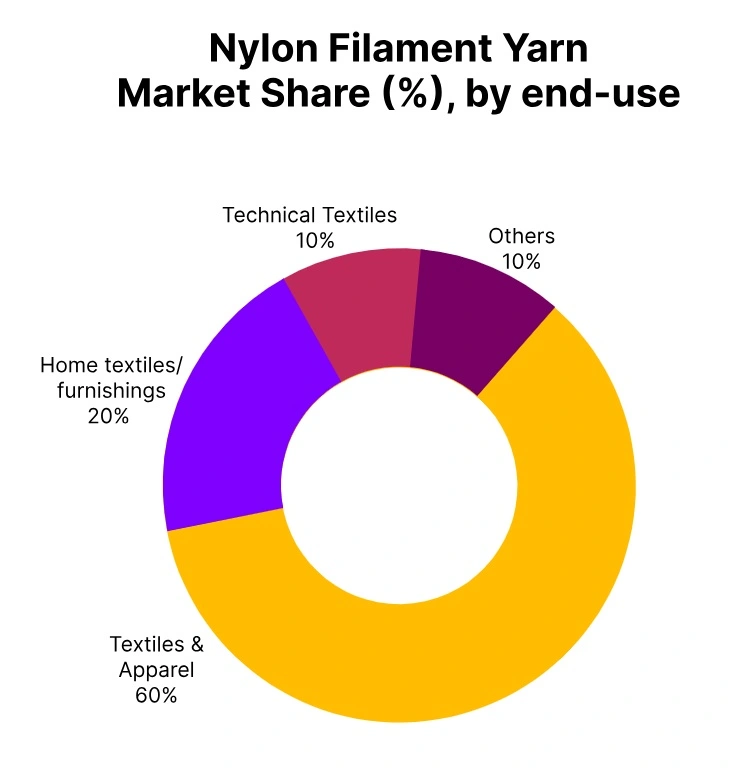
nylon filament yarn market share end use

Historically, several events have caused significant fluctuations in Nylon Filament Yarn (nfy) prices

Russia Ukraine War & Global Energy Crisis (2022–2023) 

The outbreak of the Russia Ukraine conflict in early 2022 triggered a surge in natural gas and Naphtha prices, both critical for upstream production of Caprolactam and Adipic Acid. These inputs saw production costs rise by 30 to 50 percent, affecting Nylon chip and ultimately Nylon Filament Yarn prices. Major producers in Europe, including BASF’s Ludwigshafen site, either reduced operating rates or shut down plants during winter gas shortages. Spot Caprolactam prices reached multi year highs, and Nylon Filament Yarn prices rose by over 25 percent by the third quarter of 2022. Although partial relief came in early 2023 with redirected Ammonia and Caprolactam flows from the United States and the Middle East, continued freight issues and elevated energy surcharges kept prices well above pre conflict levels. 

US China Trade War & Section 301 Tariffs (2018–2020) 

In 2018, the United States imposed Section 301 tariffs ranging from 10 to 25 percent on Chinese imports, including key Nylon intermediates such as Adipic Acid and Hexamethylene Diamine. Anticipating cost increases, importers in North America and Europe front loaded purchases, driving up feedstock prices by around 15 percent. Chinese Nylon chip exporters subsequently diverted surplus to Southeast Asia, resulting in regional oversupply and a 5 to 10 percent drop in Nylon Filament Yarn prices in early 2019. Though tariffs eventually relaxed and alternate sources emerged, the event reshaped global sourcing and logistics strategies and introduced a period of price instability through mid-2020. 

China’s Environmental Crackdowns & Dual Control Energy Policy (2016–2018) 

Between 2016 and 2018, the Chinese government intensified environmental audits and implemented dual control policies aimed at limiting energy consumption and emissions, particularly in high polluting industries including Nylon intermediates such as Caprolactam and Adipic Acid. These measures led to the temporary shutdown of several Nylon chip and upstream chemical plants, especially in provinces like Jiangsu and Shandong. The resulting supply tightness pushed raw material prices higher, leading to a 10 to 15 percent increase in Nylon Filament Yarn prices across Asia during key audit phases. At the same time, downstream converters faced delivery delays and increased conversion costs due to limited polymer availability. Although supply stabilized over time, these controls ushered in a new norm of stricter compliance costs and occasional production constraints that continued to influence pricing and plant operations in subsequent years. 

Why Price Watch™?

Price Watch™ is your trusted resource for tracking global nylon filament yarn (nfy) price trends. Our platform delivers real-time data and expert analysis, offering deep insights into the key factors driving price fluctuations in the nylon filament yarn (nfy) market. By monitoring critical events such as geopolitical tensions, supply chain disruptions, and economic shifts, Price Watch™ keeps you fully informed of market dynamics.

In addition, Price Watch™ provides detailed forecasts and updates on production capacities, enabling you to anticipate market changes and make well-informed decisions. With Price Watch™, you gain a competitive edge in understanding all the elements that influence nylon filament yarn (nfy) prices worldwide. Stay ahead of the curve with Price Watch’s™ reliable, accurate, and timely nylon filament yarn (nfy) market data.

Track Price Watch's™ nylon filament yarn (nfy) price assessment on a weekly basis since 2015 onwards, along with short-term forecasts, and get access to the detailed report in a downloadable format.

Nylon Filament Yarn (nfy) Market Price Trend published by Price Watch™ reflect prevailing spot market conditions, derived from independent research, verified trade inputs, and proprietary market intelligence as of the publication date. Prices are published on the specified Incoterm and represent indicative base market levels, exclusive of applicable taxes, VAT, duties, tariffs, and other statutory charges. Actual transaction values may vary depending on volume, credit terms, contractual structure, and other negotiated conditions. Market prices are inherently subject to volatility, liquidity dynamics, regulatory changes, and evolving trade activity. The information provided is for reference and benchmarking purposes only and does not constitute an offer, recommendation, or guarantee of transactional outcomes. Users should exercise independent commercial judgment and assess their specific contractual, regulatory, tax, and application requirements before making business decisions. Price Watch™ assumes no liability for decisions taken based on this information.

The pricing of Nylon Filament Yarn is primarily driven by the costs of Caprolactam or Adipic Acid and Hexamethylene Diamine—the core monomers—and the energy required for melt spinning. Feedstock availability, plant operating rates, and maintenance turnarounds also influence raw‑material pricing. Transportation expenses and global supply‑chain disruptions further affect landed yarn costs.

When Caprolactam or energy costs rise, manufacturers typically pass those higher expenses through to yarn prices. Conversely, if feedstock contracts soften or energy rates stabilize, producers can offer more competitive yarn pricing. Extended plant shutdowns or feedstock oversupply can introduce additional volatility.

Buyers should watch developments in sustainable bio‑based Nylon, advances in recycling technologies, and shifts in technical textile demand (such as automotive or medical applications). Trade policies, regional capacity expansions, and currency movements (for example USD‑INR for import pricing) also play a critical role in supply and cost dynamics.

Nylon Filament Yarn is a continuous synthetic yarn made from polyamide polymers, mainly Nylon 6 or Nylon 66. It is used in hosiery, sportswear, swimwear, sewing thread, industrial fabrics, tyre cord, carpets, and technical textiles because of its strength, elasticity, and abrasion resistance.

Its price directly affects the cost of fabric, apparel, and industrial textile production. Buyers in knitting, weaving, and technical textile segments watch Nylon Filament Yarn prices closely because even small changes can affect margins and export competitiveness.

Prices are mainly driven by feedstock costs, polymer chip prices, operating rates, demand from textile and industrial users, and import-export trends. Currency movement, freight, and seasonal buying patterns also play a role.

The yarn is produced from Nylon polymer chips, usually Nylon 6 or Nylon 66. Since those chips come from petrochemical feedstocks, movement in upstream raw material costs quickly passes into yarn pricing.

The biggest demand comes from textiles, especially hosiery, innerwear, sportswear, and stretch fabrics. Industrial users also buy it for sewing thread, tyre reinforcement, carpets, fishing nets, and performance fabrics.

Nylon 66 filament yarn is usually priced higher because its raw material chain is more complex and it offers higher heat resistance and mechanical performance. Nylon 6 filament yarn is more common in general textile applications and often sees broader market availability.

Finer deniers, higher filament counts, and specialized grades such as bright, semi-dull, or dope-dyed yarns often cost more. The final price also depends on strength, elongation, uniformity, and processing suitability.

Demand often improves before active apparel production cycles, especially for stretch fabrics, sportswear, and winter-linked textile planning. Industrial demand can also rise with stronger orders from carpets, sewing thread, and technical textile sectors.

Regional prices change based on local chip availability, freight costs, import dependence, labour and energy expenses, and downstream textile demand. Markets with strong domestic production usually see steadier pricing than import-driven regions.

When polyester yarn prices weaken, some buyers shift procurement away from nylon where possible. Nylon Filament Yarn pricing is also influenced by demand substitution in fabrics that can use either synthetic fibre.

Yes. Any disruption in nylon chip supply or filament yarn production can tighten availability quickly. Since many textile buyers work on short inventory cycles, even brief outages may lead to price spikes.

Specialized market intelligence platforms track supplier offers, regional price levels, and market movement across major trade routes. Price Watch™ helps buyers follow Nylon Filament Yarn pricing, supply conditions, and market direction.