Sodium Lauryl Ether Sulfate (sles) Price Trend and Forecast

UNSPC code: 51473905
|
Weekly Update
|
Historical Data Since 2015
|
Forecast for 2026

sodium lauryl ether sulfate (sles) Price Trends by Country

inIndia
cnChina
myMalaysia
aeUnited Arab Emirates
vnVietnam
usUnited States

Global sodium lauryl ether sulfate (sles) Spot Market Prices, Trend Analysis and Forecast

Price-Watch™ provides price assessments for Sodium Lauryl Ether Sulfate across top trading regions:

Asia-Pacific

  • Sodium lauryl ether sulfate (SLES) Active Matter (70%) FOB Nhava Sheva, India
  • Sodium lauryl ether sulfate (SLES) Active Matter (70%) FOB Qingdao, China
  • Sodium lauryl ether sulfate (SLES) Active Matter (70%) CIF Penang (India), Malaysia
  • Sodium lauryl ether sulfate (SLES) Active Matter (70%) CIF Haiphong (China), Vietnam


Middle East

  • Sodium lauryl ether sulfate (SLES) Active Matter (70%) CIF Jebel Ali (India), United Arab Emirates


North America

  • Sodium lauryl ether sulfate (SLES) Active Matter (70%) CIF Houston (China), USA


Note:
In assessments structured as CIF [Importing Port] (Exporting Country), the country mentioned in brackets indicates the primary origin of supply (exporting country), while the named port refers to the destination port in the importing country. Other Incoterms (FOB, FD, EXW, etc.) should be interpreted in accordance with standard international trade definitions.


Sodium lauryl ether sulfate (SLES) Price Trend Q1 2026

In Q1 2026, there are several regions in the world where SLES prices increased while others decreased. Some regions where price increases are observed include China, India, and the USA, owing to the increased demand from personal care products, household cleaners, and industrial applications.

Other regions, including Malaysia and UAE, who are importers of Indian products, showed fluctuations in prices due to lower demand in the textiles and cleaning industry sectors. Geopolitical issues, especially those between Iran and Israel, affected production costs, thereby causing regional changes in prices.

The overall supply is relatively stable but conservative purchasing trends and minimal restocking efforts in certain regions influenced the global SLES market.

India: Sodium lauryl ether sulfate (SLES)  Export prices FOB Nhava Sheva, India; Grade- Active Matter (70%)

The SLES price in India in Q1 2026 showed an increase of 1.5% against the price of the prior quarter. The SLES price trend in India shows that due to continued demand from the personal care and cleaning industry, the purchase trends have been cautious with respect to the consumption levels across major sectors.

In India, SLES price in March 2026 show an increase of 22% over February 2026. The SLES price trend in India has been affected significantly due to the political scenario globally, especially with the Iran-Israel dispute. The price hike has been caused by higher costs of raw materials and manufacturing processes. This has resulted in a substantial upward trend in prices backed by high sectoral demands.

China: Sodium lauryl ether sulfate (SLES) Export prices FOB Shanghai, China; Grade- Active Matter (70%)

As of Q1 2026, the SLES price in China has risen by 5% relative to the preceding quarter, fuelled by robust demand from the personal care and cleaning segments. The SLES price trend in China has been characterized by a relatively stable business climate underpinned by consistent consumer spending in major industries, despite conservative purchasing approaches that have tempered the growth in prices.

In China, SLES prices in March 2026 have witnessed a 16% increase compared to February, owing to escalating raw material prices and growing production costs. The SLES price trend in China has been notably affected by geopolitical strife, including the Iran-Israel feud, leading to logistical disruptions and inflated input prices, thereby contributing to a sharp rise in prices.

Malaysia: Sodium lauryl ether sulfate (SLES) Import prices CIF Penang, Malaysia; Grade- Active Matter (70%)

In Q1 2026, the SLES price in Malaysia has been reduced by 1%, largely owing to the lower demands of the cleaning and personal care segments. The SLES price trend in Malaysia has shown that supply levels are stable and backed by supplies from India. Additionally, conservative buyer behavior and minimal purchasing activities have led to the price reduction.

In Malaysia, SLES prices in March 2026 have experienced a remarkable increase of 19% from February, as high costs of raw materials and new market dynamics have prevailed. The SLES price trend in Malaysia has shown a significant rise, which has been highly affected by geopolitical issues, especially the Iran-Israel dispute, which has caused higher production and supply expenses.

UAE: SLES Import prices CIF Jebel Ali, United Arab Emirates; Grade- Active Matter (70%)

According to Price-Watch™, in Q1 2026, SLES prices in the UAE (importing from India) increased by 2%, driven by consistent demand from the personal care and cleaning sectors. While supply remained stable, cautious procurement strategies and limited restocking led to the price hike.

In the UAE, SLES prices in March 2026 surged by 29%, due to rising crude oil prices and geopolitical tensions, particularly the Iran-Israel conflict, which escalated production costs. The overall SLES price trend in the UAE showed a significant rise, propelled by strong demand and higher production costs, influenced by external market dynamics.

Vietnam: Sodium lauryl ether sulfate (SLES) Import prices CIF Haiphong, Vietnam; Grade- Active Matter (70%)

In Q1 2026, SLES prices in Vietnam (importing from China) rose by 5%, supported by steady demand from the cleaning and personal care sectors. The market remained stable, with consistent consumption from key industries.

In Vietnam, SLES prices in March 2026 increased by 15%, driven by higher raw material costs and geopolitical tensions, particularly the Iran-Israel conflict, which impacted production costs and supply availability.

The SLES price trend in Vietnam reflected broader market conditions, showing a notable increase due to global supply chain disruptions and price adjustments.

USA: Sodium lauryl ether sulfate (SLES) Import prices CIF Houston, USA; Grade- Active Matter (70%)

In Q1 2026, SLES prices in the USA (importing from China) increased by 4.5driven by steady demand from the personal care and cleaning sectors. Despite stable supply conditions, cautious buying behavior and limited procurement activity led to moderate price growth.

In the USA, SLES prices in March 2026 surged by 15%, influenced by higher production costs resulting from rising raw material prices and geopolitical tensions, particularly the Iran-Israel conflict.

The SLES price trend in the USA reflected stronger demand, with continued upward pressure on prices due to external market factors, including increased production costs and global supply chain disruptions.

Sodium Lauryl Ether Sulfate (SLES) Price Trend Analysis: Q4 2025

The global market for SLES in Q4 2025 has exhibited a fluctuating trend with prices experiencing rises to falls in different geographic locations. While price hikes are witnessed in Asia because of stable demand from the personal care and cleaning products industry, falling prices occurred in the UAE, Malaysia, and Vietnam because of weak demand from the textile and cleaning industry respectively.

Nevertheless, it could be said that at this stage, the SLES market has been quite balanced due to stable supply levels and prudent procurement strategies on the part of purchasers. Indeed, the weakening of prices towards the end of December 2025 in many regions could be explained by restricted restocking activity and decreased spot availability.

India: SLES Export prices FOB Nhava Sheva, India; Grade- Active Matter (70%)

The SLES price in India in Q4 2025 witnessed a slight rise of 0.2% when compared with the previous quarter owing to consistent demand from sectors like personal care and cleaning. The SLES price trend in India is characterized by stable supply from Chinese imports whereas the cautious attitude towards purchases and procurement has contributed to slow rises in price.

In India, SLES prices in December 2025 witnessed a decline of 1% as compared to November, mostly due to the reduced level of short-term restocking and lower spot trading. The SLES price trend in India reflects that there is a cautious approach towards market purchases and procurement in the latter part of the quarter.

China: SLES Export prices FOB Shanghai, China; Grade- Active Matter (70%)

SLES prices in China for Q4 2025 have seen a rise of 3.5% relative to the preceding quarter due to sustained demand from personal care products and cleaning materials segments. SLES price trend in China has been characterized by healthy demand from various consumption sectors despite cautious purchasing patterns and minimal procurement levels.

In China, SLES price in December 2025 fell by 2% relative to November due to limited restocking activity and limited availability in the spot market. The SLES price trend in China revealed a relatively balanced market environment in which constant demand is countered by prudent purchasing approaches and supply factors, leading to moderate price fluctuations at the end of the quarter.

Malaysia: SLES Import prices CIF Penang, Malaysia; Grade- Active Matter (70%)

As per Q4 2025, the SLES prices in Malaysia have witnessed a fall by 1.5%, mainly owing to poor demand from the cleaning and personal care applications. With regards to the SLES price trend in Malaysia, there is stable availability backed by imports from India; however, conservative buying patterns and sluggish buying activities have led to lower prices.

In Malaysia, SLES prices in December 2025 have fallen by 2% as compared to the previous month on account of limited restocking activities, among others. In Malaysia, the SLES price trend has witnessed sustained weakness in market conditions, where conservative buying policies and poor demand trends have driven down price levels during the specified time frame.

UAE: SLES Import prices CIF Jebel Ali, United Arab Emirates; Grade- Active Matter (70%)

According to Price-Watch™, in Q4 2025, SLES prices in the UAE (importing from India) decreased by 1.5%, driven by weaker demand from the personal care and cleaning industries. While supply conditions remained stable, cautious buying behavior and limited procurement activity led to the price decline.

The overall SLES price trend in the UAE reflected the broader softness observed in other regions, with reduced consumption in key sectors such as textiles and cleaning products. In the UAE, SLES prices in December 2025 fell by 1.5%, impacted by minimal short-term restocking and reduced spot availability.

This decline highlighted the continued subdued market conditions, with cautious procurement strategies maintaining downward pressure on prices throughout the quarter.

Vietnam: SLES Import prices CIF Haiphong, Vietnam; Grade- Active Matter (70%)

In Q4 2025, SLES prices in Vietnam (importing from China) increased by 0.3%, supported by steady demand from cleaning and personal care industries. Despite stable supply conditions, cautious buying behavior and limited procurement activity contributed to modest price growth.

In Vietnam, SLES prices in December 2025 decreased by 2%, influenced by reduced short-term restocking efforts and lower spot availability. The overall SLES price trend in Vietnam followed the general regional pattern, reflecting soft demand conditions and cautious procurement strategies throughout the quarter, leading to a decline in prices by the end of the year.

USA: SLES Import prices CIF Houston, USA; Grade- Active Matter (70%)

In Q4 2025, SLES prices in the USA (importing from China) increased by 1.5%, driven by steady demand from the personal care and cleaning product sectors. The market saw stable supply conditions, but cautious buying behavior and limited procurement activity helped moderate the price increase.

In the USA, SLES prices in December 2025 fell by 4%, influenced by reduced availability of spot supplies and weaker demand towards the end of the quarter. The overall SLES price trend in the USA reflected market softness, with slower procurement strategies and reduced restocking efforts contributing to the downward price movement as the quarter closed.

In Q3 2025, the global Sodium Lauryl Ether Sulfate (SLES) market showed mixed price trends across regions. Countries like India and Vietnam saw price increases, while regions such as Malaysia, the UAE, and the USA experienced slight declines. The price changes were influenced by demand in industries such as cosmetics, personal care, and detergents.

In September 2025, Sodium Lauryl Ether Sulfate (SLES) prices in India and Vietnam continued to show upward trends, reflecting consistent industrial demand. Meanwhile, regions like the USA and the UAE saw reductions in prices due to lower consumption. The Sodium Lauryl Ether Sulfate (SLES) price trend in Q3 2025 highlighted regional market differences and demand shifts across key sectors.

India: Sodium Lauryl Ether Sulfate (SLES) Export prices FOB Nhava Sheva, India, Grade- Active Matter (70%).

Sodium Lauryl Ether Sulfate (SLES) prices in India increased by 1.0% in Q3 2025. This rise was driven by stable demand from the personal care, household products, and detergent industries, all of which rely heavily on SLES. India’s strong production capacity and industrial activity helped sustain the price growth. By September 2025, Sodium Lauryl Ether Sulfate (SLES) prices in India remained steady, supported by consistent demand from these key sectors.

The Sodium Lauryl Ether Sulfate (SLES) price trend in India reflected the resilience of its manufacturing and consumer goods sectors, which contributed to the moderate price increases observed throughout the quarter. India’s industrial strength and consumption patterns kept prices steady during this period.

China: Sodium Lauryl Ether Sulfate (SLES) Export prices FOB Shanghai, China, Grade- Active Matter (70%).

Sodium Lauryl Ether Sulfate (SLES) prices in China increased by 0.9% in Q3 2025, primarily driven by consistent demand from the detergent and personal care industries, which showed steady consumption of SLES. Despite global economic uncertainty, China’s domestic market continued to support price growth due to this ongoing demand.

According to Price-Watch, by September 2025, Sodium Lauryl Ether Sulfate (SLES) prices in China stayed stable, reflecting the continued consumption from key sectors.

The Sodium Lauryl Ether Sulfate (SLES) price trend in China showed moderate growth, sustained by steady industrial output and consumption in the domestic market. This stability in prices showed that key industries in China were maintaining their demand despite broader economic challenges.

Malaysia: Sodium Lauryl Ether Sulfate (SLES) Import prices CIF Penang, Malaysia, Grade- Active Matter (70%).

According to Price-Watch, Sodium Lauryl Ether Sulfate (SLES) prices in Malaysia, importing from India, saw a decrease of 0.2% in Q3 2025. This reduction was due to lower demand from key industries like personal care and detergents, which experienced slower production during the period.

Malaysia’s import prices were influenced by fluctuations in the Indian market, which impacted the overall pricing dynamics.

In September 2025, Sodium Lauryl Ether Sulfate (SLES) prices in Malaysia went on to reflect a downward trend, driven by weaker demand for consumer products and detergents. The Sodium Lauryl Ether Sulfate (SLES) price trend in Malaysia showed slight reductions during global economic challenges, signaling less consumption of SLES in the region.

UAE: Sodium Lauryl Ether Sulfate (SLES) Import prices CIF Jebel Ali, United Arab Emirates, Grade- Active Matter (70%).

Sodium Lauryl Ether Sulfate (SLES) prices in the UAE, importing from India, dropped by 0.6% in Q3 2025. This decline was mainly due to reduced demand from the personal care and detergent industries in the region. Slower industrial activity in the UAE, along with weaker consumption of SLES, contributed to the price reduction.

By September 2025, SLES prices in the UAE remained under pressure, following the downward trend seen earlier. The Sodium Lauryl Ether Sulfate (SLES) price trend in the UAE mirrored the global slowdown in demand, leading to a slight decrease in prices during the quarter. This reflected a weaker industrial landscape in the UAE for consumer products.

Vietnam: Sodium Lauryl Ether Sulfate (SLES) Import prices CIF Haiphong, Vietnam, Grade- Active Matter (70%).

Sodium Lauryl Ether Sulfate (SLES) prices in Vietnam, importing from China, rose by 1.0% in Q3 2025. This was driven by strong demand from the personal care and detergent industries, which rely on SLES for manufacturing. Vietnam’s growth in industrial output and consumption further supported the price rise.

By September 2025, Sodium Lauryl Ether Sulfate (SLES) prices in Vietnam continued to show upward momentum, reflecting ongoing demand in these key sectors. The Sodium Lauryl Ether Sulfate (SLES) price trend in Vietnam mirrored the positive growth in the Chinese market, with ongoing demand helping to support higher prices. This indicated continued industrial activity and consumption in Vietnam’s key sectors.

USA: Sodium Lauryl Ether Sulfate (SLES) Import prices CIF Houston, USA, Grade- Active Matter (70%).

Sodium Lauryl Ether Sulfate (SLES) prices in the USA, importing from China, dipped by 1.4% in Q3 2025. This reduction was due to lower demand in key industries such as personal care, cleaning products, and detergents. Despite stable import activity, reduced consumption in these sectors led to the price decline.

By September 2025, SLES prices in the USA stayed subdued, continuing the downward trend. The Sodium Lauryl Ether Sulfate (SLES) price trend in the USA reflected weaker consumption in many key industrial sectors, contributing to the slight price decrease observed throughout the quarter. This downward movement indicated challenges in the USA’s demand for SLES.

According to PriceWatch, Q2 2025 saw the Sodium Lauryl Ether Sulfate (SLES) price trend in China surge by 33.3%, reaching USD 1301 per metric ton, marking a substantial price increase. This dramatic rise was fueled by a sharp uptick in demand from key sectors such as cosmetics, cleaning, and personal care.

Supply chain disruptions, combined with a constrained supply, amplified the price hike. Global demand for SLES surged, particularly in emerging markets, further supporting the upward trend. Malaysia, importing SLES from China, recorded an 8.9% price increase, reaching USD 1716 per metric ton.

This increase reflected tightening global supply and growing demand for personal care and industrial products. Local market growth in Malaysia was buoyed by steady consumption in the hygiene and cosmetics sectors, despite ongoing global challenges. 

In Q2 2025, India’s Sodium Lauryl Ether Sulfate (SLES) price trend experienced an 8.3% increase, reaching USD 1715 per metric ton, as reported by PriceWatch. The steady demand from key sectors like personal care, cleaning, and industrial applications contributed to this continued price rise.

The domestic market remained resilient, with personal care demand being a significant driver for the SLES market. The FOB prices also showed a similar upward trend, rising by 8.2% to USD 1736 per metric ton.

The strong market growth was further supported by stable supply chains, improved manufacturing capacities, and consistent demand for SLES in consumer products, despite global uncertainties and inflationary pressures. The price growth reflected India’s growing domestic consumption and robust demand for SLES-based products. 

In Q1 2025, the Sodium Lauryl Ether Sulfate (SLES) price trend showed a strong rebound in China, with a reported 8.6% price increase, reaching USD 1007 per metric ton, according to PriceWatch. This surge was driven by recovery in demand from both domestic and international markets, particularly within the personal care and cleaning sectors.

Improved industrial production and steady demand for SLES across various formulations led to higher prices. Malaysia, which imports SLES from China, mirrored this trend, with a 7.7% price increase, reaching USD 1634 per metric ton.

The Malaysian market’s growth was also due to consistent local demand, particularly for personal care products. Rising input costs from China, along with steady domestic consumption, pushed prices higher, supporting the market’s recovery despite global uncertainties. 

The first quarter of 2025 saw a significant rebound in India’s SLES market, with a robust 11.1% price increase, reaching USD 1583 per metric ton, according to PriceWatch. This surge was driven by strong domestic demand, particularly in personal care products and household cleaning items, as well as improved export opportunities.

The recovery in the global market and steady local consumption supported the price growth. Additionally, rising input costs and logistical improvements played a role in further pushing prices upwards.

The FOB prices also saw a rise of 10.8%, reaching USD 1618 per metric ton, reflecting the continued upward trend in the Indian market for SLES, largely driven by stronger demand and increased manufacturing activity in the region. 

Sodium Lauryl Ether Sulfate (SLES) Price Trend Analysis: Q4 2024

In Q4 2024, the SLES price trend in China, according to PriceWatch, faced a decline of 8.5%, reaching USD 927 per metric ton, largely due to seasonal variations and weakened demand from key industrial sectors.

An oversupply in the market and a slowdown in manufacturing activities further exacerbated the drop. Logistical disruptions and global economic uncertainties contributed to reduced export demand, negatively impacting the market.

Meanwhile, Malaysia experienced a 6.7% price increase, reaching USD 1518 per metric ton, driven by consistent local demand in personal care and cleaning industries.

Despite weaker global market conditions, the Malaysian market benefited from overall demand stability, allowing prices to rise even in a globally uncertain environment. 

In Q4 2024, India’s SLES market experienced a significant price increase of 7.4%, reaching USD 1425 per metric ton, as reported by PriceWatch. This surge was driven by the continued demand in the personal care and cleaning sectors, which showed resilience despite global economic challenges.

The price increase was also supported by higher input costs and slight supply constraints. India’s local consumption continued to rise, particularly in the personal care industry, where SLES is a key ingredient in products like shampoos and body washes.

The sles FOB prices mirrored the market trend, rising by 7.2% to USD 1460 per metric ton. The overall price hike in India was attributed to increased demand coupled with supply-side pressures. 

According to PriceWatch, Q3 2024 saw significant price fluctuations in the SLES price trend, particularly in China, where prices surged by 21.1%, reaching USD 993 per metric ton. This sharp increase was attributed to strong demand from both domestic industries and international export markets.

The cosmetics and cleaning sectors, in particular, experienced robust growth, leading to upward pressure on prices. Supply chain constraints and logistical challenges further supported the price hike. Malaysia, importing SLES from China, recorded a 1.3% price increase, reaching USD 1423 per metric ton.

Although China’s prices surged, Malaysia’s increase remained more modest due to stable local demand and relatively stable availability of SLES. Local demand for personal care products helped mitigate the impact of global price volatility. 

In Q3 2024, the Sodium Lauryl Ether Sulfate (SLES) market in India saw a more moderate price increase of 1.9%, reaching USD 1327 per metric ton. The PriceWatch data indicated that while demand remained stable in key sectors such as personal care and cleaning, the pace of price growth decelerated compared to earlier quarters.

The slower rate of increase was partly due to some market adjustments and the stabilization of supply chains. The sles FOB prices showed a similar trend with a 1.8% rise, reaching USD 1362 per metric ton, reflecting less volatile pricing dynamics.

While demand remained steady, both local manufacturers and consumers began to adjust to more stable market conditions, leading to a more modest price increase. 

In Q2 2024, PriceWatch reported a 1.8% price increase, reaching USD 836 per metric ton, for SLES in China, driven by steady demand from the cosmetics and household cleaning sectors. The supply chain also began to stabilize, supporting this price uptick.

However, the growth remained subdued due to lingering concerns over global economic conditions, which dampened overall consumption. Malaysia, importing SLES from China, experienced a more pronounced 5.8% price increase, reaching USD 1405 per metric ton.

This surge was attributed to higher domestic demand for personal care products, along with the recovery of the supply chain. As local manufacturers faced rising raw material costs, they passed these costs on to consumers, especially within the cosmetics and hygiene sectors. 

In Q2 2024, India saw a more notable 5.8% price increase, reaching USD 1302 per metric ton, in the SLES market, driven by strong demand in both the personal care and household cleaning sectors.

According to PriceWatch, the rise was supported by a recovery in local manufacturing activity and improved consumption patterns across multiple industries.

The supply chain, which had faced some disruption earlier, showed signs of stabilizing, further contributing to the price growth. The sles FOB prices saw a similar rise of 5.7%, reaching USD 1337 per metric ton, in line with the overall market trend.

The increase reflected the ongoing steady demand within India’s domestic market for SLES, especially in sectors like cosmetics, where demand continued to grow. 

According to PriceWatch, the SLES price trend in Q1 2024 showed mixed trends in China and Malaysia. China experienced a 3.9% price decline, reaching USD 821 per metric ton, driven by weakened demand from key sectors such as detergents and personal care.

Domestic industrial activity slowed down, and export demand was lower, contributing to the price drop. Conversely, Malaysia, which imports SLES from China, saw a moderate 2.1% price increase, reaching USD 1328 per metric ton.

This rise was supported by steady demand from the personal care and cleaning sectors, where SLES remains a vital ingredient. Despite challenges in China, the Malaysian market benefited from stable local consumption, reflecting steady demand in key industries, especially in personal care. 

In Q1 2024, the Sodium Lauryl Ether Sulfate (SLES) market in India saw a modest 1.3% rise, reaching USD 1231 per metric ton, driven by stable demand from the domestic personal care and cleaning sectors.

Despite some challenges in global markets, local consumption remained relatively stable, especially in the personal care sector. The demand for SLES was bolstered by consistent consumer activity, which led to this mild price increase.

Additionally, the market saw some support from raw material cost adjustments, although the overall demand for SLES remained moderate due to factors like ongoing global economic uncertainties.

The sles FOB prices also mirrored this trend, with a similar 1.3% price increase, reaching USD 1266 per metric ton, reflecting the market dynamics in India. 

Technical Specifications of Sodium Lauryl Ether Sulfate (sles) Price Trends

Product Description

Sodium Lauryl Ether Sulfate (SLES) is a colourless to pale yellow liquid widely used as a surfactant and intermediate in various industrial applications. It plays a crucial role in the production of cleaning agents, detergents, shampoos, and soaps, providing foaming and cleansing properties.

SLES is also utilized in the production of emulsifiers, personal care products, and household products. Its feedstock includes ethylene oxide and sodium bisulfate, and it is commonly used in the formulation of skin and hair care products.

Identifiers and Classification:

  • CAS No – 68891-38-3
  • HS Code – 34021190
  • Molecular Formula – C₁₂H₂₅NaO₄S
  • Molecular Weight (in gm/mol) – 288.38 g/mol


Sodium Lauryl Ether Sulfate Synonyms:

  • Sodium Laureth Sulphate


Sodium Lauryl Ether Sulfate Grades Specific Price Assessment:

  • SLES (Active matter =70%)


Sodium Lauryl Ether Sulfate Global Trade and Shipment Terms

  • Quotation Terms (Product & Country Specific): 25-28 MT, 15-20MT
  • Packaging Type (Product & Country Specific): Drum


Incoterms Referenced in Sodium Lauryl Ether Sulfate Price Reporting

Shipping Term  Location  Definition 
Ex- Bharuch  Bharuch, India  SLES domestically traded price in India 
FOB Nhava Sheva  Nhava Sheva, India  SLES Export Price from India 
FOB Qingdao  Qingdao, China  SLES Export Price from China 
CIF Penang (India)  Penang, Malaysia  SLES Import price in Malaysia from India 
CIF Jebel Ali (India)  Jebel Ali, United Arab Emirates 


SLES Import price in UAE from India 
CIF Haiphong (China)  Haiphong, Vietnam  SLES Import price in Vietnam from China 
CIF Houston (China)  Houston, USA  SLES Import price in USA from China 

*Quotation Terms refers to the quantity range specified for the Sodium Lauryl Ether Sulfate being quoted or offered in a commercial transaction.

**Packaging Type refers to standard packaging size commonly used for Sodium Lauryl Ether Sulfate packing, ease of handling, transportation, and storage in industrial and commercial applications.

Key Sodium Lauryl Ether Sulfate Manufacturers and their brands

Brand Name  Manufacturer 
Texapon  BASF SE 
N/A  Godrej Group  
N/A  Galaxy Surfactants 
N/A  Hunan Resun Auway Industrial Co., Ltd. 

Sodium Lauryl Ether Sulfate (sles) Industrial Applications

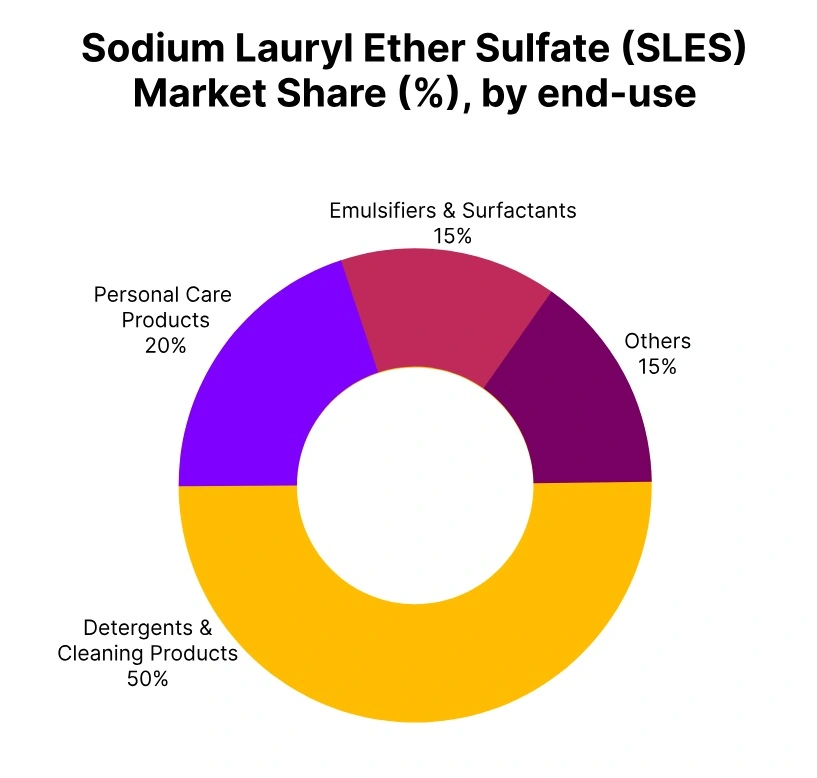
sodium laurl ether sulfate market share end use

Historically, several events have caused significant fluctuations in Sodium Lauryl Ether Sulfate (sles) prices

  • COVID-19 Pandemic (2020): The initial lockdowns resulted in a decline in demand for SLES as various industries slowed down. However, the pandemic underscored the importance of hygiene and personal care products, leading to a dramatic surge in demand for SLES. By mid-2021, prices rose by approximately 20% as manufacturers responded to the increased need for cleaning agents and personal care items. 
  • U.S.-China Trade War (2018-2019): The imposition of tariffs on chemicals had a noticeable impact on the SLES market. Rising production costs and disruptions in supply chains created significant challenges for manufacturers, resulting in price fluctuations of around 10-15%. 
  • Global Supply Chain Disruptions (2017-2018): Natural disasters and geopolitical tensions impacted the availability of essential raw materials for SLES production, particularly in regions like China and Southeast Asia. These disruptions led to a temporary price increase of about 15-20% due to supply constraints. 


These events underscore the SLES market’s vulnerability to global disruptions and highlight the need for continuous monitoring of supply-demand dynamics.

Why Price Watch™?

Price Watch™ is your trusted resource for tracking global sodium lauryl ether sulfate (sles) price trends. Our platform delivers real-time data and expert analysis, offering deep insights into the key factors driving price fluctuations in the sodium lauryl ether sulfate (sles) market. By monitoring critical events such as geopolitical tensions, supply chain disruptions, and economic shifts, Price Watch™ keeps you fully informed of market dynamics.

In addition, Price Watch™ provides detailed forecasts and updates on production capacities, enabling you to anticipate market changes and make well-informed decisions. With Price Watch™, you gain a competitive edge in understanding all the elements that influence sodium lauryl ether sulfate (sles) prices worldwide. Stay ahead of the curve with Price Watch’s™ reliable, accurate, and timely sodium lauryl ether sulfate (sles) market data.

Track Price Watch's™ sodium lauryl ether sulfate (sles) price assessment on a weekly basis since 2015 onwards, along with short-term forecasts, and get access to the detailed report in a downloadable format.

Sodium Lauryl Ether Sulfate (sles) Market Price Trend published by 𝐏𝐫𝐢𝐜𝐞 𝐖𝐚𝐭𝐜𝐡™ reflect prevailing spot market conditions, derived from independent research, verified trade inputs, and proprietary market intelligence as of the publication date. Prices are published on the specified Incoterm and represent indicative base market levels, exclusive of applicable taxes, VAT, duties, tariffs, and other statutory charges. Actual transaction values may vary depending on volume, credit terms, contractual structure, and other negotiated conditions. Market prices are inherently subject to volatility, liquidity dynamics, regulatory changes, and evolving trade activity. The information provided is for reference and benchmarking purposes only and does not constitute an offer, recommendation, or guarantee of transactional outcomes. Users should exercise independent commercial judgment and assess their specific contractual, regulatory, tax, and application requirements before making business decisions. 𝐏𝐫𝐢𝐜𝐞 𝐖𝐚𝐭𝐜𝐡™ assumes no liability for decisions taken based on this information.

The cost of Sodium Lauryl Ether Sulphate (SLES) is affected by various factors, such as the prices of raw materials, manufacturing processes, and overall market demand.

The primary raw materials for SLES production, such as palm oil or coconut oil, can fluctuate in price due to agricultural conditions and global trade policies. Additionally, the manufacturing process can impact the cost; more efficient production methods may lower prices.

Market demand for SLES in industries such as personal care, household cleaning, and industrial applications also plays a significant role. Suppliers may adjust prices based on trends and shifts in demand, making it essential to monitor these factors for optimal procurement.

To ensure competitive pricing for Sodium Lauryl Ether Sulphate (SLES), it’s crucial to adopt a strategic sourcing approach. Begin by conducting market research to identify multiple suppliers and their pricing structures.

Engaging in long-term contracts can provide stability in pricing and supply. Furthermore, exploring bulk purchasing can help you benefit from economies of scale.

Regularly reviewing supplier performance and maintaining open communication can also foster better pricing negotiations. Finally, staying updated on market trends and potential disruptions can help you make informed sourcing decisions, allowing you to capitalize on favourable pricing.

Establishing long-term contracts for Sodium Lauryl Ether Sulphate (SLES) offers several benefits, including price stability and predictable supply. Long-term agreements often lead to better pricing due to the commitment from both parties, which can help mitigate the impact of market fluctuations.

Additionally, having a reliable supplier can ensure consistent quality and availability, reducing the risk of production disruptions. Procurement heads should also consider negotiating favourable terms, such as volume discounts and flexible delivery schedules, to maximize value in their long-term contracts.

Sodium Lauryl Ether Sulfate (SLES) is a widely used surfactant in the production of detergents, personal care products, and industrial cleaners. It is a key ingredient in shampoos, body ishes, dishishing liquids, and laundry detergents due to its excellent foaming and cleansing properties.

SLES is also used in the formulation of emulsifiers and is important in industries such as textiles, agriculture, and oil refining. Its pricing directly impacts the cost of cleaning agents, personal care products, and various industrial applications.

As a result, the price of Sodium Lauryl Ether Sulfate is closely monitored by manufacturers of cleaning products, personal care goods, and industries where surfactants are used for various formulations.

The demand for SLES is also influenced by consumer preferences, regulatory factors, and trends towards natural or sulfate-free products in the personal care sector. Price-Watch™ tracks these prices to help businesses and consumers understand and stay updated with the market trends.

SLES prices vary by region and delivery basis. Prices are typically quoted per metric ton and change based on supply, demand, feedstock costs, and production capacity. Price-Watch™ provides real-time price assessments across different global markets to help buyers and sellers make informed decisions.

Sodium Lauryl Ether Sulfate (SLES) prices fluctuate due to various factors, including changes in raw material costs (such as fatty alcohols), energy price shifts, and production capacity utilization. Demand from industries like personal care, household cleaning products, textiles, and industrial cleaners significantly influences price trends.

Seasonal demand, especially in personal care and cleaning products, inventory levels, transportation and logistics costs, and competition with alternative surfactants also affect pricing.

Additionally, trade policies, tariffs, and fluctuations in the availability of key raw materials, such as fatty alcohols and ethoxylated products, play an important role in shaping price movements. Plant turnarounds and maintenance schedules, along with broader economic conditions, can further add to market volatility.

Recent market trends have been impacted by fluctuations in raw material costs, supply chain disruptions, and changing consumer preferences, particularly the shift toward sulfate-free products in the personal care sector, which has affected SLES pricing dynamics.

The largest consumers of Sodium Lauryl Ether Sulfate (SLES) are manufacturers in the personal care, household cleaning, and detergent industries.

SLES is a key ingredient in products such as shampoos, body ishes, facial cleansers, and dishishing liquids, making it essential to the production of various personal care and cleaning formulations.

Significant demand also comes from the textile industry, where it is used in fabric treatments, and the agricultural sector, where it is utilized in certain pesticide formulations. Additionally, SLES is used in industrial applications like oil refining and water treatment.

Its ability to act as a foaming agent, emulsifier, and surfactant makes it critical in the formulation of cleaning products, personal care items, and other industrial chemicals. Price-Watch™ analyzes demand patterns across these diverse industries to provide valuable insights into market trends.

Sodium Lauryl Ether Sulfate (SLES) is primarily produced through the ethoxylation of lauryl alcohol, a process where lauryl alcohol reacts with ethylene oxide in the presence of a catalyst to form SLES.

Lauryl alcohol is typically derived from natural fats and oils or produced through petrochemical processes, while ethylene oxide is derived from petrochemical sources. The production of SLES involves the sulfation of the ethoxylated lauryl alcohol using sulfur trioxide or chloro-sulfonic acid.

Sustainable production methods are being explored, such as using bio-based feedstocks and renewable energy sources, in line with growing consumer demand for eco-friendly and sustainable chemicals.

Major chemical companies involved in SLES production typically operate integrated facilities for both fatty alcohol production and ethoxylation, serving industries such as personal care, household cleaning, textiles, and industrial applications, where SLES is used as a key surfactant.

Sodium Lauryl Ether Sulfate (SLES) trade is influenced by production capacity, raw material availability, and regional demand from industries such as personal care, household cleaning, textiles, and industrial cleaning products.

Countries with established petrochemical and surfactant manufacturing infrastructure, like China, India, and Brazil, play significant roles in the global SLES market.

Additionally, regions like Europe and North America, with their large personal care and cleaning product industries, are major consumers and exporters of SLES.

Export volumes fluctuate depending on production capacity, the availability of fatty alcohols, ethylene oxide, and sulfuric acid, as well as seasonal demand in cleaning and personal care sectors. Shipping costs, logistical challenges, and regional supply-demand dynamics also impact trade flows.

Furthermore, competition from alternative surfactants, changes in trade policies, tariffs, and market-specific pricing conditions can all influence global SLES trade patterns.

Price-Watch™ tracks production levels, export flows, and trade patterns to help businesses understand global supply chains and identify sourcing opportunities.

Supply and demand for Sodium Lauryl Ether Sulfate (SLES) generally align, but regional shortages can occur due to production disruptions, such as plant shutdowns, raw material supply constraints, and transportation issues.

Planned and unplanned maintenance in key production facilities, limitations in the availability of fatty alcohols or ethylene oxide, and shifts in the types of petrochemicals produced can temporarily disrupt supply.

Additionally, sudden spikes in demand from industries such as personal care, cleaning products, and textiles can strain available supply. Market tightness can also occur if there are fluctuations in the availability of key raw materials, or if logistical issues hinder the timely delivery of products.

Supply shortages may lead to price volatility, particularly when demand is high in seasonal peaks or when there are disruptions in the supply chain.

Price-Watch™ monitors these supply-demand imbalances to alert the market about potential shortages or surpluses, helping businesses stay informed about market conditions and make proactive sourcing decisions.

Sodium Lauryl Ether Sulfate (SLES) prices vary based on application grades, delivery terms, and contract structures. SLES is produced in different grades based on purity and concentration, with varying applications in personal care products, household cleaning items, and industrial cleaners.

Lower-grade SLES (typically 25-28% active matter) is commonly used in household cleaners, laundry detergents, and body ishes, while higher-grade SLES (30% and above) is used in specialized personal care formulations such as shampoos, facial cleansers, and industrial cleaning products.

Higher concentration grades tend to command premium prices due to their enhanced performance and ability to create stronger foaming and better cleansing effects.

Pricing also varies based on delivery terms (bulk shipments, drums, or IBC containers), contract types (spot vs. long-term), and geographic location, with costs influenced by transportation logistics, regional supply-demand dynamics, and raw material availability.

Price-Watch™ provides separate price assessments for different delivery bases and contract types, ensuring market transparency for businesses and consumers.

When demand for Sodium Lauryl Ether Sulfate (SLES) rises quickly, often due to increased production in personal care, cleaning products, or textile manufacturing, prices generally increase.

Suppliers may prioritize long-term contract customers, leaving spot buyers with tighter availability, longer lead times, or significantly higher prices to secure supplies. Production flexibility is limited by raw material availability, manufacturing capacity constraints, and the time required to restart idled production facilities.

Market conditions, such as seasonal demand spikes especially in the personal care and cleaning sectors or disruptions in the supply chain, can further affect availability.

In addition, factors like fluctuations in the cost of fatty alcohols or ethylene oxide, which are key raw materials for SLES, can also influence price trends and availability, making the market more volatile during periods of high demand or supply chain disruptions. Price-Watch™ captures these market dynamics in real-time.

Energy and feedstock costs are the primary drivers of Sodium Lauryl Ether Sulfate (SLES) pricing. When the prices of crude oil, fatty alcohols, or ethylene oxide rise, the cost of producing SLES also increases, as these raw materials are essential in its manufacturing process.

SLES production requires significant energy inputs, particularly during the ethoxylation and sulfation stages, making it highly sensitive to fluctuations in energy prices. The pricing of SLES is closely linked to the cost of raw materials like fatty alcohols and ethylene oxide, with changes in their prices directly impacting production costs.

Additionally, energy price fluctuations can lead to increased costs in transportation and logistics, further affecting the overall pricing of SLES in the market. This relationship is analyzed in real-time by Price-Watch™ which tracks energy costs and feedstock trends to provide accurate price assessments and market insights.

Sodium Lauryl Ether Sulfate (SLES) prices vary by region based on local production capacity, raw material availability, manufacturing infrastructure, energy costs, and regional supply-demand dynamics.

Differences in raw materials, such as fatty alcohols and ethylene oxide, influence production costs, with regions using different sources or processes affecting SLES pricing. Local energy prices, transportation costs, and logistical factors also contribute to price variations across regions.

Furthermore, the concentration of key industries like personal care, household cleaning, textiles, and industrial cleaners, as well as the volume of SLES import/export activity, plays a crucial role in shaping regional pricing trends.

Regions with more established manufacturing sectors and integrated downstream industries generally experience different pricing trends compared to regions with lower industrial concentration or limited production capacity. Price-Watch™ tracks SLES prices across all major regions to highlight these differences and provide detailed market insights.

The Sodium Lauryl Ether Sulfate (SLES) market outlook is influenced by factors such as raw material price trends (particularly fatty alcohols and ethylene oxide), production rates in key sectors, capacity expansions (including SLES production facilities), and maintenance schedules.

Demand from industries like personal care, household cleaning, textiles, and industrial cleaners are significant drivers of price trends. Growth in cleaning products, personal care formulations, and textile manufacturing also plays a crucial role in shaping market dynamics.

Changes in raw material availability, particularly fatty alcohols and ethylene oxide, along with transportation or shipping costs, can affect SLES pricing. Additionally, regional supply-demand balances, import/export activity, and broader macroeconomic conditions that impact industrial production will continue to influence the market.

Fluctuations in energy prices, regulatory changes, and consumer preferences toward more sustainable or sulfate-free products may also contribute to the price movements of SLES.

Price-Watch™ regularly publishes detailed forecasts, analyzing supply-demand patterns, seasonal trends, and economic indicators to help businesses anticipate market conditions and plan accordingly for SLES prices over the next 12 months.

Absolutely. Accurate forecasting allows you to time your purchases better, negotiate contracts more effectively, and budget more accurately. If Price-Watch™ forecasts predict a price increase in three months, you might choose to stock up now or lock in long-term contracts at current rates, potentially saving thousands of dollars.

Global events can have a significant impact on the supply and pricing of Sodium Lauryl Ether Sulfate (SLES). Disruptions such as natural disasters, accidents at production facilities, shortages in raw materials, planned and unplanned maintenance shutdowns, and geopolitical tensions affecting the petrochemical or energy markets can lead to supply shortages and price volatility.

For instance, disruptions like hurricanes affecting surfactant manufacturing plants, unplanned facility closures in key production regions, or geopolitical conflicts in areas that affect the supply of key raw materials such as fatty alcohols or ethylene oxide can cause significant market fluctuations for SLES.

Economic downturns or shifts in consumer demand, especially in the personal care, household cleaning, and textile industries, can also influence SLES pricing.

Additionally, rising energy prices and changes in trade policies or tariffs may further affect production costs, availability, and ultimately, the price of SLES. Price-Watch™ provides timely alerts when such global events affect SLES market conditions, helping businesses anticipate price fluctuations.

Price-Watch™ collects data from manufacturers, distributors, and buyers worldwide to publish regular price assessments, market reports, and forecasts for SLES. Our transparent methodology and comprehensive coverage make us a trusted source for understanding fair pricing and market trends in the SLES industry.