2-ethylhexyl Acrylate Price Trend and Forecast

UNSPC code: 12352130
|
Weekly Update
|
Historical Data Since 2015
|
Forecast for 2026

2-ethylhexyl acrylate Price Trends by Country

cnChina
inIndia
myMalaysia
idIndonesia
vnVietnam
brBrazil
phPhilippines

Global 2-ethylhexyl acrylate Spot Market Prices, Trend Analysis and Forecast

𝐏𝐫𝐢𝐜𝐞 𝐖𝐚𝐭𝐜𝐡™ provides price assessments for 2-Ethylhexyl Acrylate across top trading regions:

Asia-Pacific

  • 2-Ethylhexyl Acrylate (2-EHA) Industrial Grade (99%) FOB Klang, Malaysia
  • 2-Ethylhexyl Acrylate (2-EHA) Industrial Grade (99%) FOB Shanghai, China
  • 2-Ethylhexyl Acrylate (2-EHA) Industrial Grade (99%) CIF Tanjung Priok (Malaysia), Indonesia
  • 2-Ethylhexyl Acrylate (2-EHA) Industrial Grade (99%) CIF Haiphong (China), Vietnam
  • 2-Ethylhexyl Acrylate (2-EHA) Industrial Grade (99%) CIF Manila (China), Philippines
  • 2-Ethylhexyl Acrylate (2-EHA) Industrial Grade (99%) CIF Nhava Sheva (China), India


South America

  • 2-Ethylhexyl Acrylate (2-EHA) Industrial Grade (99%) CIF Santos (China), Brazil


Note:
In assessments structured as CIF [Importing Port] (Exporting Country), the country mentioned in brackets indicates the primary origin of supply (exporting country), while the named port refers to the destination port in the importing country. Other Incoterms (FOB, FD, EXW, etc.) should be interpreted according to standard international trade definitions.

2-Ethylhexyl Acrylate (2-EHA) Price Trend Q4 2025

In Q4 2025, the global 2-Ethylhexyl Acrylate (2-EHA) market showed a slightly firm trend across key regions, supported by stable downstream demand and balanced supply fundamentals. Prices moved within a controlled upward range as consumption from coatings, adhesives, and polymer industries remained consistent. Feedstock Acrylic Acid and 2-Ethylhexanol markets exhibited minimal volatility, allowing producers to maintain stable operating rates. Export activity from Asia, particularly China and Southeast Asia, remained steady amid manageable freight conditions. Buyers adopted cautious yet steady procurement strategies to maintain inventories. Overall, the market reflected a balanced-to-firm sentiment, with stable trade flows and gradual price improvements expected to continue into early Q1 2026.

Malaysia: 2-EHA Export Prices; FOB Klang, Malaysia; Industrial Grade (99%)

In Q4 2025, 2-EHA prices in Malaysia showed a moderate upward trend, supported by stable demand from paints, coatings, and adhesive industries. The increase was driven by consistent downstream consumption and steady export inquiries from Southeast Asian markets such as Indonesia and Vietnam. The 2-EHA price trend in Malaysia reflected balanced supply conditions, as producers maintained disciplined operating rates to avoid excess inventory buildup. Feedstock acrylic acid and 2-ethylhexanol markets remained largely stable, limiting cost fluctuations. Smooth port operations and manageable freight rates supported uninterrupted export flows. In December 2025, 2-EHA prices in Malaysia rose by 1.62% under FOB Klang, reflecting a firm market tone backed by steady regional demand.

China: 2-EHA Export Prices; FOB Shanghai, China; Industrial Grade (99%)

In Q4 2025, 2-EHA prices in China showed a slight upward movement, supported by gradual improvement in demand from coatings, adhesives, and sealants sectors. Stable production levels among major acrylate manufacturers ensured adequate supply availability, while export demand from Southeast Asia and South Asia provided additional support. The 2-EHA price trend in China reflected balanced fundamentals, with limited volatility in acrylic acid and 2-ethylhexanol feedstock markets restricting cost pressures. Market sentiment remained cautiously firm as buyers maintained controlled purchasing strategies. Logistics and port operations remained efficient, supporting consistent export flows. In December 2025, 2-EHA prices in China increased by 0.86% under FOB Shanghai, indicating a stable-to-firm market tone.

Indonesia: 2-EHA Import Prices; CIF Tanjung Priok (Malaysia); Industrial Grade (99%)

In Q4 2025, 2-EHA prices in Indonesia showed a gradual upward trend, supported by improved demand from coatings, construction chemicals, and adhesive sectors. Stable infrastructure activity and packaging demand contributed to consistent acrylate consumption. The 2-EHA price trend in Indonesia reflected balanced supply conditions, with steady import flows from Malaysia and China ensuring adequate availability. Importers maintained moderate purchasing activity to replenish inventories ahead of anticipated demand shifts. Feedstock trends remained stable, limiting cost volatility across the supply chain. Freight conditions across Southeast Asian routes remained smooth during the quarter. In December 2025, 2-EHA prices in Indonesia under CIF Tanjung Priok increased by 1.26%, reflecting a balanced-to-firm market supported by steady downstream demand.

Vietnam: 2-EHA Import Prices; CIF Haiphong (China); Industrial Grade (99%)

In Q4 2025, 2-EHA prices in Vietnam showed a slight upward movement, supported by consistent demand from coatings, adhesives, and textile finishing sectors. Stable manufacturing activity and export-oriented production helped sustain chemical consumption levels. The 2-EHA price trend in Vietnam indicated balanced supply conditions, with reliable imports from China maintaining adequate availability. Buyers continued cautious procurement strategies to manage inventory levels amid stable market conditions. Feedstock acrylic acid and 2-ethylhexanol prices remained largely steady, limiting production cost fluctuations. Trade flows remained uninterrupted with stable freight conditions. In December 2025, 2-EHA prices in Vietnam increased by 0.87% under CIF Haiphong, signalling a steady-to-firm market tone.

Brazil: 2-EHA Import Prices; CIF Santos (China); Industrial Grade (99%)

In Q4 2025, 2-EHA prices in Brazil showed a mild upward trend, supported by gradual recovery in demand from coatings, construction chemicals, and adhesive industries. Improved infrastructure activity and steady packaging demand contributed to moderate consumption growth. The 2-EHA price trend in Brazil reflected balanced supply conditions, with consistent import volumes from Asian suppliers, particularly China and Southeast Asia. Stable feedstock dynamics and manageable freight rates supported procurement activity. Market sentiment improved slightly as buyers resumed steady purchasing after earlier cautious behaviour. In December 2025, 2-EHA prices in Brazil under CIF Santos increased by 0.87%, indicating a stable-to-firm trading environment.

Philippines: 2-EHA Import Prices; CIF Manila (China); Industrial Grade (99%)

In Q4 2025, 2-EHA prices in the Philippines showed a gradual upward trend, supported by stable demand from adhesives, paints, and construction chemical sectors. Ongoing infrastructure projects and consistent packaging demand sustained acrylate consumption. The 2-EHA price trend in the Philippines reflected balanced supply dynamics, with steady import flows from China and Malaysia ensuring adequate availability. Buyers maintained moderate procurement volumes to stabilize inventory levels. Feedstock conditions remained stable, limiting production cost fluctuations. Freight rates across intra-Asia routes remained manageable, supporting trade continuity. In December 2025, 2-EHA prices in the Philippines under CIF Manila increased by 0.87%, highlighting a balanced market with gradual improvement.

India: 2-EHA Import Prices; CIF Nhava Sheva (China); Industrial Grade (99%)

In Q4 2025, 2-EHA prices in India showed a slight upward trend, supported by stable demand from coatings, sealants, and adhesive industries. Infrastructure development and steady packaging demand contributed to consistent consumption levels. The 2-EHA price trend in India reflected balanced supply conditions, with regular imports from China and Southeast Asia maintaining adequate availability. Buyers continued cautious procurement strategies to manage inventory amid stable pricing trends. Feedstock acrylic acid and 2-ethylhexanol markets showed limited volatility, restricting cost pressures. Logistics into western ports remained smooth, supporting uninterrupted supply. In December 2025, 2-EHA prices in India under CIF Nhava Sheva increased by 0.87%, reflecting a stable-to-firm market environment.

2-Ethylhexyl Acrylate Price Trend Analysis: Q4 2025

In Q22025, Chinas 2 Ethylhexyl Acrylate (2-EHA) prices declined by around 6.46% from Q1 2025, reflecting a softening in overall market sentiment. The dip followed waning post-peak demand from superabsorbent polymer and hygiene product segments, along with cautious downstream procurement by the coatings and adhesives sectors, who were working through earlier stockpiles.

Feedstock pressures, especially for Acrylic acid eased, while normalized freight movement and improved vessel availability helped reduce cost burdens. Meanwhile, healthy production rates and improved intra-regional supply flows contributed to looser spot availability, reinforcing the downward pricing tone. 

In Q22025,  according to PriceWatch, Indian 2Ethylhexyl Acrylate (2EHA) prices declined by 1.35% quarteronquarter, extending the mild correction from Q1 2025. Downstream restocking by coatings and adhesives producers softened, as buyers drew down earlier inventories rather than place fresh orders. Domestic output remained robust, while import volumes stayed limited, resulting in balanced supply conditions across key consumption hubs.

Feedstock costs for propylene and crude oil held steady, and routine port and logistics operations proceeded without disruption. Overall, the market settled into a cautiously bearish tone, with modest price easing reflecting tempered enduse demand and stable fundamentals. 

In Q12025, Chinas 2Ethylhexyl Acrylate (2EHA) prices go up 5% from Q42024. The rise was driven by broadbased restocking among superabsorbentpolymer producers gearing up for peak hygieneseason demand, alongside renewed bulk buying by coatings and adhesive manufacturers for consumergoods and automotive refinish projects.

Sustained feedstock cost inflation particularly for propylene oxide and acrylic acid filtered through to finished prices, while tighter freight capacity and higher logistics rates added further deliveredcost pressure. Although plant operating rates remained robust, earlier inventory draws and intermittent supplychain snags kept spot availability tight, resulting in a moderately firm yet somewhat volatile market tone. 

In Q1 2025, Indian 2-Ethylhexyl Acrylate (2-EHA) prices reflecting a modest 1.76% increase from Q4 2024. This moderate price rise was driven by a cautious recovery in downstream demand, particularly from coatings and adhesives sectors as buyers began restocking following the year-end slowdown.

Improved consumption sentiment, combined with steady domestic production and limited imports, tightened supply in some regions, putting mild upward pressure on prices. Feedstock costs for propylene and crude oil remained stable, and with balanced inventories and no major supply or logistics disruptions, the market experienced a gradual, yet steady price rebound in Q1 2025. 

2-Ethylhexyl Acrylate Price Trend Analysis: Q4 2024

In Q42024, 2Ethylhexyl Acrylate (2EHA) prices in China averaged USD1,500/mt, a 2.5% quarter on quarter increase driven by festive season restocking of superabsorbentpolymer producers and stronger buying from coatings and adhesive manufacturers for consumergoods packaging.

Continued economic growth in key export markets supported healthy demand, while high propylene oxide and acetic acid costs maintained upstream price support. At the same time, tight freight capacity and rising logistics rates added to delivered cost inflation, reinforcing a modestly firm market tone despite generally smooth plant operations. 

In Q4 2024, Indian 2-Ethylhexyl Acrylate (2-EHA) prices declined to approximately ₹144,462/MT, marking a 5.12% drop from Q3. This downturn was driven by year-end demand fatigue as superabsorbent-polymer and coatings producers paused purchases for maintenance and audits. Meanwhile, ample supply from increased imports and steady domestic production led to swelling inventories.

With propylene oxide and acetic acid feedstock costs remaining flat and smooth port operations, supply-side pressures outweighed any logistical or cost support, resulting in a subdued market. Looking ahead, Q1 2025 could see price stabilization or further correction, depending on downstream restocking activity and changes in feedstock costs. 

In Q32024, 2Ethylhexyl Acrylate (2EHA) prices in China averaged USD1,464/mt, down 5.5% from Q2, as the initial boost from super absorbent polymer restocking ahead of the holiday season petered out and downstream coatings and adhesives demand eased. Although tighter freight capacity and elevated transport costs provided some price support, midquarter declines in acrylic acid and nbutanol feedstock costs, together with rising regional production and completion of inventories, outweighed those pressures. Overall, the market shifted from a restockingdriven uplift to a modest correction amid balanced to slightly oversupplied conditions. 

In Q3 2024, the Indian 2-Ethylhexyl Acrylate (2-EHA) market experienced a price decline of approximately 5.13%, settling at ₹152,257.69 per metric tonne. This downturn mirrored trends observed in Acrylic Acid, influenced by synchronized demand revival and upstream cost pressures. However, the 2-EHA market faced additional challenges, including intermittent supply adjustments, logistics bottlenecks, and fluctuating feedstock costs. 

In Q22024, 2Ethylhexyl Acrylate (2EHA) prices in China averaged USD1,550/mt, marking a 3.5% rise from Q12024. The regional market mirrored broader Asian trends of initial firmness followed by downward adjustments, as cost support from crude oil and downstream feedstocks began to wane mid quarter.

Demand from hygiene polymer producers ahead of restocking cycles and increased coatings output lent upward momentum to spot values. However, inventory restocking by Chinese buyers was largely completed by late Q2, and fresh buying interest tapered off as downstream margins came under pressure. 

In Q22024, Indian 2Ethylhexyl Acrylate (2EHA) prices averaged 160,484.62/MT, up 6.58% quarter on quarter outpacing the 6% rise in domestic acrylic acid. This stronger than regional trend was driven by continued feedstock driven cost passthrough from both acrylic acid and 2ethylhexanol, frontloaded restocking amid anticipated supply volatility, intermittent plant turnarounds tightening output, logistical bottlenecks at major ports, and resilient demand from coatings, adhesives, sealants, and superabsorbentpolymer producers.

Going forward, 2EHA pricing is expected to remain sensitive to global crude and propylene movements, the timing of new capacity additions in India and China, and the recovery pace of key downstream sectors. 

In Q12024, 2Ethylhexyl Acrylate (2EHA) prices in China averaged USD1,504/mt, reflecting a 4% decline from Q42023. This downturn was driven by softer-than-anticipated recovery in domestic downstream sectors particularly pressure sensitive adhesives and specialty coatingswhere demand in key industrial regions remained subdued despite broader market stabilization in Asia.

A continued inventory destocking cycle among Chinese buyers further weighed on spot purchases, while easing feedstock costs (notably butanol) and uninterrupted production across major Asian suppliers allowed sellers to offer more competitive terms amid a balanced to slightly oversupplied market. 

In Q12024, Indian 2Ethylhexyl Acrylate (2EHA) prices averaged 150,580.77/MT, up 2.14% quarteronquarter against a largely flat to slightly declining APAC market. This rise was driven by higher upstream costs particularly from acrylic acid and 2ethylhexanol prompting cost passthrough; frontloaded restocking by distributors wary of further volatility; intermittent supply constraints due to plant turnarounds; logistical tightness at key ports; and sustained demand from coatings, adhesives, sealants, and superabsorbentpolymer segments. Looking ahead, prices are expected to track global crude and feedstock cost movements, new capacity additions in India and China, and the pace of downstream sector recovery.  

Technical Specifications of 2-ethylhexyl Acrylate Price Trends

Product Description

2-Ethylhexyl Acrylate (2-EHA) is a versatile acrylate monomer produced through the esterification of acrylic acid and 2-ethylhexanol. It offers excellent flexibility, adhesion, and weather resistance, making it a key ingredient in formulating coatings, adhesives, and sealants. Its performance characteristics can be fine-tuned by modifying formulation parameters, providing adaptability for diverse applications requiring elasticity, durability, and chemical resistance.

Identifiers and Classification:

  • CAS No -103-11-7
  • HS Code – 29161290
  • Molecular Formula – C11H20O2
  • Molecular Weight (in gm/mol) – 184.2753


2-Ethylhexyl Acrylate Synonyms:

  • 2-Ethylhexyl 2-propenoate
  • 2-Ethylhexyl prop-2-enoate


2-Ethylhexyl Acrylate (2-EHA) Grades Specific Price Assessment:

  • 2-EHA Industrial (99%) Grade Price Trend


2-Ethylhexyl Acrylate (2-EHA) Global Trade and Shipment Terms

  • Quotation Terms (Product & Country Specific): 25-28 MT
  • Packaging Type (Product & Country Specific): ISO tanks


Incoterms Referenced in 2-EHA Price Reporting

Shipping Term  Location  Definition 
FOB Malaysia  Kelang, Malaysia  2-EHA Export price from Malaysia 
FOB China  Shanghai, China  2-EHA Export price from China 
CIF Tanjung Priok (Malaysia)  Tanjung Priok, Indonesia  2-EHA import price in Indonesia from Malaysia 
CIF Haiphong (China)  Haiphong, Vietnam  2-EHA import price in Vietnam from China 
CIF Santos (China)  Santos, Brazil  2-EHA import price in Brazil from China 
CIF Manila (China)  Manila, Philippines  2-EHA import price in Philippines from China 
CIF Nhava Sheva (China)  Nhava Sheva, India  2-EHA import price in India from China 
CIF Nhava Sheva (Malaysia)  Nhava Sheva, India  2-EHA import price in India from Malaysia 
Ex-Mumbai  Mumbai, India  Domestically Traded 2-EHA price in India 

*Quotation Terms refers to the quantity range specified for the 2-EHA being quoted or offered in a commercial transaction.

**Packaging Type refers to standard packaging size commonly used for 2-EHA packing, ease of handling, transportation, and storage in industrial and commercial applications.


Key 2-Ethylhexyl Acrylate (2-EHA) Manufacturers

Brand Name  Manufacturer 
2-EHA  BASF Petronas, Malaysia 
2-EHA  Satellite Chemicals, China 

2-ethylhexyl Acrylate Industrial Applications

2-Ethylhexyl acrylate is a versatile compound widely used in various industries due to its excellent adhesion properties and flexibility. It is commonly found in the formulation of pressure-sensitive adhesives and sealants, as well as in protective coatings, paints, and varnishes that require durability and weather resistance. In the textile industry, it enhances water resistance and improves fabric performance.

Additionally, it serves as a crucial monomer in the production of emulsion polymers, contributing to products like inks, coatings, and construction materials. Its applications extend to the automotive sector, where it is used in coatings and adhesives that must withstand harsh conditions, making it an essential component in many industrial processes.

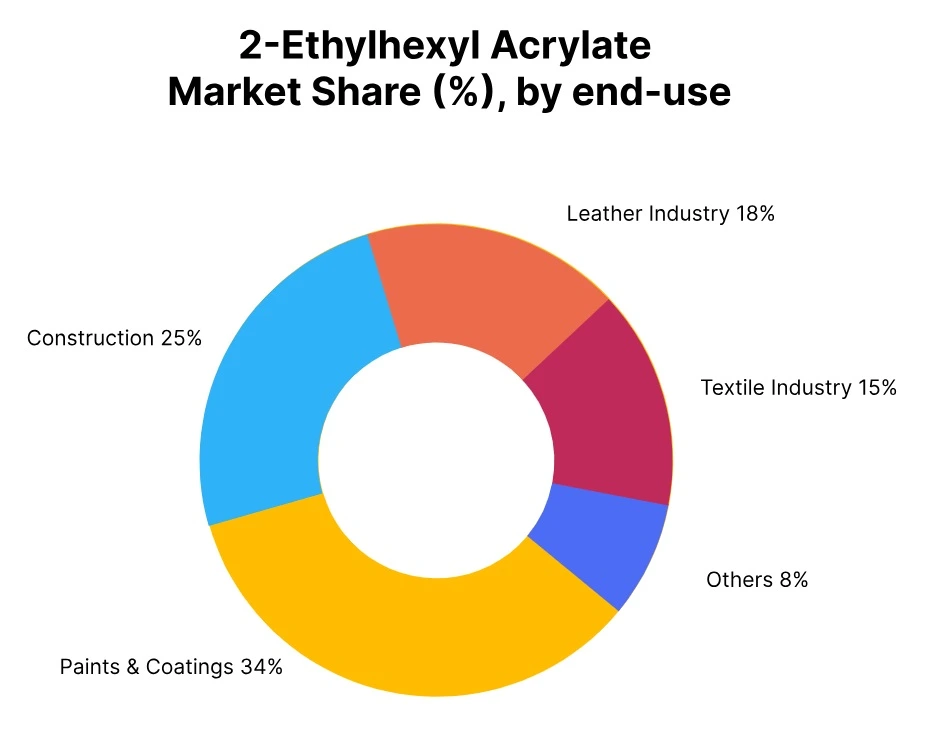
2-ethylhexyl acrylate market share end use

Historically, several events have caused significant fluctuations in 2-ethylhexyl Acrylate prices

  • Geopolitical Tensions: Conflicts in oil-producing regions and trade tensions, such as U.S.-China tariffs, affected global supply chains and market stability, leading to unpredictable price changes. 
  • Economic Recovery Post-Pandemic: As economies reopened and demand surged in 2021, the rapid recovery outpaced supply capabilities, leading to significant price increases due to heightened demand. 
  • COVID-19 Pandemic (2020): The pandemic disrupted manufacturing and supply chains worldwide, leading to temporary production halts and decreased demand in certain sectors, which initially lowered prices. As demand rebounded, prices surged due to supply constraints.  


These events underscore the 2-Ethylhexyl Acrylate market’s vulnerability to global disruptions and highlight the need for continuous monitoring of supply-demand dynamics.
 

Why Price Watch™?

Price Watch™ is your trusted resource for tracking global 2-ethylhexyl acrylate price trends. Our platform delivers real-time data and expert analysis, offering deep insights into the key factors driving price fluctuations in the 2-ethylhexyl acrylate market. By monitoring critical events such as geopolitical tensions, supply chain disruptions, and economic shifts, Price Watch™ keeps you fully informed of market dynamics.

In addition, Price Watch™ provides detailed forecasts and updates on production capacities, enabling you to anticipate market changes and make well-informed decisions. With Price Watch™, you gain a competitive edge in understanding all the elements that influence 2-ethylhexyl acrylate prices worldwide. Stay ahead of the curve with Price Watch’s™ reliable, accurate, and timely 2-ethylhexyl acrylate market data.

Track Price Watch's™ 2-ethylhexyl acrylate price assessment on a weekly basis since 2015 onwards, along with short-term forecasts, and get access to the detailed report in a downloadable format.

2-ethylhexyl Acrylate Market Price Trend published by 𝐏𝐫𝐢𝐜𝐞 𝐖𝐚𝐭𝐜𝐡™ reflect prevailing spot market conditions, derived from independent research, verified trade inputs, and proprietary market intelligence as of the publication date. Prices are published on the specified Incoterm and represent indicative base market levels, exclusive of applicable taxes, VAT, duties, tariffs, and other statutory charges. Actual transaction values may vary depending on volume, credit terms, contractual structure, and other negotiated conditions. Market prices are inherently subject to volatility, liquidity dynamics, regulatory changes, and evolving trade activity. The information provided is for reference and benchmarking purposes only and does not constitute an offer, recommendation, or guarantee of transactional outcomes. Users should exercise independent commercial judgment and assess their specific contractual, regulatory, tax, and application requirements before making business decisions. 𝐏𝐫𝐢𝐜𝐞 𝐖𝐚𝐭𝐜𝐡™ assumes no liability for decisions taken based on this information.

The pricing of 2-Ethylhexyl Acrylate is influenced by several factors, including raw material costs, production capacity, supply chain disruptions, demand from end-use industries (like adhesives, coatings, and textiles), and geopolitical conditions. Additionally, fluctuations in crude oil prices can impact the overall cost structure, as many acrylics derive from petrochemicals.

Market trends such as increasing demand from the construction and automotive sectors can drive up the availability and price of 2-Ethylhexyl Acrylate. Conversely, economic downturns or shifts in consumer preferences can lead to oversupply and price reductions. Monitoring industry reports and market analyses can provide insights into future pricing trends and availability.

Long-term pricing projections for 2-Ethylhexyl Acrylate depend on various factors, including advancements in production technologies, changes in regulatory landscapes, and shifts in global demand. Analysts suggest that while prices may experience short-term volatility due to market fluctuations, a steady increase in demand from key sectors may lead to gradual price increases over the next few years. Regularly reviewing market insights and forecasts can help procurement heads make informed decisions.

2-Ethylhexyl Acrylate (2-EHA) is a colorless, reactive acrylate eth, which is widely used across industrial and consumer applications including pressure-sensitive adhesives, paints and coatings, sealants, construction chemicals, and specialty polymers. It provides flexibility, durability, and weather resistance in formulations. Its price directly impacts downstream products such as tapes, labels, automotive coatings, packaging materials, and infrastructure chemicals. Since 2-EHA is produced from Acrylic Acid and 2-Ethylhexanol, fluctuations in feedstock markets and petrochemical supply chains significantly influence its pricing. 𝐏𝐫𝐢𝐜𝐞 𝐖𝐚𝐭𝐜𝐡™ tracks these prices to help businesses and consumers stay updated with market trends.

2-EHA prices vary by region, particularly across China, Southeast Asia, India, and other importing markets, and are typically quoted per metric ton under FOB, CIF, or domestic delivery terms. Prices fluctuate based on supply-demand balance, feedstock costs such as Acrylic Acid and 2-Ethylhexanol, and broader energy market trends. Trade flows, freight rates, currency movements, and inventory levels also contribute to regional price differences. Import-dependent regions may experience higher volatility compared to integrated production hubs. 𝐏𝐫𝐢𝐜𝐞 𝐖𝐚𝐭𝐜𝐡™ provides real-time price assessments across global markets to support informed procurement decisions.

2-EHA prices fluctuate due to changes in feedstock costs, particularly Acrylic Acid and 2-Ethylhexanol, along with crude oil and energy price movements. Demand from key consuming industries such as adhesives, coatings, and construction chemicals plays a major role in shaping price trends. Production factors including plant operating rates, capacity utilization, and maintenance shutdowns influence supply availability. Export competitiveness from Asian producers, logistics costs, and seasonal demand patterns in manufacturing and infrastructure sectors further impact pricing. Broader macroeconomic conditions and industrial activity cycles also contribute to price volatility observed in the global market.

The largest consumers of 2-EHA are manufacturers of pressure-sensitive adhesives, paints, coatings, and sealants, where it is used to enhance flexibility and adhesion performance. Packaging industries, particularly tapes and labels, account for significant demand. Additional consumption comes from construction chemicals, automotive coatings, and specialty polymer producers. Textile coatings and industrial applications also contribute to demand in certain regions. Chemical intermediates manufacturers using 2-EHA for downstream acrylate derivatives further expand its consumption base. 𝐏𝐫𝐢𝐜𝐞 𝐖𝐚𝐭𝐜𝐡™ analyzes demand patterns across all these industries to provide a comprehensive market overview.

2-EHA is produced through the esterification of Acrylic Acid with 2-Ethylhexanol in large petrochemical facilities. These plants are typically integrated with upstream Acrylic Acid and oxo-alcohol production units, which rely on propylene feedstock derived from crude oil or natural gas. Major production hubs include China, South Korea, and Southeast Asia, where integrated petrochemical value chains provide cost efficiencies. The production process is energy-intensive and closely linked to olefin and alcohol markets, making feedstock availability and energy costs key determinants of supply dynamics and pricing trends.

2-EHA trade is primarily driven by Asian producers, with China, Malaysia, and South Korea being the largest exporters globally. China dominates due to its large production capacity and competitive pricing structure, while Southeast Asian producers supply regional markets. Export flows vary depending on domestic demand conditions, feedstock economics, and global trade dynamics. Import-dependent regions such as India and parts of Southeast Asia rely heavily on these suppliers. 𝐏𝐫𝐢𝐜𝐞 𝐖𝐚𝐭𝐜𝐡™ tracks export patterns to help businesses understand sourcing opportunities.

Global supply of 2-EHA is generally balanced due to strong production capacity in Asia and integrated petrochemical operations. However, regional shortages can occur due to plant shutdowns, maintenance turnarounds, or disruptions in feedstock supply such as Acrylic Acid or 2-Ethylhexanol. Sudden increases in downstream demand from adhesives or coatings sectors can also tighten availability. Conversely, oversupply conditions in export markets can lead to competitive pricing. 𝐏𝐫𝐢𝐜𝐞 𝐖𝐚𝐭𝐜𝐡™ monitors these supply-demand imbalances to provide market clarity.

2-EHA is primarily sold as industrial grade with purity levels above 99%, but variations in purity, inhibitor content, and application-specific requirements can influence pricing. Specialty grades used in high-performance adhesives or coatings may command premium prices due to stricter quality standards and consistency requirements. Packaging formats, regulatory specifications, and regional certifications also contribute to price differences. 𝐏𝐫𝐢𝐜𝐞 𝐖𝐚𝐭𝐜𝐡™ provides differentiated price assessments based on grade and application to ensure transparency.

When demand rises sharply, particularly from adhesives, packaging, or construction sectors, 2-EHA prices typically increase due to tighter supply availability. Producers may prioritize long-term contract customers, while spot buyers face higher prices and reduced availability. Since production depends on Acrylic Acid and 2-Ethylhexanol supply, output cannot always be increased quickly, leading to short-term price spikes. Procurement cycles may shorten, and lead times may extend during such periods. 𝐏𝐫𝐢𝐜𝐞 𝐖𝐚𝐭𝐜𝐡™ captures these real-time market dynamics.

Energy is a significant cost component in 2-EHA production. Increases in natural gas, electricity, and steam costs raise overall production expenses, which are typically passed on to buyers. Feedstock costs for Acrylic Acid and 2-Ethylhexanol are also linked to crude oil and natural gas markets, making 2-EHA pricing sensitive to energy fluctuations. Regions with lower energy costs and integrated production facilities tend to offer more competitive pricing. 𝐏𝐫𝐢𝐜𝐞 𝐖𝐚𝐭𝐜𝐡™ analyzes these correlations in its market reports.

2-EHA prices vary across regions based on local production capacity, feedstock availability, energy costs, transportation and logistics expenses, and regional demand strength. Areas with integrated petrochemical complexes and access to Acrylic Acid and 2-Ethylhexanol typically have lower production costs and more competitive pricing. In contrast, import-dependent regions face higher prices due to freight costs, duties, and supply risks. Currency fluctuations and trade policies further influence regional price variations. 𝐏𝐫𝐢𝐜𝐞 𝐖𝐚𝐭𝐜𝐡™ tracks prices across major global markets to highlight these differences and support procurement decisions.

The 2-EHA market outlook depends on trends in Acrylic Acid and 2-Ethylhexanol feedstock prices, crude oil and energy costs, and demand growth in key industries such as adhesives, coatings, and construction chemicals. Capacity additions, plant shutdowns, and global trade flows also influence future pricing. Seasonal demand patterns in infrastructure and packaging sectors, along with macroeconomic conditions, further shape market direction. 𝐏𝐫𝐢𝐜𝐞 𝐖𝐚𝐭𝐜𝐡™ provides detailed forecasts based on comprehensive supply-demand analysis to help businesses anticipate price movements.

Absolutely. Accurate forecasting enables businesses to optimize procurement timing, negotiate long-term contracts more effectively, and manage budgets with greater precision. If forecasts indicate rising prices, companies can secure inventory early or lock in favorable contracts. Conversely, if prices are expected to decline, buyers may delay purchases to benefit from lower costs. This strategic approach can lead to significant cost savings and improved supply chain efficiency. 𝐏𝐫𝐢𝐜𝐞 𝐖𝐚𝐭𝐜𝐡™ provides actionable insights to support informed decision-making.

Global events such as natural disasters, geopolitical tensions, trade restrictions, plant shutdowns, or feedstock supply disruptions can significantly impact 2-EHA production and pricing. Since the product relies on Acrylic Acid and 2-Ethylhexanol, any disruption in upstream petrochemical supply chains can tighten availability. Logistics issues such as port congestion or freight rate spikes also affect trade flows. Economic downturns or surges in industrial activity further influence demand patterns. 𝐏𝐫𝐢𝐜𝐞 𝐖𝐚𝐭𝐜𝐡™ provides timely updates when such events affect the market.

𝐏𝐫𝐢𝐜𝐞 𝐖𝐚𝐭𝐜𝐡™ collects pricing data from manufacturers, distributors, traders, and buyers worldwide to provide accurate and transparent market intelligence. It publishes regular price assessments, market insights, and forecasts across multiple regions. With a robust methodology and comprehensive coverage, it serves as a trusted source for understanding fair pricing, supply-demand trends, and future outlooks in the 2-EHA market.