

The strongest rallies are not always driven by stronger demand. Sometimes they begin with a single shift in market sentiment.
In July 2026, ABS prices in China followed an unusual path. After declining during late June as easing Middle East tensions weakened crude oil-linked feedstock costs, the market staged a strong rebound before losing momentum once again.
The movement highlighted how quickly geopolitical developments can reshape pricing sentiment, even when underlying demand remains largely unchanged.
ABS Prices in China Rebound as Feedstock Costs Reverse Course
The ABS price trend in China initially weakened following the reopening of the Strait of Hormuz, which accelerated the correction in crude oil prices and reduced cost support from styrene and butadiene.
Comfortable inventories and cautious procurement from automotive, consumer electronics, and home appliance manufacturers reinforced the softer market tone, prompting suppliers to lower offers.
That trend reversed within weeks.
Renewed geopolitical uncertainty surrounding the US-Iran conflict restored the crude oil risk premium, lifting benzene and styrene values while strengthening producers’ pricing confidence.
At the same time, inventories at polymerization plants fell below recent levels as shipments improved, providing additional support to domestic quotations despite operating rates remaining broadly stable at around 60 percent.
How China’s ABS Value Chain Is Responding
The recovery has not been driven by stronger consumption alone.
- Feedstock costs have become the primary driver of pricing sentiment, while downstream buyers continue limiting purchases to immediate requirements.
- Inventory reductions have improved supplier confidence, but seasonal weakness across appliance and consumer electronics sectors continues to restrict large-volume procurement.
Two developments stand out.
The recent rebound has been supported more by changing production economics than by a structural improvement in demand.
Meanwhile, acrylonitrile continues facing oversupply concerns, while butadiene and styrene are following different cost trajectories, creating an increasingly fragmented feedstock environment for ABS producers.
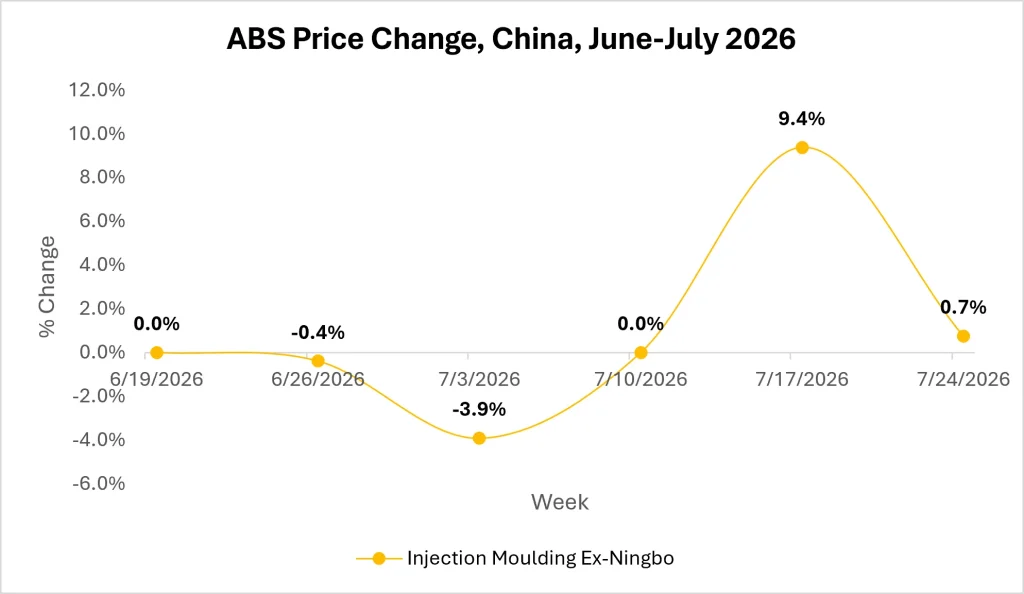
Source: Price Watch™ Acrylonitrile Butadiene Styrene
Can China’s ABS Market Sustain Its Recovery?
The next one to three months will depend on whether feedstock support continues to outweigh seasonal demand weakness.
While lower inventories and firmer styrene values have improved near-term pricing sentiment, downstream buyers remain cautious, with procurement largely restricted to immediate requirements.
At the same time, expectations of additional acrylonitrile capacity and only modest improvements in end-user demand suggest that supply fundamentals remain comfortable.
Here is a question worth considering; if the recent rally has been driven primarily by geopolitics rather than stronger consumption, what happens when the risk premium begins to fade but downstream demand still hasn’t returned?
Stay connected with Price Watch™ for continued insights and weekly updates on ABS prices in China and the evolving ABS price trend in China.
Follow Price Watch™ on LinkedIn for real-time polymer market insights, ABS price trends, supply chain intelligence, and global commodity updates.