

The global Butyl Acrylate (BA) market remained influenced by feedstock volatility, shifting trade flows, and cautious procurement strategies during Q2 2026.
Fluctuations in acrylic acid and n-butanol costs continued to impact production economics, while buyers across major consuming regions largely adopted a need-based purchasing approach amid uncertain market fundamentals.
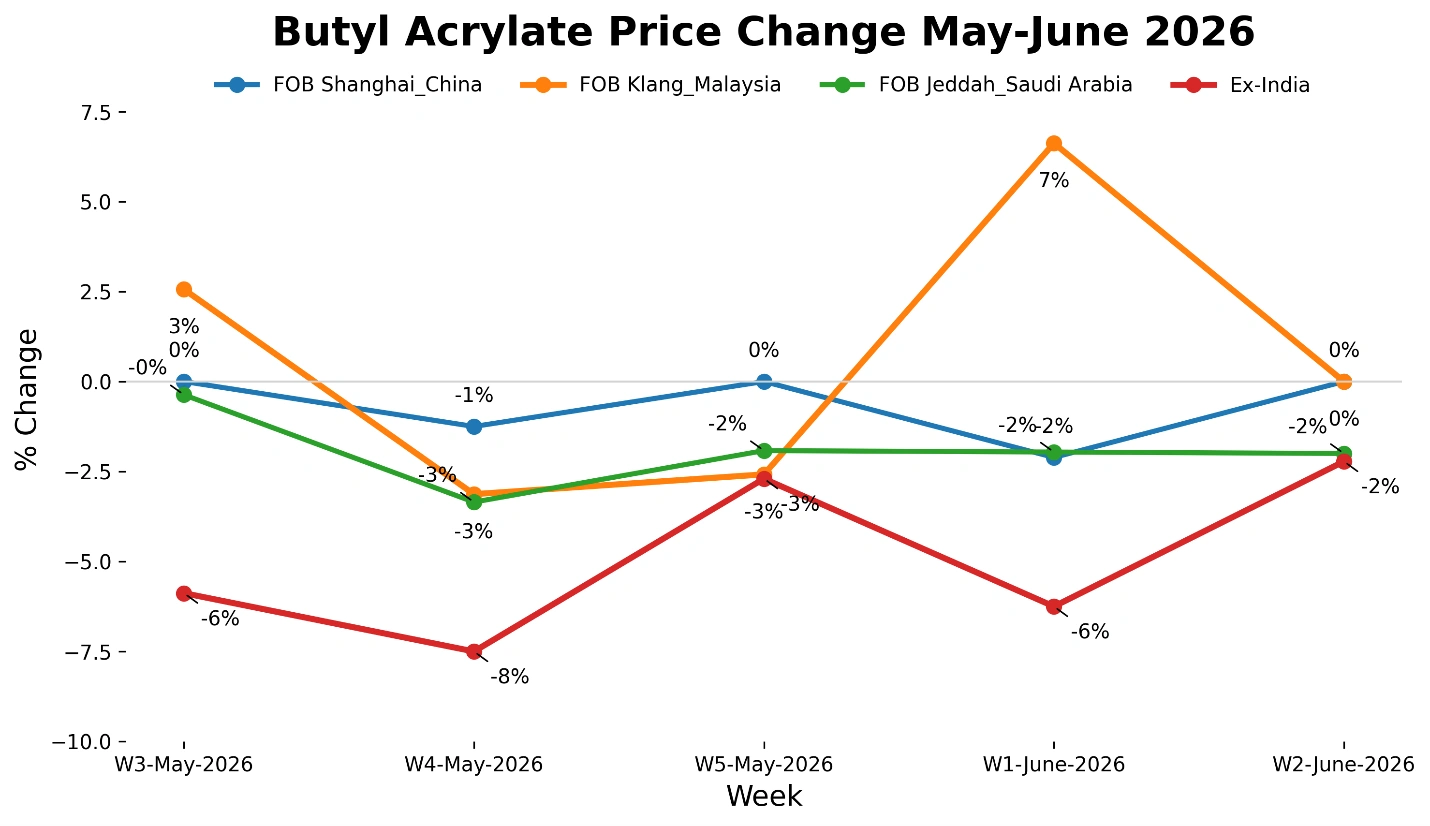
Source: Price Watch™ Butyl Acrylate price trend
China Butyl Acrylate Market Maintains Export Advantage
China, the largest BA producer and exporter in Asia, maintained ample supply availability through ongoing capacity expansions.
Despite periodic increases in feedstock costs, competitive export offers and abundant inventories prevented significant price escalation, reinforcing China’s influence on regional pricing dynamics.
Malaysia Butyl Acrylate Market Benefits from Regional Trade
Malaysia benefited from its strategic position within Southeast Asia’s manufacturing and trading network. Stable demand from coatings, packaging, adhesives, and construction-related industries supported market activity, while efficient logistics and access to ASEAN markets strengthened their role as a regional distribution hub.
However, competitive Chinese exports continued to exert pricing pressure across the market.
Saudi Arabia Butyl Acrylate Market Supported by Integrated Production
In Saudi Arabia, integrated petrochemical operations provided producers with a feedstock advantage, supporting relatively stable production economics.
Market sentiment remained sensitive to crude oil movements, freight fluctuations, and geopolitical developments affecting global energy and shipping routes. Meanwhile, strong demand from construction coatings, waterproofing materials, and industrial adhesives supported regional consumption.
Butyl Acrylate Market Outlook
India continued to be a key demand center, driven by infrastructure spending, expanding paints and coatings production, and growing adhesive consumption.
Looking ahead, BA market sentiment is expected to remain closely tied to feedstock costs, energy markets, and regional trade competitiveness.
While downstream demand remains fundamentally healthy, abundant supply and expanding Asian capacities are likely to keep market participants focused on inventory management, export opportunities, and cost optimization through the remainder of 2026.
Follow Price Watch™ on LinkedIn for real-time raw material insights, pricing trends, supply chain intelligence, and market updates shaping global commodity markets.