

The global energy matrix is undergoing a quiet, structural overhaul. Driven by tightening climate deadlines, the staggering electricity demands of artificial intelligence, and national security interests, the shift from fossil fuels to clean alternatives is no longer just a localized environmental goal-it is a brutal macroeconomic race.
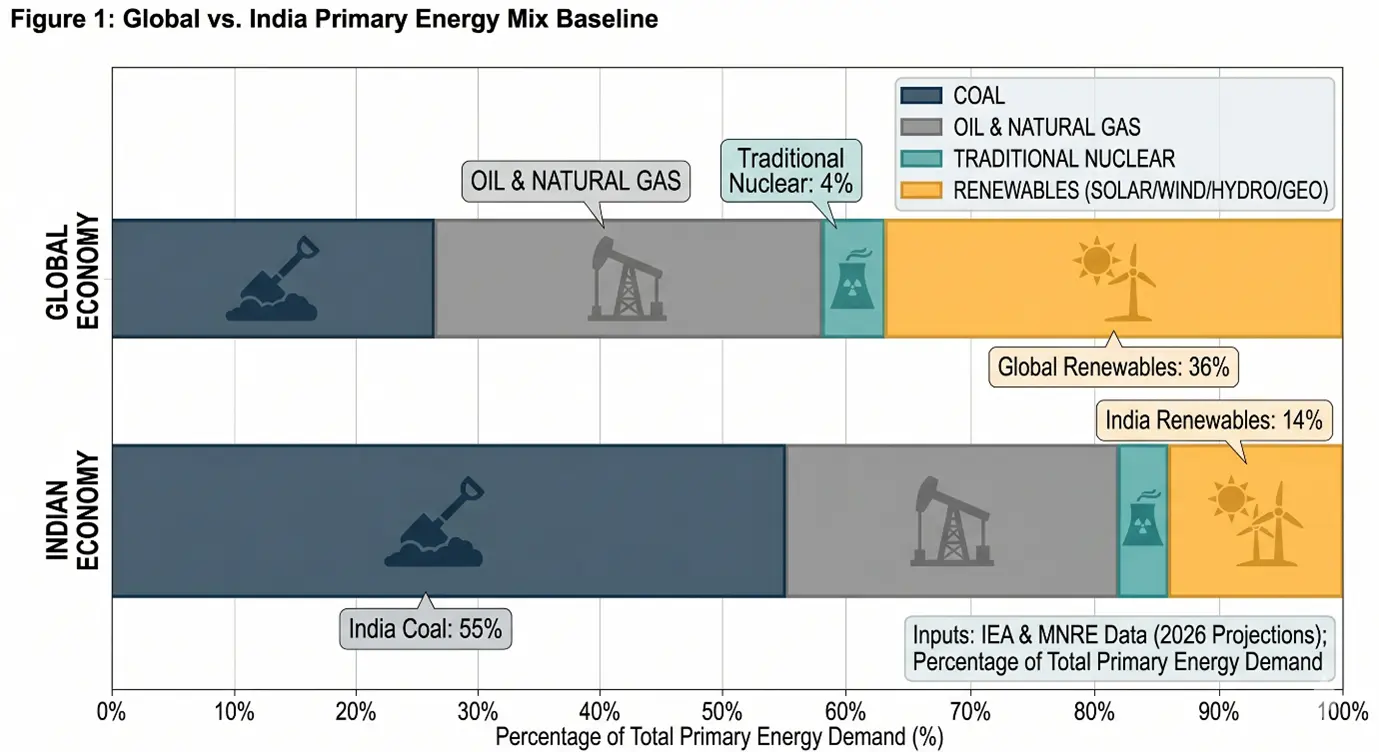
The Multi-Vector Clean Matrix: Operational Realities
A hundred years of development based on fossil fuels requires moving from the basic principles of thermal power generation to a complicated system of energy vectors that obey their own physical and economic laws.
Solar Photovoltaic (PV)
The solar sector has earned its title as the most crucial renewable energy source. The world’s installed solar capacity has already passed 2,392 GW. India has become the 3rd largest country in the world in terms of its overall renewable energy capacity, which amounts to 283.46 GW including 150.26 GW of solar.
However, while large-scale projects such as India’s Bhadla Solar Park use state-of-the-art mono-crystalline passivated emitter and rear cells (PERC) to optimize efficiency during intense sunlight conditions from the scorching desert sun, solar is faced with a serious roadblock known as intermittency – that is, when the sun sets, the power production goes to zero.
Wind Energy (Onshore & Offshore)
Wind functions as the ideal atmospheric partner to solar, frequently peaking at night or during heavy weather. To capture faster, cleaner air currents, developers are pushing hub heights (the altitude of the central rotor) higher. India runs over 56 GW of onshore wind.
Globally, the real frontier has moved to offshore wind-massive marine installations boasting significantly higher capacity factors (the ratio of actual power generated over a year versus its theoretical maximum) because ocean winds don’t have to fight hills, trees, or buildings.
Nuclear & SMRs
Because solar and wind cannot run 24/7, grids require zero-carbon baseload power-the constant, minimum floor of electricity needed around the clock. This need is sparking a nuclear renaissance. The industry is pivoting to Small Modular Reactors (SMRS)-fractional nuclear units under 300 MW built on factory assembly lines and shipped on flatbed trucks.
SMRs completely change the safety equation using passive safety systems. Instead of relying on electric pumps that can fail during a blackout, they utilize natural physics-like gravity, cooling convection loops, and thermal expansion-to cool themselves down automatically without human intervention.
Geothermal & Hydro Batteries
Geothermal systems break out of traditional volcanic boundaries using Enhanced Geothermal Systems (EGS), fracturing deep tectonic basement rocks to let water harvest the Earth’s core heat and return as high-pressure turbine steam. Hydropower, meanwhile, remains our largest absolute generator of clean electrons.
To buffer solar drops, India is aggressively building Pumped Hydro Storage Projects (PSPS). These act as massive mechanical water batteries: cheap, excess midday solar power pumps water up a mountain, and when evening peak demand hits, the gates open, dropping the water through hydro-turbines to save the grid from blackouts.
Follow Price-Watch™ on LinkedIn for real-time raw material insights, pricing trends, supply chain intelligence, and market updates shaping global commodity markets.