

Abstract: The abrupt shutdown of the Strait of Hormuz has led to a situation where 20% of LNG production has been cut off and this has upset the international economy. In this regard, West Asia has been faced with an energy crisis, where the utilization of natural gas has gone beyond being a utility and has become a means of asserting national sovereignty.
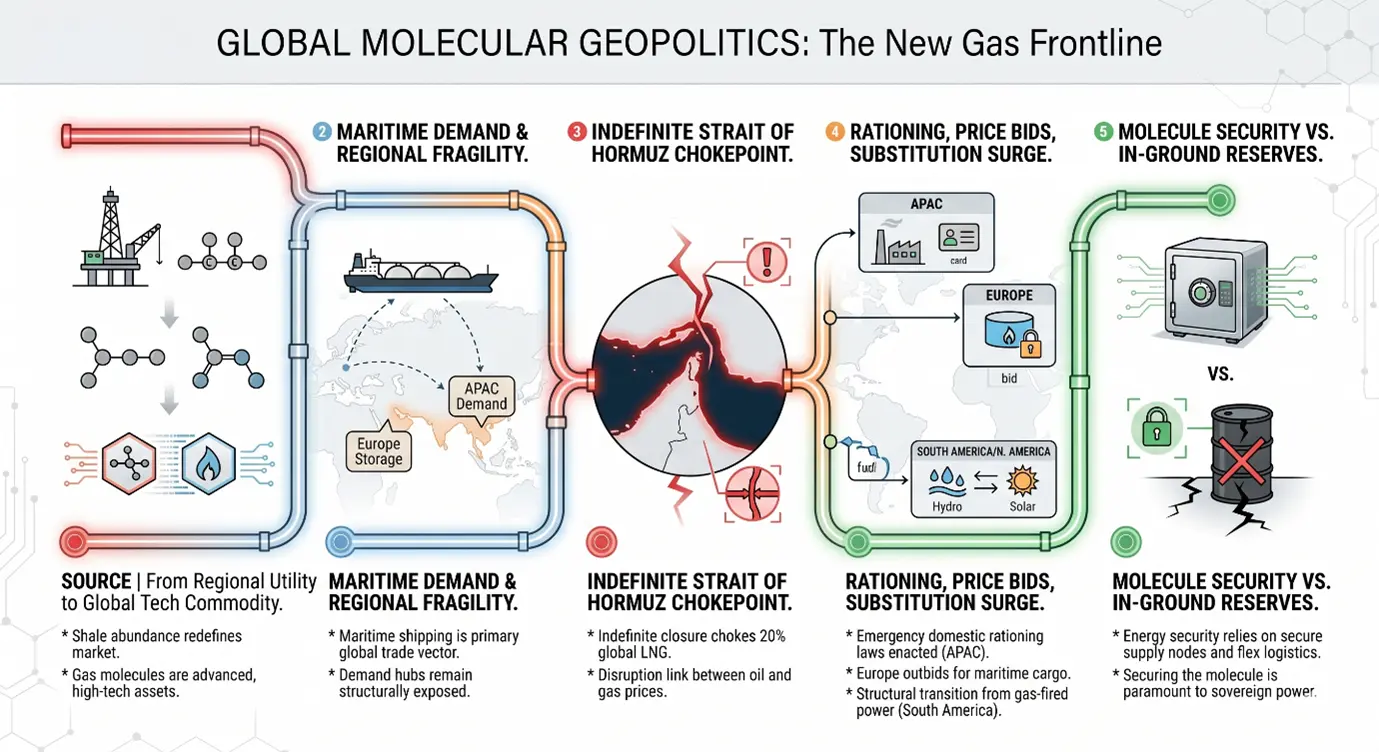
The Molecular Pivot
For nearly a century, crude oil was the paramount leader of global energy. This heavy hydrocarbon powered global transportation, and its price movements had the unique power to destabilize governments, trigger recessions, and shape international diplomacy.
Natural gas, on the other hand, lived in oil’s shadow. It was seen merely as a regional utility, trapped inside fixed underground pipelines and used primarily for winter heating or home cooking. For decades, the prices of the two fuels were locked together, with natural gas prices simply following the ups and downs of the oil market.
But a huge change was occurring quietly below the surface. With major economies switching over to clean energy, oil was slowly starting to face demand limits in the future because of electric cars and better chemicals. At the same time, natural gas was evolving.
The development of massive, complex cooling facilities allowed companies to super-chill gas into a liquid, creating Liquified Natural Gas (LNG). By breaking free from fixed pipelines, natural gas could now travel across oceans on cargo ships. It transformed from a simple local utility into a globally traded tech commodity, setting the stage for a permanent split from oil – a true Molecular Pivot.
The Geographic Accord
By the mid-2020s, the world economy had reorganized itself into a Geographic Accord along this new mobile gas molecule, producing an unstable web of international interdependence. In each part of the world, various regions depended upon these ocean trade routes for their very economic survival.
The Asia-Pacific (APAC) region became the main hub for global gas demand. Underpinned by fast-paced urbanization and the unprecedented transition from coal to gas-fired power plants, countries like China, India, Japan, and South Korea have become heavily dependent on LNG vessels that ply the seas.
In turn, they started purchasing more than two-thirds of all available spot cargoes of LNG to keep their electricity generation systems stable and their industries operating. On the other side of the Atlantic, Europe became an inflexible buyer, completely focused on its maritime supply routes after losing access to cheap Russian pipeline gas.
Meanwhile, there was an aggressive shift towards energy production in the Western Hemisphere. North America emerged as a major exporter of energy. Shale independents in the Permian and Marcellus basins brought forth cheap domestic gas and embarked on constructing export facilities along the Gulf Coast.
Energy production similarly picked up pace in South America as Brazil exploited its deep-water offshore energy reserves while Argentina solved its transport problems to become a net exporter from the massive Vaca Muerta shale basin.
However, this global network was, however, dependent on extremely risky maritime routes. Although the Americas were relatively safe in their geographic isolation, a major proportion of global gas resources depended on the risky waters of West Asia and passed through vulnerable maritime choke points. It was like a tightly wound spring that only needed a single spark to ignite.
The Chokepoint Fracture
The breaking point arrived with sudden, disruptive force. Due to the escalating tensions in the West Asian region, the Strait of Hormuz was shut indefinitely. Furthermore, the export infrastructure in the Gulf region was attacked, leading to destruction of some of the largest export terminals like the massive Ras Laffan industrial complex in Qatar.
In a matter of hours, roughly 20% of the world’s liquefied natural gas and liquefied petroleum gas (LPG) supply vanished from the market. The shockwaves through global trading desks were immediate.
The historical price link between oil and gas dissolved completely. While crude oil experienced a nervous price spike, natural gas prices exploded exponentially to unprecedented heights. Natural gas had officially been weaponized by geography, creating a severe supply squeeze that left import-dependent nations facing immediate economic disaster.
Follow Price-Watch™ on LinkedIn for real-time raw material insights, pricing trends, supply chain intelligence, and market updates shaping global commodity markets.