

Why Has the Israel–Iran Conflict Become a Global Oil Market Concern?
The ongoing tensions between Israel and Iran have created major uncertainty across global crude oil markets in 2026. What initially appeared to be a regional geopolitical issue quickly evolved into a worldwide energy concern because the Middle East accounts for nearly 30% of global crude oil production and remains the backbone of international seaborne oil trade.
Investors and governments reacted strongly as fears grew over disruptions in the Strait of Hormuz, through which nearly 20 million barrels per day (MBPD) of crude oil and petroleum products normally pass, representing almost 20% of global oil consumption and nearly 25–27% of global seaborne oil trade.
Why Did Crude Oil Prices React So Aggressively?
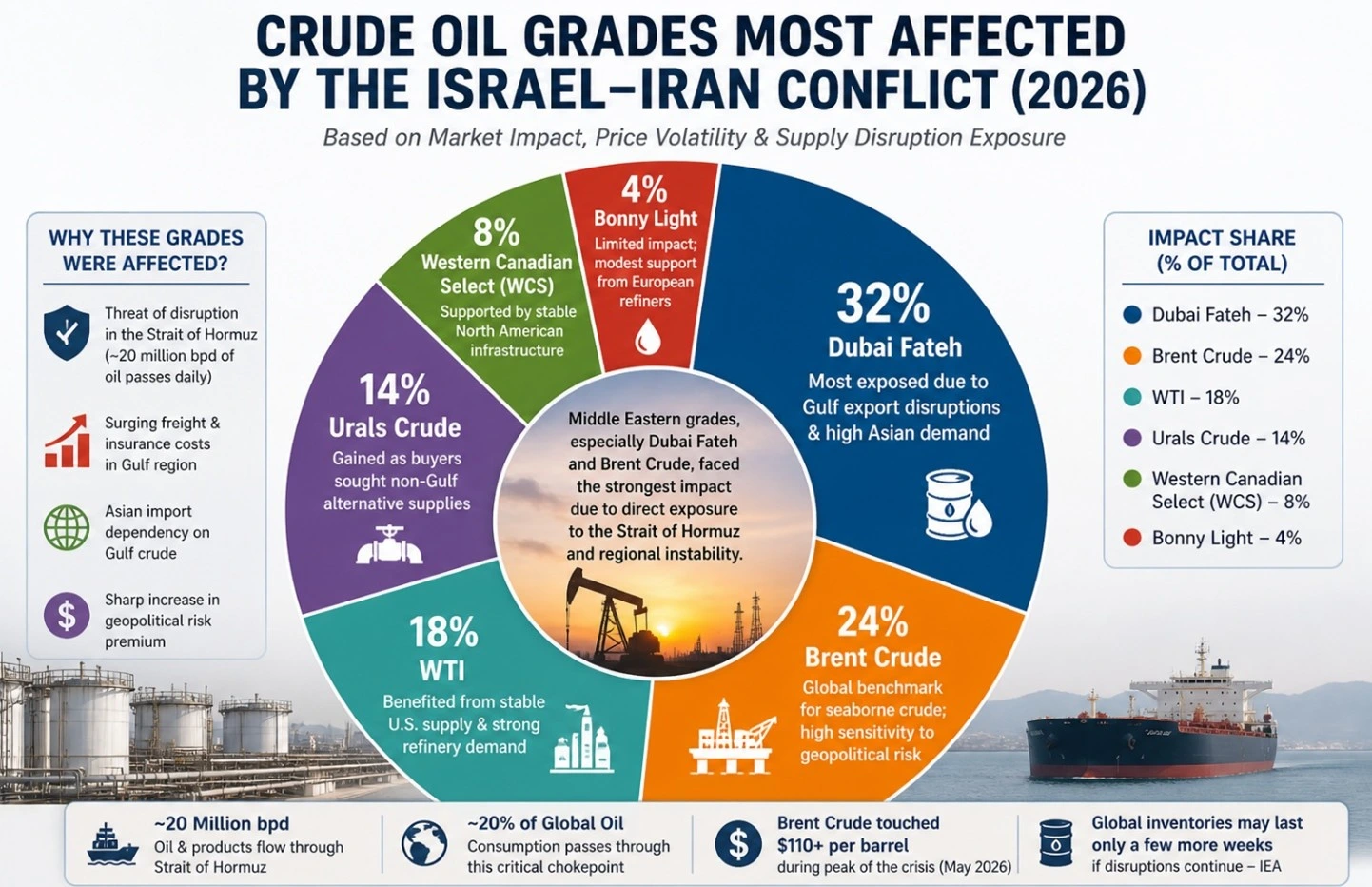
Global crude benchmarks such as Brent Crude, West Texas Intermediate, and Dubai Fateh surged sharply because markets feared immediate supply shortages if tanker movement through Gulf waters became restricted. Brent crude recently crossed $110 per barrel while WTI traded above $106 per barrel after drone attacks and partial shipping disruptions near the Gulf region.
Oil markets typically react aggressively to geopolitical risks because even minor disruptions can rapidly tighten global supply balances. During the peak of the crisis, tanker transit through Hormuz reportedly dropped by over 90%, with daily vessel movement falling from nearly 130–160 ships to fewer than 10 vessels per day.
Which Crude Oil Grades Were Most Affected?
Middle Eastern crude grades such as Dubai Fateh experienced the strongest upward momentum because nearly 84% of Hormuz crude exports are directed toward Asian markets including China, India, Japan, and South Korea. Meanwhile, Urals Crude gained temporary support as several importers searched for alternative supplies outside the Middle East.
North American grades like Western Canadian Select and WTI also benefited from stronger refinery demand because buyers considered North American exports relatively safer and more stable compared to Gulf-linked supplies.
How Large Is the Middle East’s Oil Export Dependency?
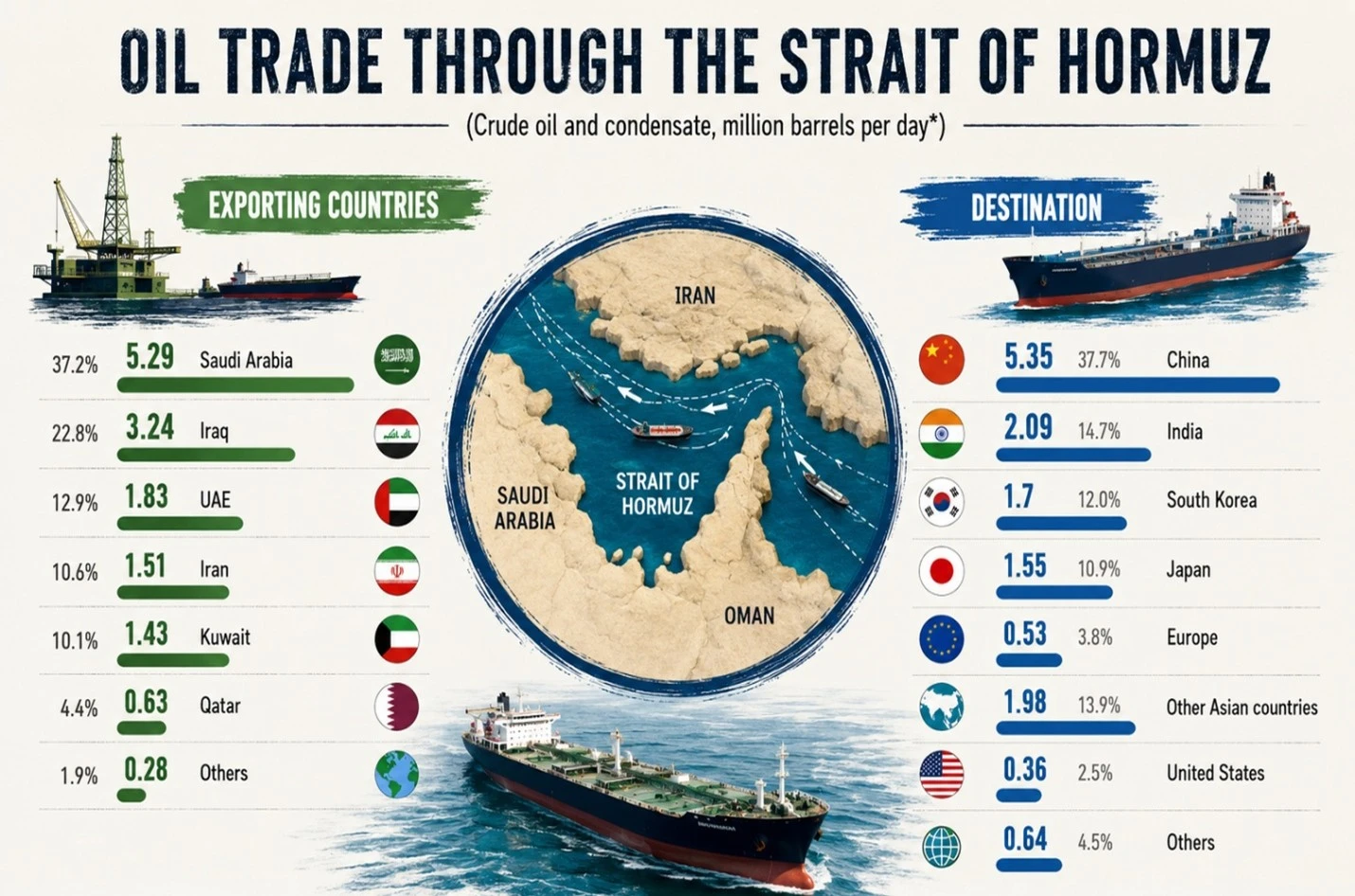
Saudi Arabia alone ships nearly 5.5 – 6 million barrels per day through Hormuz, while Iraq exports around 3.4 mbpd and the UAE exports approximately 3 mbpd through the route. Iran itself contributes nearly 1.5–2 mbpd under current trade conditions. Countries like Japan and South Korea rely on the Gulf for over 75–95% of their crude imports, making Asian economies especially vulnerable during the conflict.
What Problems Did the Global Economy Face During the Crisis?
The conflict created widespread economic pressure across multiple industries. Rising crude prices increased transportation and logistics costs globally, pushing inflation higher across both developed and emerging economies.
Reuters estimated that the conflict has already imposed over $25 billion in costs on global corporations due to higher fuel expenses, shipping disruptions, and raw material inflation. Airlines alone reportedly faced losses approaching $15 billion because of higher jet fuel costs and rerouted flight operations.
How Did OPEC+ and UAE Production Plans Influence the Situation?
OPEC+ attempted to stabilize the market by approving a modest production increase of nearly 188,000 barrels per day for June 2026. However, supply additions remained limited because physical exports through Hormuz were still unstable.
At the same time, the UAE accelerated expansion plans after exiting OPEC+, targeting production capacity above 5 million barrels per day by 2027, with the possibility of reaching 6 mbpd in future years. This signaled that Gulf producers are preparing for long-term market competition despite geopolitical instability.
Why Is the Strait of Hormuz So Important to Global Oil Markets?
The Strait of Hormuz is considered the world’s most critical oil transit chokepoint because nearly 20 million barrels per day of crude oil pass through this narrow route, accounting for almost 20% of global oil consumption. Major oil-producing countries including Saudi Arabia, Iraq, UAE, Kuwait, and Iran rely heavily on this corridor for exports to Asia and Europe.
During the Israel–Iran conflict, fears of tanker disruptions and possible shipping restrictions through Hormuz sharply increased crude oil prices, freight costs, and global market volatility. Even temporary disruptions in the Strait can create major supply concerns, making it one of the most closely monitored regions in the global energy market.
What Happened After Diplomatic Efforts Began?
After weeks of escalating tensions, diplomatic negotiations and international pressure helped partially restore tanker movement through the Strait of Hormuz. Oil prices cooled temporarily as markets expected gradual normalization in shipping activity.
However, traders continued adding geopolitical risk premiums because the conflict remained unresolved and commercial oil inventories globally continued declining rapidly. The International Energy Agency warned that commercial inventories may only sustain demand for a few more weeks if disruptions continue.
What Could Be the Future of the Crude Oil Market?
The future direction of global crude oil markets will largely depend on Middle East stability and supply security around Hormuz. If tensions escalate again, analysts believe Brent crude could potentially move toward $120–130 per barrel due to renewed fears of supply disruption.
However, if diplomatic stability improves and OPEC+ maintains balanced production growth, prices could gradually stabilize despite slowing global economic growth. The crude market currently remains extremely sensitive, where even a single military event or tanker disruption can rapidly influence global energy prices, inflation, and investor sentiment worldwide.
Crude oil Market outlook
The global crude oil market is expected to remain volatile in the coming months as geopolitical tensions in the Middle East, OPEC+ production strategies, and shifting global demand continue influencing market sentiment.
Future price direction will largely depend on stability near the Strait of Hormuz, refinery demand across China, India, Japan, South Korea, the United States, Saudi Arabia, UAE, Russia, Canada, Nigeria, and Europe, along with changing global inventory levels and shipping conditions.
With its real-time market intelligence, forecasting models, and in-depth commodity outlook analysis, Price-Watch.ai helps businesses monitor crude oil market movements, anticipate supply disruptions, and make data-driven procurement decisions before major price fluctuations occur.
Covering key crude oil markets across the United States, Canada, Russia, OPEC regions, UAE, Nigeria, and Europe, Price-Watch delivers the market intelligence and pricing transparency today’s evolving global energy sector demands.
Follow Price Watch™ on LinkedIn for real-time raw material insights, pricing trends, supply chain intelligence, and market updates shaping global commodity markets.