

The Asian epoxy resin market entered 2026 amid shifting feedstock economics, improving industrial activity, and cautious procurement behavior from downstream consumers. Both Liquid Epoxy Resin (LER) and Solid Epoxy Resin (SER) markets continued to respond to fluctuations in Bisphenol-A (BPA) and Epichlorohydrin (ECH) costs, while demand from coatings, electronics, composites, and wind energy sectors provided varying degrees of support.
Across key markets including China, India, Taiwan, and South Korea, producers balanced operating rates with evolving demand conditions as the market sought stability following periods of feedstock-driven volatility.
China and India Drive Regional Epoxy Resin Consumption
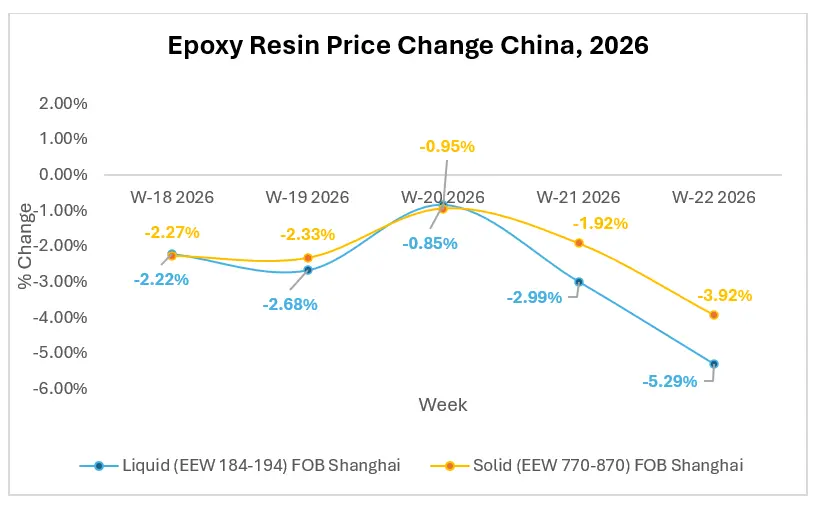
China remained the dominant force in the Asian epoxy resin industry, accounting for a significant share of regional production and exports. During the first half of 2026, Chinese epoxy resin producers experienced fluctuating raw material costs as BPA and ECH markets responded to changing phenol, acetone, and propylene fundamentals.
 Source: Price-Watch™ | Epoxy Resin Prices
While domestic demand from industrial coating and construction sectors remained moderate, the electronics and renewable energy industries continued supporting consumption of higher-value epoxy grades.
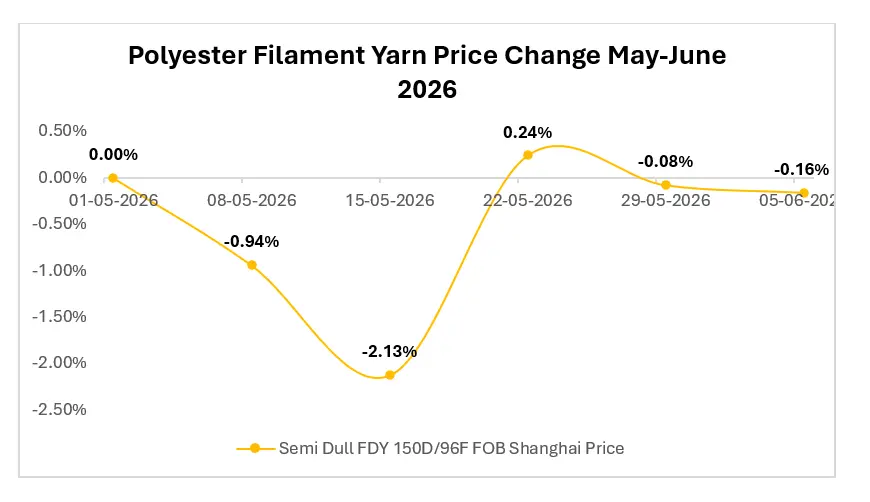
Export activity remained active throughout the region, although ample production capacity and competitive market conditions limited sustained upward price momentum. Both liquid and solid epoxy resin suppliers maintained flexible operating strategies to manage inventories amid uneven downstream purchasing.
Source: Price-Watch™ | Epoxy Resin Prices
India continued to emerge as one of Asia’s most attractive growth markets for epoxy resins. Demand remained robust across infrastructure, protective coatings, electrical laminates, adhesives, flooring systems, and renewable energy projects. Government-led investments in transportation, power transmission, and manufacturing expansion supported consumption of both liquid and solid epoxy resin grades.
While domestic production capacity continued expanding, India remained reliant on imports from China, Taiwan, and South Korea for a substantial portion of its requirements. Buyers actively monitored FOB Asia offers as feedstock-driven price movements and freight costs influenced procurement decisions throughout the period.
Taiwan and South Korea Anchored by Electronics and Advanced Manufacturing
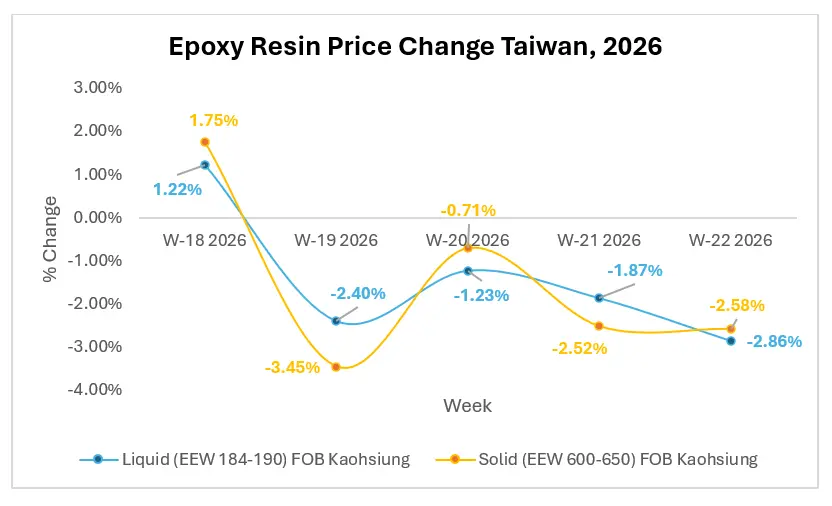
Taiwan maintained its strategic position within the global epoxy resin supply chain, particularly for electronics-grade and specialty epoxy systems. Demand from semiconductor manufacturing, printed circuit boards (PCBS), and electronic encapsulation applications continued supporting epoxy resin consumption despite fluctuations in broader industrial activity.
Source: Price-Watch™ | Epoxy Resin Prices
Taiwanese producers benefited from strong integration with the electronics value chain, allowing them to maintain relatively stable demand compared to more construction-oriented markets. However, competition from regional suppliers and feedstock volatility remained key challenges influencing market sentiment.
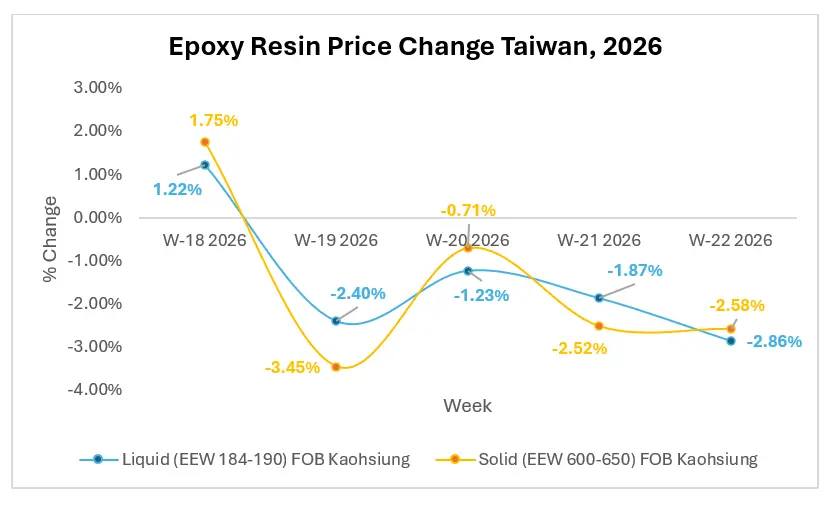
South Korea’s epoxy resin market remained closely linked to the performance of its electronics, automotive, and industrial manufacturing sectors. Producers benefited from established technological expertise and access to advanced downstream applications, particularly in electrical laminates, automotive coatings, and high-performance composites.
 Source: Price-Watch™ | Epoxy Resin Prices
Nevertheless, competitive export markets and fluctuations in BPA and ECH costs continued impacting production economics. Market participants remained focused on operational efficiency and margin management as global epoxy resin supply remained adequate.
Across the region, the market continued to be shaped by developments in the BPA and ECH value chains. Changes in feedstock availability, operating rates at major epoxy facilities, and energy market volatility directly influenced pricing sentiment.
Meanwhile, growth in renewable energy installations, electric vehicles, advanced electronics, and infrastructure development provided long-term support for epoxy resin demand across both liquid and solid grades.
Epoxy Resin Market Outlook
Looking ahead, the Asian epoxy resin market is expected to remain fundamentally supported by demand from construction, electronics, renewable energy, and industrial manufacturing sectors.
However, buyers are likely to maintain disciplined procurement strategies while monitoring feedstock trends, inventory levels, and global economic conditions. Although supply availability remains comfortable, producers may increasingly focus on value-added applications and specialty grades to protect margins in a competitive market environment.
As investments in clean energy, advanced electronics, and infrastructure continue accelerating across Asia, both Liquid Epoxy Resin and Solid Epoxy Resin markets are expected to benefit from structural demand growth, reinforcing their importance within the region’s industrial materials value chain.
Follow Price-Watch™ on LinkedIn for real-time raw material insights, pricing trends, supply chain intelligence, and market updates shaping global commodity markets.