

The Asian Ethyl Acrylate (EA) market entered 2026 amid a complex mix of feedstock volatility, evolving trade dynamics, and improving downstream consumption. While demand from paints, coatings, adhesives, textiles, and specialty chemical applications remained relatively stable, market participants continued to closely monitor fluctuations in acrylic acid prices and regional operating rates.
As one of the key derivatives of acrylic acid, Ethyl Acrylate remained highly sensitive to upstream cost movements, particularly across major markets such as China, India, and South Korea.
Ethyl Acrylate Market in China
China continued to dominate the regional Ethyl Acrylate landscape, supported by its extensive acrylic acid production base and integrated petrochemical infrastructure. During the first half of 2026, Chinese producers experienced rising production costs as acrylic acid values strengthened on the back of fluctuating propylene prices.
However, ample domestic supply and ongoing capacity expansions limited the extent of price increases. Export activity remained competitive, with suppliers targeting Southeast Asian and Indian markets to offset periods of softer domestic demand.
While coatings and adhesive sectors provided consistent consumption support, buyers generally adopted cautious procurement strategies amid uncertain market conditions.
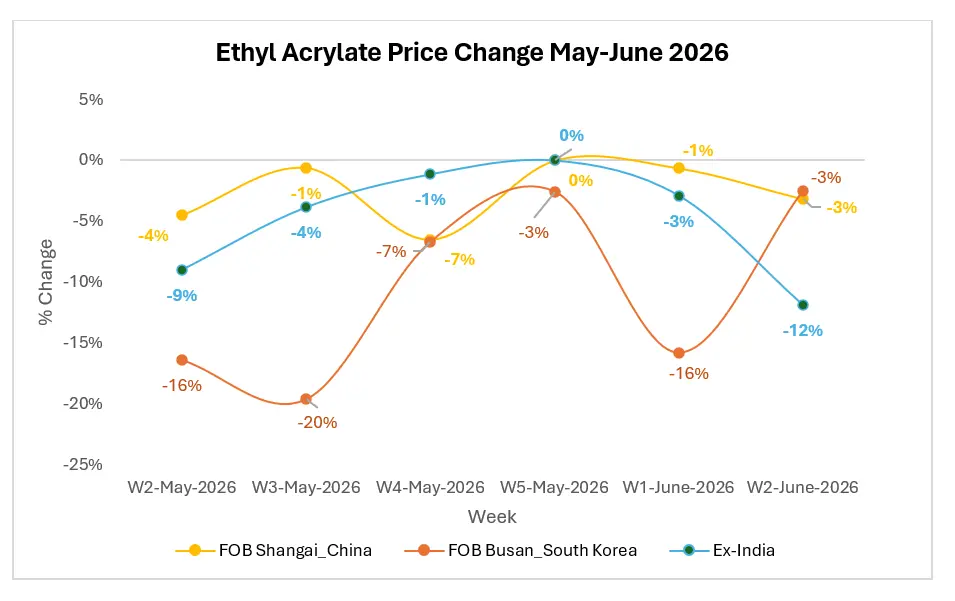
Source: Price-Watch™ Ethyl Acrylate Prices
Ethyl Acrylate Demand Growth Keeps India a Key Import Market
India remained one of the strongest demand centers for Ethyl Acrylate in Asia. Consumption was supported by robust activity in paints and coatings, pressure-sensitive adhesives, textiles, packaging, and construction chemicals. As domestic demand continued to expand, Indian buyers remained active in import markets, particularly during periods of favorable FOB Asia pricing.
Infrastructure investments, growth in the decorative coatings segment, and increasing adoption of water-based formulations continued to support long-term demand fundamentals. However, fluctuations in freight costs and feedstock-driven price movements encouraged buyers to maintain disciplined inventory management practices.
Ethyl Acrylate Producers in South Korea Face Competitive Pressures
South Korea’s Ethyl Acrylate market faced a more challenging environment during 2026. Producers encountered growing competition from Chinese exporters while navigating fluctuating feedstock costs and uncertain export demand.
Despite stable operating rates at major petrochemical complexes, manufacturers remained focused on preserving margins amid pressure from regional oversupply. Demand from downstream coatings, electronics, and specialty chemical sectors provided a degree of stability, although export inquiries remained uneven throughout the period.
Across the region, the market continued to be shaped by developments in the acrylic acid value chain. Changes in propylene availability, operating rates at major acrylate facilities, and fluctuations in energy markets directly influenced production economics. At the same time, demand from coatings, adhesives, and textile applications remained resilient, preventing significant market weakness despite ample supply availability.
Ethyl Acrylate Market Outlook
Looking ahead, the Ethyl Acrylate market is expected to remain closely tied to acrylic acid fundamentals and regional industrial activity. Buyers are likely to maintain cautious purchasing strategies while monitoring feedstock trends, export opportunities, and inventory levels.
Although competitive pressures may persist, steady downstream demand growth across key end-use industries is expected to provide support for market fundamentals through the remainder of 2026.
As Asian producers continue balancing capacity utilization with changing demand patterns, the Ethyl Acrylate market may increasingly be influenced by operational efficiency, export competitiveness, and feedstock management rather than outright supply availability.
Follow Price-Watch™ on LinkedIn for real-time raw material insights, pricing trends, supply chain intelligence, and market updates shaping global commodity markets.