

The testliner landscape at Laem Chabang is showing signs of cautious stability after weeks of choppy trading. Weak downstream demand from corrugated box plants serving Thailand’s manufacturing and export oriented industrial base has met steady inflows of imported recycled containerboard, expanded regional supply and kept prices under pressure.
Add to this the persistent volatility in OCC (Old Corrugated Containers) feedstock costs, elevated marine freight on intra-Asian routes, and cautious inventory management by paper mills and box manufacturers, and the result is a market where sentiment remains subdued. For exporters routing through Laem Chabang and Bangkok ports, navigating these dynamics is becoming increasingly challenging.
How Testliner Prices Reached Recent Peaks
Before the latest price softening, the FOB Laem Chabang testliner market had been on a firm upward trajectory, driven by a combination of feedstock tightness and logistics disruption. Geopolitical tensions in the Red Sea and the rerouting of cargoes around the Cape of Good Hope disrupted OCC import flows into Thai ports, forcing mills to rely more heavily on domestic recovered paper collection.
With OCC availability tightening, prices for imported and domestic brown grades climbed sharply, pushing testliner production costs higher across the Thai mill base.
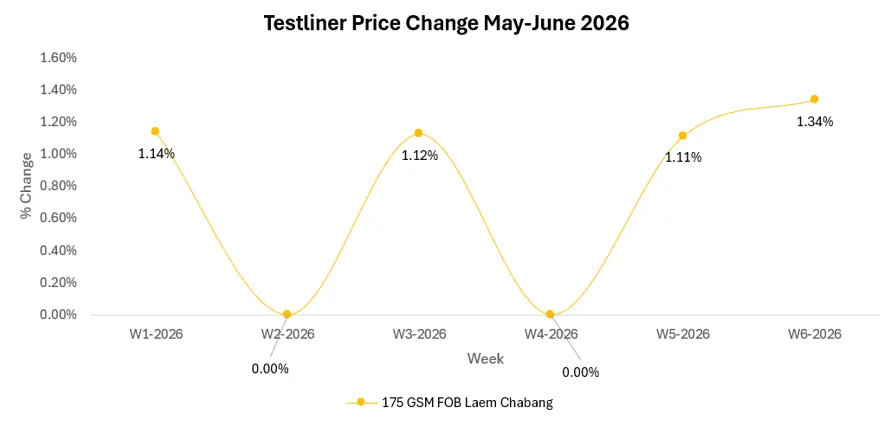
Source: Price Watch™ Testliner
Several mills across the Eastern Seaboard and central Thailand cut operating rates amid energy cost pressure and feedstock shortages, restricting available export volumes and leaving overseas buyers particularly in Vietnam, China, and the wider Southeast Asian belt scrambling for committed tonnage.
With limited material in the spot market, traders leveraged the scarcity, selling available testliner at elevated FOB levels. Rising electricity, natural gas, and steam costs at Thai mills, coupled with higher container freight rates ex Laem Chabang, further intensified the upward price momentum.
On top of these factors, the weakening Thai baht against the US dollar amplified offered costs for international buyers, while making FOB export realisations more attractive for Thai mills in baht terms.
Importers in regional markets faced delayed shipments, partial allocations, and uncertainty in supply timing, creating a tense and highly constrained market environment where securing material often meant paying a premium over published benchmarks. The combined effect of feedstock tightness, freight disruption, and currency fluctuations made the market notably challenging through the peak phase.
Testliner Market Reacts to Easing Supply
What’s happening in the FOB Laem Chabang testliner market right now? Prices are on a softening trend as OCC import flows into Thai ports have normalised, easing feedstock cost pressure and giving mills room to lower export quotations. Improved intra-Asian shipping availability has also helped calm the market, allowing committed cargoes to move more freely to regional destinations.
Meanwhile, kraft pulp and recovered paper benchmarks across Asia have softened as downstream corrugated demand remains subdued, particularly across China’s export packaging segment and Vietnam’s manufacturing sector.
Buyers are cautious, purchasing mainly for immediate production needs, while Thai mills are reducing spot offers amid thin trading activity. With domestic inventories still elevated and seasonal restocking yet to gather pace, suppliers are even offering export tonnage below recent contract levels to clear stocks. The result is a calmer, more competitive market and softer FOB Laem Chabang prices for regional buyers.
Testliner Market Outlook
So, what’s in store for Thailand’s testliner export market? After a period of elevated prices and tight feedstock supply, conditions are starting to ease. Ample OCC availability at Thai ports, combined with elevated mill inventories, is keeping export buyers cautious, while softer recovered paper costs across Asia are reducing production expenses for testliner grades.
Key regional buying markets, especially China, Vietnam, and Indonesia, are resuming regular procurement but at measured volumes, ensuring smoother but disciplined import flows from Thai ports.
All these factors point to one clear trend FOB Laem Chabang testliner prices are likely to remain under pressure in the near term, giving overseas converters some relief but posing margin challenges for Thai mills and traders who committed feedstock at earlier, higher levels.
Continued monitoring of OCC import parity, intra-Asian freight rates, and regional corrugated demand will be critical as the market navigates this transition phase. Mills with strong domestic OCC sourcing networks and disciplined inventory management are best positioned to weather the current softness.
Subscribe to Price-Watch™ today to get weekly updates and stay informed on FOB Laem Chabang testliner price movements.
Follow Price-Watch™ on LinkedIn for real-time raw material insights, pricing trends, supply chain intelligence, and market updates shaping global commodity.