

Global fertilizer markets are in the middle of their sharpest supply shock since the 2021-22 energy crisis, and this time the trigger is the Strait of Hormuz, not Russia or Belarus.
Since fighting between the USA,Israel and Iran broke out in late February 2026, the near-closure of the strait a route carrying roughly a third of the world’s seaborne fertilizer trade had pushed prices and rattled food-security planners everywhere.
Two recent moves capture how governments and producers are responding, a defensive subsidy from Paris, and an offensive capacity bet from Doha.
France’s short-term relief, long-term hedge
On July 9, Paris unveiled a two-track response. In the near term, farmers get direct cash €50 per tonne of nitrogen fertilizer purchased, capped at half of 2025 usage, rising to €70 per tonne where fertilizer costs exceed 10% of operating expenses.
The scheme draws on France’s €107 million share of a €540 million EU farm-support package, topped up to roughly €145 million with national funds.
Longer term, France is backing a €2 billion, 10-year industrial program including €620 million in public funds to modernize plants and build new low-carbon nitrogen capacity, aiming to lift domestic output 20% by 2032.
| Metric | Value |
| Immediate aid | €50-70/t nitrogen fertilizer |
| National funding | €145M (of €540M EU package) |
| Industrial plan | €2B over 10 years |
| Output target | +20% domestic nitrogen by 2032 |
Qatar’s bet on becoming the “urea capital of the world”
While France plays defense, Qatar is playing offense. Contractors including consortia led by Tecnimont/Larsen & Toubro, Samsung E&A/Thyssenkrupp/CCC, and Saipem/CTCI/CC7 have bid on QatarEnergy’s Mesaieed expansion, which would add 6.4 million tonnes a year of low-carbon ammonia and urea capacity.
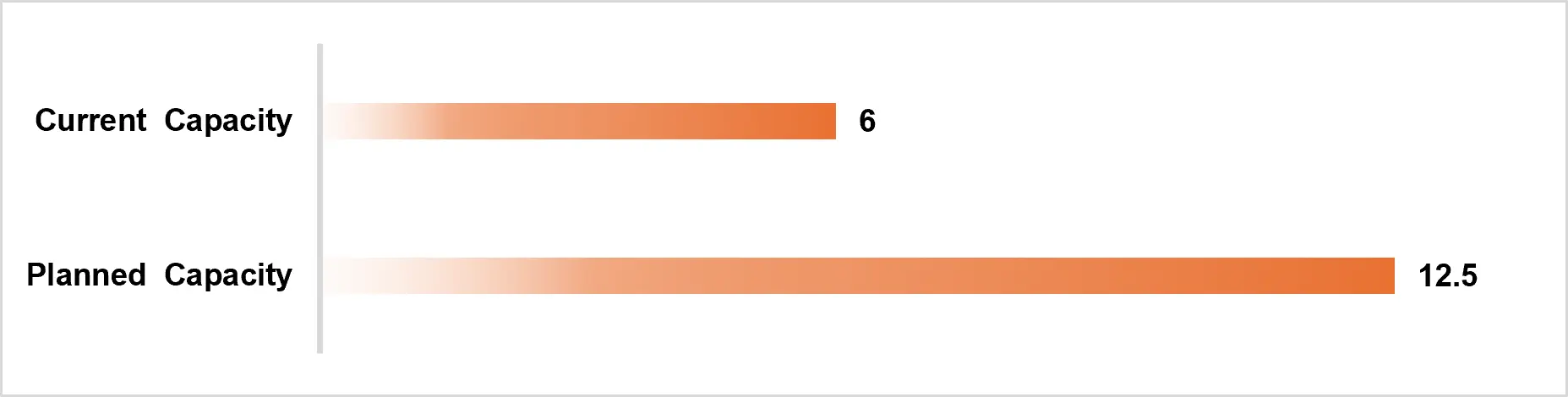
It’s part of a plan to nearly double national urea capacity from 6 million to more than 12.4 million tonnes by 2030, alongside the $1.2 billion Ammonia-7 project, set to be the world’s largest blue ammonia facility.
CEO Saad Sherida Al-Kaabi has framed the bet around demographics, as global population grows by an estimated 1.5-2 billion people over the next few decades, urea demand for food production will climb sharply.
Qatar urea capacity Current Capacity & Planned Capacity, Million Tones
What does this mean for the market
These two moves point to a bifurcating market: import-dependent regions building demand-side insulation through subsidies and domestic capacity, while Gulf producers double down on supply-side consolidation, betting cheap gas and low-carbon capacity will let them dominate global urea supply once the conflict eases.
The World Bank projects urea prices could rise nearly 60% in 2026 before easing in 2027, with DAP and potash seeing more moderate gains risks skew upward if the Hormuz disruption drags past Q3 2026 or China tightens exports further.
How other countries are hedging
France and Qatar are not alone. Government and producers worldwide are pursuing a range of strategies to insulate their agriculture sectors from fertilizer price volatility.
| Country | Strategy |
| France | Subsidy and capacity build |
| Qatar | Major capacity expansion |
| Brazil | Petrobras plant revival for import independence |
| India | ~$32B in existing subsidies |
| China | Export restrictions |
| United States | Duty relief on Moroccan imports |
| Morocco | Alternative phosphate supply (OCP) |
Reviving Petrobras to reclaim “national sovereignty”
Brazil adds a third capacity-expansion data point alongside France and Qatar and frames it explicitly around geopolitical exposure.
On June 26, President Luiz Inacio Lula da Silva restarted construction on Petrobras’ long-suspended UFN-III nitrogen fertilizer plant in Tres Lagoas, calling domestic fertilizer production “a strategic issue for national sovereignty.”
The project draws more than R$5 billion in investment under Brazil’s Novo PAC program, is already 81% complete, and is set to begin commercial operations in 2029 with China’s Power China among the contractors finishing the build.
UFN-III alone will produce about 1.3 million tonnes of urea a year, roughly 16% of Brazil’s current domestic demand.
It’s one of four Petrobras fertilizer units under Novo PAC (alongside Fafen-BA, Fafen-SE, and ANSA) together they’re expected to supply around 35% of Brazil’s urea market by 2029, cutting into an import dependence that officials say the Ukraine war exposed as a serious vulnerability.
The Bigger Picture
France, Qatar, and now Brazil preview how the whole market is likely to evolve, importers building buffers and domestic capacity against future chokepoint shocks, while low-cost Gulf producers race to lock in market share on the supply side.
Brazil’s move is notable because it recasts fertilizer self-sufficiency as a matter of sovereignty rather than pure economics a framing that may spread to other large importers if the Hormuz disruption or a future shock repeats the pattern.
Sub-Saharan Africa, lacking both the fiscal firepower of Europe and the industrial base Brazil is now building, remains the most exposed a gap multilateral lender will likely be pressed to fill if the price surge doesn’t unwind by 2027 as forecast.
For more such details visit Price Watch™. Our platform delivers real-time data and expert analysis, offering deep insights into the key factors driving price fluctuations in the fertilizer (DAP, Ammonia, Sulphur, Ammonium Nitrate, SSP, Urea, TSP etc) market.
By tracking critical events such as geopolitical tensions, supply chain disruptions, and economic shifts, Price Watch™ keeps you fully informed of market dynamics.
Track Price Watch™ fertilizer price assessment on a weekly basis from 2015 onwards along with short term forecasts and get access to the detailed report in downloadable format.
Follow Price Watch™ on LinkedIn for real-time fertilizer market insights, pricing trends, supply chain intelligence, and global commodity updates.