

Before you read: three questions this report answers
1) Why did Indian Acetone rise approx. 120% in six months when Taiwanese and Korean import offers rose only approx. 60-85%?
2) Can one plant’s 215,000-tonne Acetone co-product erase a 151,000-tonne import bill?
3) Why is Acetone, not Phenol, the product most exposed to the Haldia reset?
Inside this report
1 Acetone’s two-quarter sprint: approx. 35% then approx. 84%: domestic bulk tanker rates versus import offers
2 The premium that opened up: Domestic outran Korea and Taiwan by approx. 35-60 points
3 What lands at Haldia on 14 October: 215 KTPA Acetone, 345 KTPA Phenol, on purpose propylene
4 From import gap to surplus: Acetone flips first capacity vs demand to 2028
5 Phenol: the quieter half of the chain: approx. 10.5% then approx. 59%, and a 40% import share to defend
6 What to watch next: Ramp up, propylene, Korean and Taiwanese response
Ask any pharma solvent buyer in Hyderabad or paint formulator in Gujarat what 2026 has felt like and they will name one molecule: Acetone. Domestic bulk tanker rates climbed roughly approx. 35% in the first quarter and a further approx. 84% in the second, the sharpest move in India’s chemical basket.
Now, on 14 October 2026, Haldia Petrochemicals switches on a ₹6,000 crore ($627 million) complex whose Acetone co-product alone is roughly 1.4 times the volume India imported last year. The question is not whether the market resets it is how much of this year’s rally survives.
| approx. 35% / approx. 84%
Acetone domestic, Q1 / Q2 2026 |
approx. +120%
cumulative H1 2026, Acetone bulk tanker |
215 KTPA
Acetone capacity at Haldia |
151 KT
India Acetone imports, 2025 |
Acetone’s two-quarter sprint
The Middle East supply shock of late Q1 cut Gulf cargoes, spiked tanker freight and pushed import replacement costs sharply higher. Acetone, already the tighter half of the Phenol-Acetone chain in India, reacted first.
Domestic bulk tanker rates rose about approx. 35% quarter-on-quarter in Q1 2026 and then accelerated to roughly approx. 84% in Q2. Import offers followed but lagged: Taiwanese CFR India offers rose about approx. 7% and then approx. 52%, while South Korean offers rose roughly approx. 16.5% and then approx. 68%.
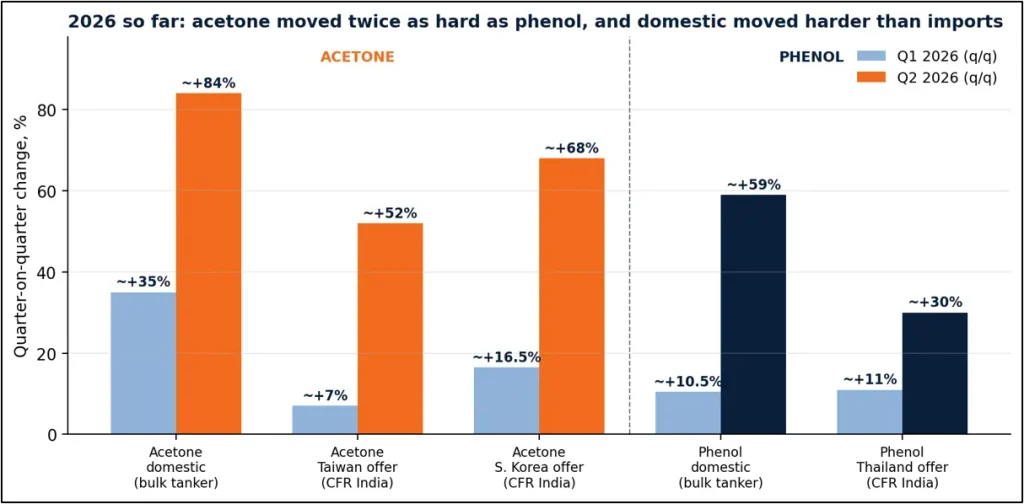
Figure 1 · Quarter-on-quarter change in India Acetone and Phenol prices, 2026, Source: Price Watch™
Table 1 · Quarterly price moves, India market, 2026 (approx. % change q/q)
| Product / basis | Q1 2026 | Q2 2026 | H1 cumulative* | Read-across |
| Acetone – domestic bulk tanker | approx. 35% | approx. 84% | approx. 120% | Fastest-moving item in the Indian basket |
| Acetone – Taiwan offer, CIF India | approx. 7% | approx. 52% | approx. 60% | Import parity lagged domestic by approx. 60 points |
| Acetone – South Korea offer, CIF India | approx. 16.5% | approx. 68% | approx. 85% | Closest tracker of domestic tightness |
| Phenol – domestic bulk tanker | approx. 10.5% | approx. 59% | approx. 70% | Roughly half the Acetone move |
| Phenol – Thailand offer, CIF India | approx. 11% | approx. 30% | approx. 40% | Import parity stayed comparatively calm |
*Source: Price Watch™ calculation, approx.: Q1 and Q2 changes added, Dec 2025 base.
The premium that opened up
Add the two quarters together and the picture sharpens. Domestic Acetone is up about approx. 120% since December the Korean offer is up approx. 85% and the Taiwanese offer approx. 60%.
That leaves an approximate approx. 35-60 percentage point gap between what Indian buyers paid at the tank and what overseas sellers were quoting at the port, a premium built on scarce tanker slots, delayed Gulf arrivals and a single dominant domestic producer.
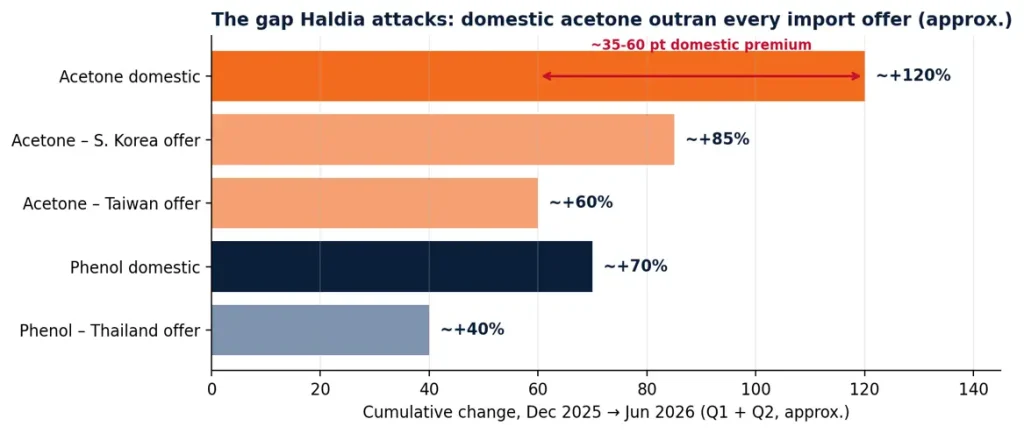
Figure 2 · Cumulative H1 2026 change (approx.), domestic versus import offers Source: Price Watch™
| Curious fact
Phenol’s domestic premium over its main import offer widened by roughly approx. 30 points in H1 2026. Acetone’s widened by up to approx. 60. Same plants, same feedstock, same quarter, but Acetone has no second Indian supplier to discipline it. Until 14 October. |
What lands at Haldia on 14 October
Developed through subsidiary Adplus Polymers & Chemicals, the Haldia complex pairs India’s largest Phenol unit with the country’s first on purpose propylene plant based on olefin conversion technology.
Every tonne of Phenol brings roughly 0.62 tonnes of Acetone whether the market wants it or not, so 345 KTPA of Phenol means 215 KTPA of Acetone, produced on the east coast, far from the Kandla-Dahej axis that sets prices today.
Table 2 · Haldia Phenol-Acetone complex at a glance
| Parameter | Value | Why it matters for Acetone buyers |
| Investment | ₹6,000 crore (≈$627 million) | Largest chemical project in West Bengal |
| Acetone capacity | 215 KTPA | ≈70% of India’s consumption 1.4× 2025 imports |
| Phenol capacity | 345 KTPA | India’s largest single unit ≈55% of demand |
| Propylene | On purpose, olefin conversion technology | Removes the feedstock constraint behind past outages |
| Inauguration | 14 October 2026 | Ramp-up through Q4 FY2027 |
| Location | Haldia, West Bengal | First east coast supply for Kolkata, Bihar and UP clusters |
Source: Price Watch™
From import gap to surplus
India consumes roughly 300 KTPA of Acetone against about 200 KTPA of domestic nameplate, importing 151 KT in 2025 worth around $150 million. Haldia lifts capacity to about 415 KTPA, a surplus of 100 KT before Deepak Chem Tech’s planned 185 KTPA addition by FY2028.
Phenol follows the same path from a 240 KT import gap to surplus, but Acetone crosses the line first and by a wider margin.
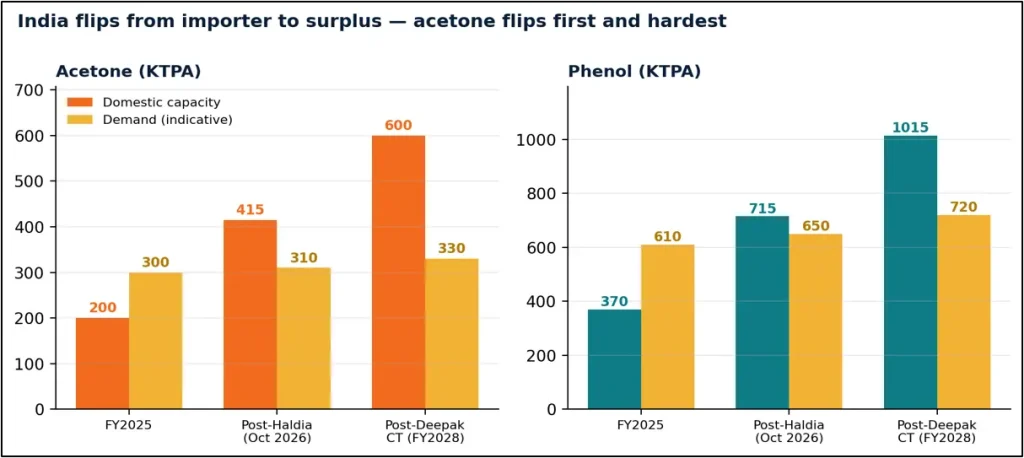
Figure 3 · Domestic capacity versus indicative demand, Source: Price Watch™ estimates
Table 3 · India Acetone & Phenol balance (KTPA, indicative)
| Acetone demand | Acetone capacity | Phenol demand | Phenol capacity | Position | |
| FY2025 | approx. 300 | approx. 200 | approx. 610 | approx. 370 | Net importer (Acetone 151 KT Phenol approx. 240 KT) |
| Post-Haldia (Oct 2026) | approx. 310 | approx. 415 | approx. 650 | approx. 715 | Surplus on both Acetone +100 KT |
| Post-Deepak Chem Tech (FY2028) | approx. 330 | approx. 600 | approx. 720 | approx. 1,015 | Structural exporter Acetone +270 KT |
Source: Price Watch™
The arithmetic buyers forget
Run Haldia at 80% in its first full year and India adds approx. 170 KT of Acetone against approx. 150 KT of imports it no longer needs. The approx. 120% H1 rally was built on scarcity; the approx. 60-point premium over Taiwanese offers is the first thing that scarcity’s disappearance takes back.
Phenol: the quieter half of the chain
Phenol moved too domestic bulk rates up about approx. 10.5% in Q1 and approx. 59% in Q2, with Thai CFR offers up approx. 11% and approx. 30% but its premium over imports widened far less, because Deepak Phenolics at Dahej already anchors approx. 57% of the market and imports from Thailand, Singapore and Korea fill a approx. 40% share.
Haldia’s 345 KTPA turns that 40% import share into a modest surplus and attacks the ₹5-10/kg freight and tanking premium inland buyers pay to haul western port material east.
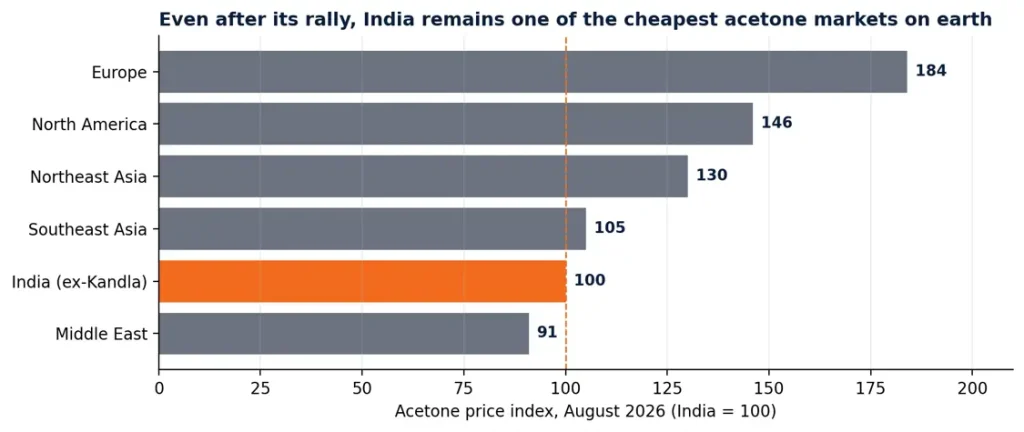
Figure 4 · Regional Acetone price index, August 2026 (India = 100) the export outlet for any surplus, Source: Price Watch™
Table 4 · Where the reset bites first (Price Watch™ assessment)
| Segment | Key input | H1 2026 input inflation | Exposure to Haldia reset |
| Pharma solvents, South & West India | Acetone | approx. 120% | Highest – import-parity pricing returns |
| Paints, coatings, IPA/MIBK | Acetone | approx. 120% | High – surplus seeks derivative outlets |
| Laminates / plywood, East India | Phenol | approx. 70% | High – first east-coast supply |
| Phenolic resins, North India | Phenol | approx. 70% | Medium – inland premium compresses |
| BPA / polycarbonate | Both | approx. 70% / approx. 120% | Medium – integrated buyers absorb |
Source: Price Watch™ estimates
Phenol-Acetone Market Outlook
▪ Ramp-up speed: new Phenol-Acetone units typically take 3-6 months to reach stable rates Q1 2027 is the first real price test.
▪ Korean and Taiwanese response: sellers whose offers rose approx. 60-85% in H1 must discount into India or redirect to Southeast Asia, where Acetone trades only approx. 5% above Indian levels.
▪ Propylene and benzene: on purpose propylene protects Haldia’s rates, but Asian benzene still sets the Phenol floor and, through co-product economics, the Acetone ceiling.
▪ Deepak’s counter-move: Deepak Chem Tech’s 185 KTPA Acetone and 165 KTPA polycarbonate project by FY2028 decides whether the surplus is absorbed at home or exported.
The approx. 84% quarter was a scarcity story. The next two quarters are a supply story.
Stay ahead of the reset with Price Watch™
Price Watch™ tracks domestic bulk tanker rates and CFR India import offers for Acetone and Phenol from Taiwan, South Korea and Thailand, alongside the benzene propylene feedstock chain and the freight charges that move them, in near real time. That is how procurement teams saw the 85-point Acetone premium open and how they will see it close.
Follow Price Watch™ on LinkedIn for weekly Acetone and Phenol price updates, chemical market intelligence, freight trends, supply-demand developments, and global commodity insights.