

The global Glycerine market is entering a new phase of trade uncertainty as recently announced US tariffs are expected to influence sourcing strategies, regional competitiveness, and international trade flows.
A widening cost gap among major suppliers may shift US buying patterns and redirect Asian cargoes.
A Tariff Lands on All Six Markets, But Not at the Same Rate
The USTR finalized a Section 301 forced labor tariff effective July 25, 2026, covering more than 80 trading partners. India, Indonesia, and Malaysia face a 10% duty, the lower rate reserved for countries with some forced labor import prohibitions already in place, while China, Brazil, and Spain face a steeper 12.5% rate.
The move backfills an expired blanket 10% tariff, and lands alongside a separate, pending case: Vantage Specialty Chemicals petitioned in January for antidumping duties on vegetable based fatty acids from Indonesia and Malaysia, the same oleochemical family as glycerine.
What the Rate Gap Means for Trade Flows
The 2.5 point spread is small, but it still matters in a low margin commodity like glycerine. India, Indonesia, and Malaysia now hold a modest cost edge into the US over China, Brazil, and Spain, and Indonesia’s position is further complicated by tightening crude output as the B50 mandate diverts more CPO into biodiesel.
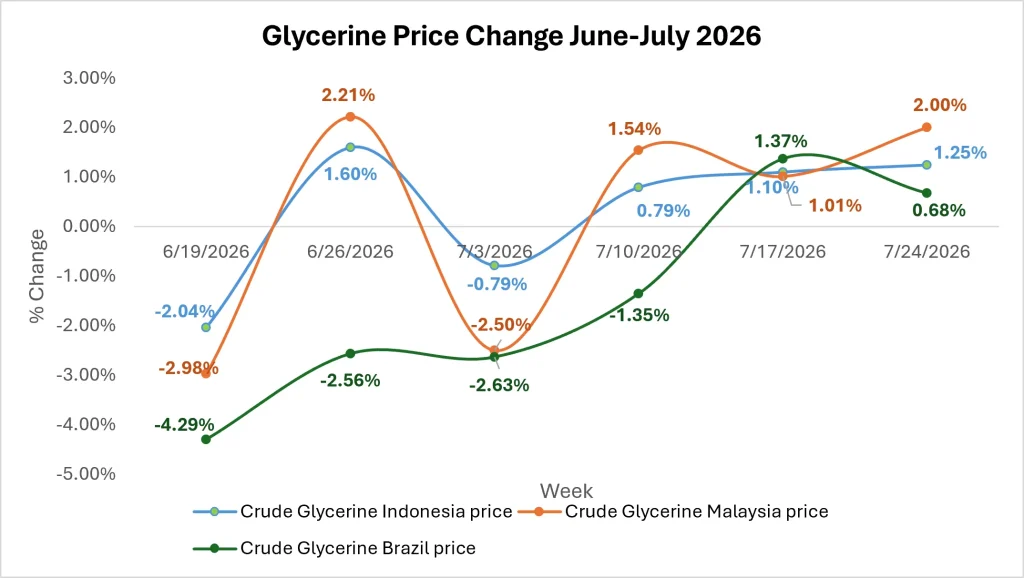
Source: Price Watch™ Glycerine Prices
Pricing already reflects some of that imbalance: Indonesia and Malaysia posted weekly gains as high as 2.2% through July, while Brazil’s benchmark stayed the weakest of the three, only turning positive in the final two weeks after four straight declines.
Brazil now faces the steeper tariff on top of the softer market, and has called its rate arbitrary, threatening WTO action and retaliatory tariffs.
Watch These Two Signals
- Whether US buyers shift volume toward the 10% tier of India, Indonesia, and Malaysia
- Whether Brazil’s retaliation threat or the Vantage antidumping case adds another layer of duties
Glycerine Market Outlook
Looking ahead, the global Glycerine market is expected to remain highly influenced by trade policy over the next three months. Buyers are likely to reassess sourcing strategies based on tariff differentials, while exporters seek alternative markets to maintain shipment volumes.
US procurement trends, the outcome of anti-dumping investigations, Brazil’s potential WTO action, biodiesel policies, feedstock availability, and freight costs will remain the key factors shaping global Glycerine trade in the coming months.
Follow Price Watch™ on LinkedIn for real-time Glycerine market insights, Glycerine price trends, supply chain intelligence, and global commodity updates.