

After months of supply pressure and high prices, improving crop prospects and policy changes are bringing relief to the raw jute market. But will this result in a sustained price correction?
For most of 2026, West Bengal’s raw jute market has been facing supply challenges due to limited fibre availability, higher procurement costs, and tight inventories.
Many jute mills struggled to secure sufficient raw material, while some reduced operations due to rising input costs.
However, with the arrival of the new jute season in July, the market has started showing early signs of improvement.
According to Price Watch™ data, Raw Jute TD-5 Ex-Nadia prices have started declining after remaining stable for several weeks, registering a marginal correction of 0.62%.
Although the decline is limited, it indicates that supply conditions are gradually improving and market sentiment is changing.
Is West Bengal Raw Jute Market Moving Towards Recovery?
The raw jute market is entering a transition phase after months of tight supply and elevated prices. Better crop expectations and rising availability of fresh fibre are helping reduce supply concerns.
However, the current price movement indicates gradual market balancing rather than a sharp correction, as the industry is still recovering from earlier supply constraints.
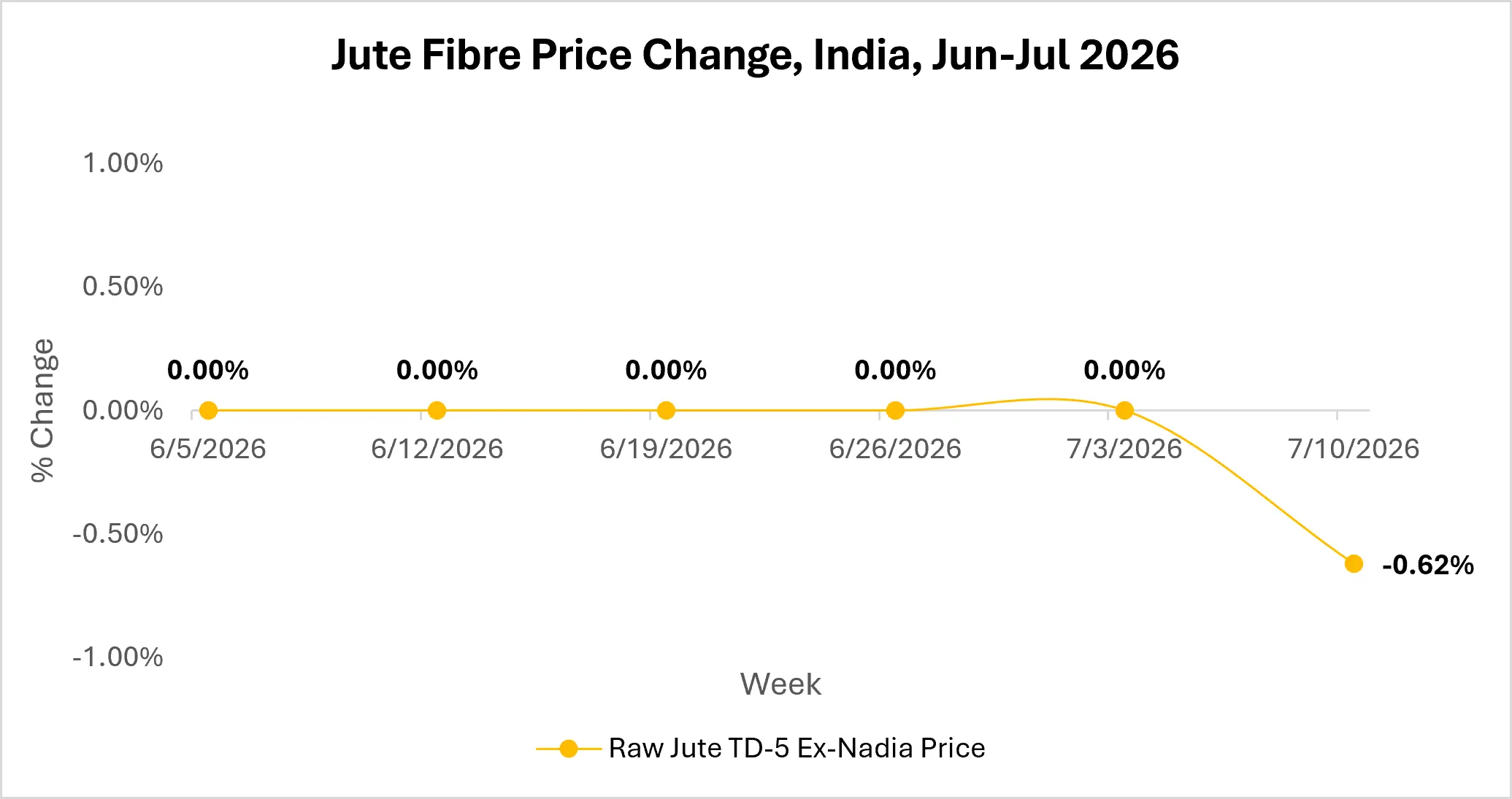
Source: Price Watch™ Jute Fibre
Can Fresh Crop Arrivals Improve Raw Jute Supply Conditions?
The recent price softening is mainly linked to improving supply prospects.
Favourable monsoon conditions and healthy crop development have increased expectations that India’s 2026-27 raw jute production could reach around 95 to 100 lakh bales.
Higher production is expected to improve fibre availability and reduce the shortage faced earlier in the year.
Fresh crop arrivals have also started reaching mandis across West Bengal. Increased availability is encouraging traders to adjust quotations.
However, the price direction will depend on arrival pace and crop quality in the coming weeks.
Will Raw Jute Stock Limit Removal Support Market Stability?
A key policy change has supported market confidence. In early July, the Office of the Jute Commissioner removed stock holding limits on raw jute, allowing traders, balers, and mills to maintain higher inventories.
The removal of restrictions is expected to improve raw jute movement, support smoother procurement, and provide more flexibility across the supply chain.
Has the Raw Jute Supply Shortage Fully Ended?
Although supply conditions are improving, the market has not completely moved out of the shortage phase.
Earlier supply constraints and high raw material costs continue to impact mill operations. The recent price decline reflects improving availability and better market sentiment, but inventory levels, crop arrivals, and mill buying activity will remain important factors.
Why Are Raw Jute Prices Staying Firm Despite Better Supply?
Despite improving supply prospects, several factors are supporting raw jute prices:
- Continued procurement by jute mills to meet production requirements.
- Government support through the Minimum Support Price of ₹5,925 per quintal for the 2026-27 season.
- Stable demand for jute packaging due to mandatory packaging requirements for food grains and sugar.
- Rising global interest in sustainable packaging solutions.
These factors are expected to limit any sharp decline in raw jute prices.
Jute Market Outlook
With fresh crop arrivals improving and supply conditions gradually easing, raw jute prices may witness further softening in the coming months.
However, strong mill demand, MSP support, and steady packaging demand are likely to restrict any major price correction. The market is expected to move towards a more balanced pricing environment as supply improves.
For detailed raw jute price trends, market insights, forecasts, and the latest industry developments, subscribe to Price Watch™ for reliable commodity intelligence.
Follow Price Watch™ on LinkedIn for real-time raw material insights, pricing trends, supply chain intelligence, and market updates shaping global commodity markets.