

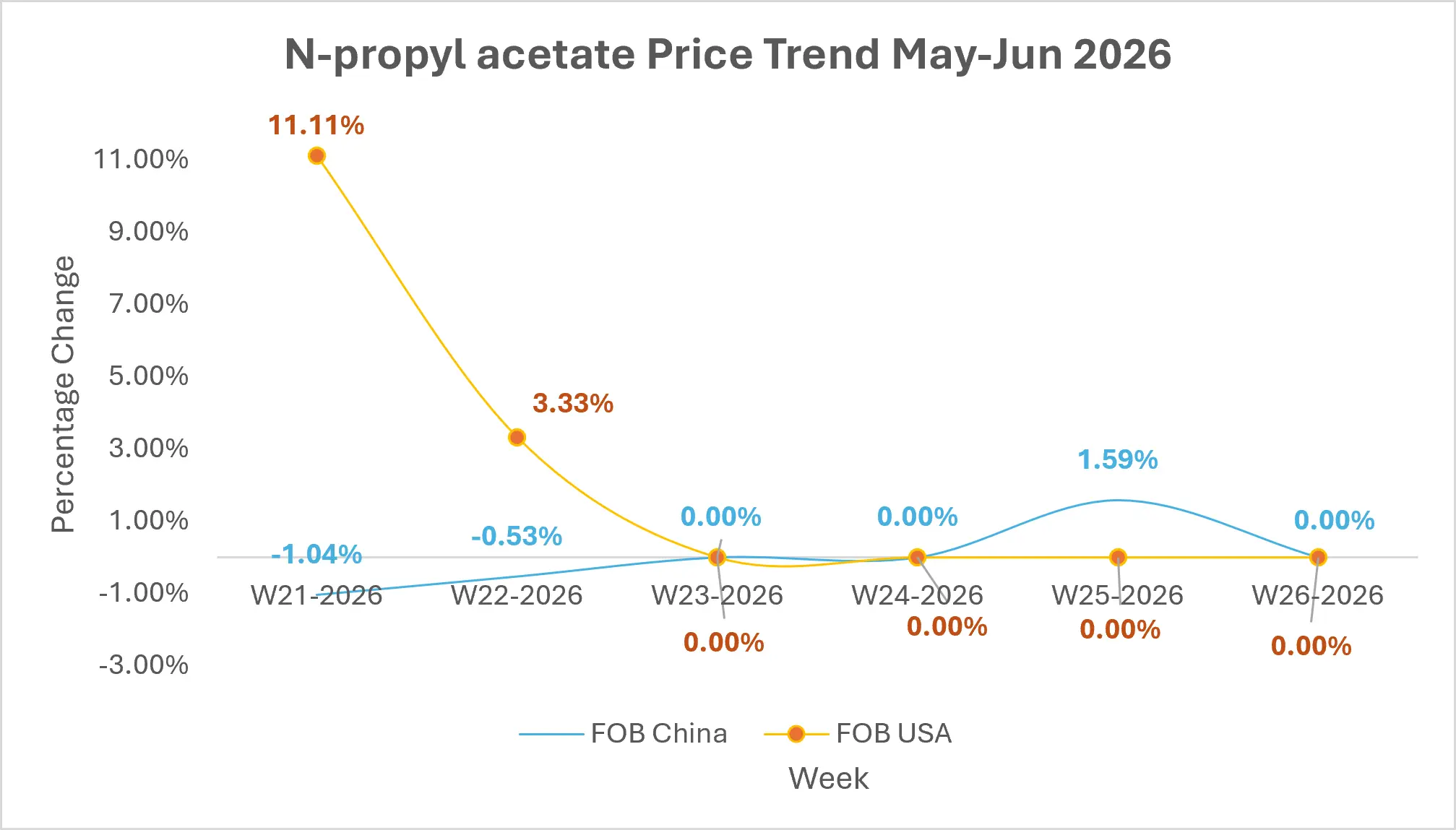
The global N-Propyl Acetate market delivered one of its most striking regional divergences during W21–W26 of 2026. While FOB China prices softened before recovering modestly, FOB USA prices surged sharply within two weeks before stabilizing for the remainder of the period.
N-propyl acetate is produced through esterification of acetic acid and n-propanol. Both feedstocks felt the impact of the Iran conflict in early 2026. Acetic acid in China stayed relatively contained due to coal-based methanol production insulating domestic costs from crude oil swings.
N-propanol in China, however, spiked nearly 38% at its April peak before easing.
US producers faced a sharper input cost shock. Acetic acid in the USA is methanol-derived, and methanol prices surged with natural gas costs as Gulf Coast energy markets reacted to the Hormuz closure. That is why FOB USA prices jumped first and harder, while FOB China moved with more restraint.
Something unusual showed up in the n-propyl acetate data between W21 and W26 2026. FOB China and FOB USA did not move together. They moved in opposite directions. China dipped slightly in W21 and W22, went flat for two weeks, then recovered modestly in W25.
USA jumped over 11% in W21, added another 3.33% in W22, then went completely flat for the remaining four weeks. Same product, same period, two very different stories. That divergence is worth understanding.
CIF Turkey and CIF Vietnam, which import from China, saw prices ease through May before the W25 China recovery nudged offers back up. India CIF and Ex-Kandla domestic prices tracked Chinese origin values closely, with Ex-Kandla carrying a modest logistics premium.
CIF Turkey and CIF Peru importing from the USA faced a steeper landed cost increase in May, though the four-week plateau in FOB USA gave buyers time to adjust.
Paint and coatings manufacturers in Turkey, the single largest CIF destination for both origins, reported that the sudden US price surge in W21 pushed some buyers to seek Chinese origin cargoes as an alternative, creating a brief but notable arbitrage window.
Source: Price Watch™ n-Propyl Acetate Prices
Key Developments in the last 6 weeks
• FOB China n-propyl acetate dipped 1.55% across W21 to W22 then recovered 1.59% in W25, ending the period marginally higher; FOB USA surged over 14% across W21 to W22 before plateauing completely for four consecutive weeks.
• The widening FOB China versus FOB USA price gap in W21 and W22 pushed Turkey and Vietnam buyers to increase Chinese origin bookings, partially displacing US supply in Southeast Asian and Mediterranean trade lanes.
Value Chain Impact: Solvents, Pharmaceuticals and Coatings
Two value-chain dynamics define this period. First, the China-USA price spread widened sharply in W21 and W22 as US feedstock costs spiked faster. At the peak, FOB USA was priced approximately 60% above FOB China, well above the historical average differential.
Second, downstream buyers in Vietnam and India used the Chinese price dip in W21 and W22 as a restocking window before the W25 recovery. Turkey-based buyers split procurement between both origins to manage landed cost risk.
N-Propyl Acetate Market Outlook
FOB China n-propyl acetate looks rangebound to slightly firm through July 2026. Acetic acid costs in China have stabilized and n-propanol values are easing off their April peak, which should keep production costs from rising further.
Demand from Turkey and Vietnam for Chinese origin cargoes is solid after the partial shift away from US supply. FOB USA faces a different dynamic; if US acetic acid costs ease as Gulf Coast methanol markets normalize post-ceasefire, there is scope for US offers to soften from their W22 highs.
However, US domestic coatings demand ahead of the summer construction season may absorb any surplus before it reaches the export market.
- US methanol costs tied to natural gas are the primary variable for FOB USA. Chinese coal-route acetic acid gives China structural cost stability, but any propylene volatility will affect n-propanol and therefore FOB China too.
- If the spread narrows back toward historical norms of 40 to 50%, expect some volume to shift back from Chinese to US origin in Turkey and Peru markets where freight economics allow both origins to compete.
China had coal-route protection this time. But what happens to the FOB China floor if n-propanol costs rise again before acetic acid stabilizes?
Follow Price Watch™ on LinkedIn for real-time raw material insights, pricing trends, supply chain intelligence, and market updates shaping global commodity markets.