

Rising costs usually create a stronger price floor. China’s SAP market showed what happens when demand becomes too weak to support that equation.
In June 2026, SAP prices in China followed a pressured trend as weak buying activity from hygiene product manufacturers outweighed support from upstream markets.
Despite temporary periods of stability during the month, the SAP price trend in China remained under pressure as buyers continued limiting procurement to immediate requirements.
The unusual movement came from the feedstock side. Propylene values strengthened during the period, normally creating upward pressure across the acrylic acid value chain. However, acrylic acid prices moved in the opposite direction as downstream demand failed to absorb higher production costs.
This price-cost divergence highlighted a deeper imbalance in the market, where consumption weakness became stronger than raw material support.
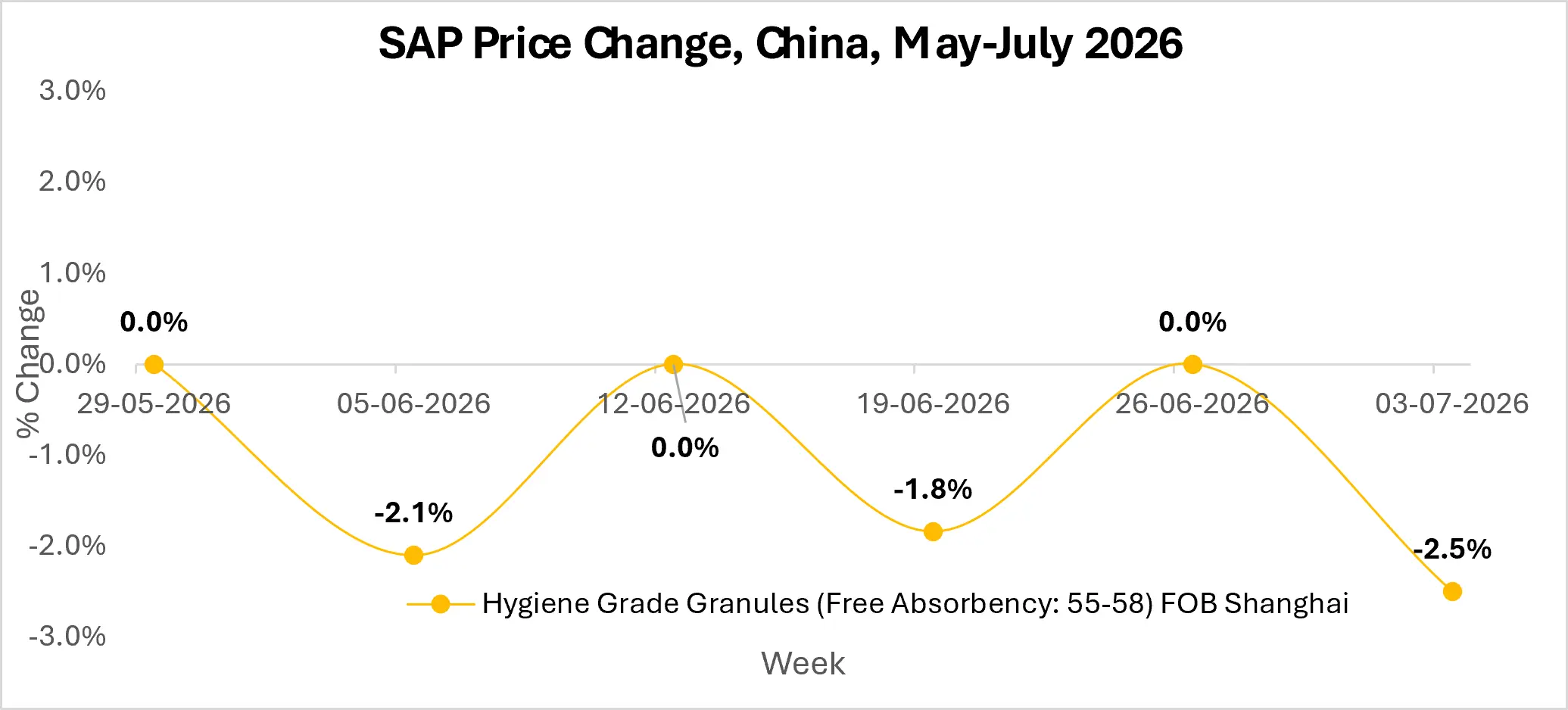
Source: Price Watch™ Super Absorbent Polymer Prices
For SAP producers, the challenge became more complicated. Ample domestic availability, slower export discussions, and increasing inventory pressure encouraged suppliers to maintain competitive FOB China offers. Instead of passing higher costs downstream, producers faced narrowing margins as they prioritized sales movement.
How China’s SAP Value Chain Is Adjusting
The pressure is spreading across the hygiene supply chain.
- Hygiene product manufacturers continue following requirement-based purchasing strategies instead of building larger inventories.
- Suppliers are balancing weaker demand with rising cost pressure, creating tighter profitability across the production chain.
Two factors stand out.
Raw material strength alone is no longer enough to protect SAP pricing.
Demand recovery has become the key factor needed to restore balance across the market.
SAP Market Outlook
The next one to three months will depend on whether downstream consumption improves enough to absorb available supply. While stronger propylene costs may continue influencing production economics, market direction will largely depend on inventory reduction, hygiene sector demand, and buyer confidence.
Here is a question worth considering; if rising feedstock costs cannot support SAP prices today, what level of demand recovery will be needed to rebuild supplier confidence?
Stay connected with Price Watch™ for continued insights and weekly updates on SAP prices in China and the evolving SAP price trend in China.
Follow Price Watch™ on LinkedIn for real-time raw material insights, pricing trends, supply chain intelligence, and market updates shaping global commodity markets.