

Brent crude jumped sharply today. It rose to around $79 a barrel, a gain of nearly 4 percent in a single session. The move came after Iran expanded strikes on Gulf states, following its declaration that the Strait of Hormuz is closed until further notice.
The United States responded with further military action over the weekend. President Trump has said the strait remains open to lawful traffic, but shipping data tells a different story. Vessel transits have dropped far below normal.
This kind of spike rarely stays contained to oil markets. It moves through the feedstock chain in stages, and each stage adds its own delay.
The first stage is naphtha. Naphtha prices track Crude Oil closely, since it is a direct refining product.
Brent Rally Begins Repricing the SBR Value Chain
A near 4 percent jump in Brent typically shows up in naphtha within days, not weeks. The second stage is Ethylene and Propylene. Both come from steam cracking naphtha, so higher naphtha costs raise cracker margins pressure almost immediately.
Producers usually pass this through within one to two weeks. The third stage is Butadiene. Butadiene is recovered as a byproduct of Ethylene and Propylene production, so tighter cracker economics reduce Butadiene output at the same time costs rise.
This tends to show up two to three weeks after the initial crude move. Styrene follows a similar path, since it also depends on cracker output and benzene availability, both sensitive to Crude Oil costs.
Only after these steps does the impact reach Styrene Butadiene Rubber. Based on past cycles during this conflict, SBR price resets typically lag the initial Crude Oil spike by three to four weeks.
Japan’s SBR Market Could Be the First to Respond
The Emulsion 1502 grade, a widely traded non-oil grade of Styrene Butadiene Rubber, tells the recent story well. The Styrene Butadiene Rubber Price Trend in Japan showed steady declines through June, falling over 4 percent in the fourth week alone. Prices then held flat through early July.
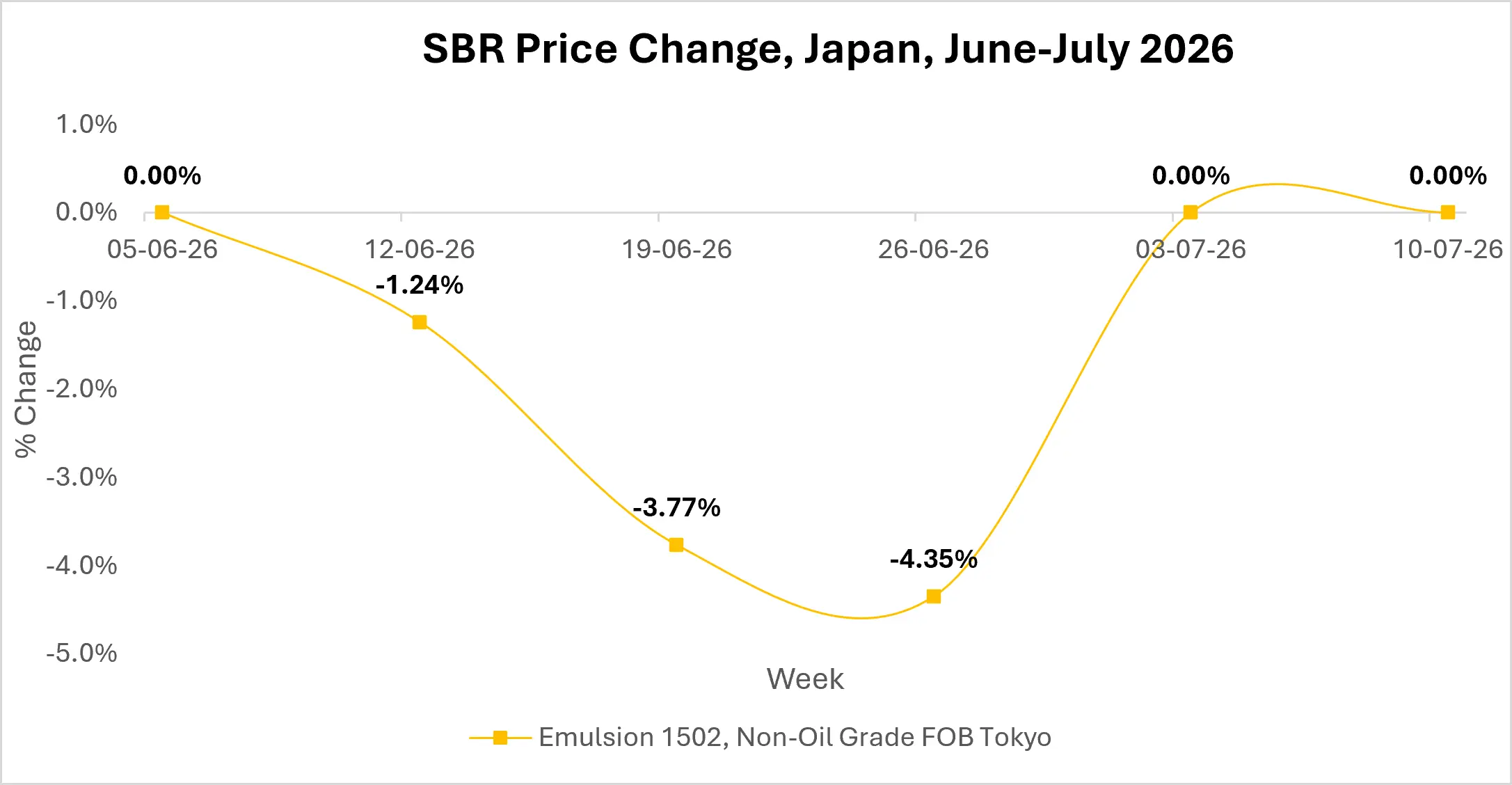
Source: Price Watch™ SBR Prices
That flat reading looks more like a pause than a floor. The Styrene Butadiene Rubber Price in Japan is watched closely because Japan sits close to key shipping lanes affected by Middle East tensions. Any renewed freight disruption tends to show up in Asian assessments before it reaches Europe or the Americas.
Styrene Butadiene Rubber Market Outlook
If the pattern from earlier this year repeats, expect a similar shape ahead. A short pause over the next one to two weeks, then a gradual climb in Butadiene and Styrene costs, followed by upward SBR price resets from late July into August 2026. The size of the eventual SBR increase will depend on how long the Hormuz disruption lasts.
A short closure resolved within days would likely produce a modest, short-lived bump. A prolonged closure stretching into weeks would push the increase further and make it stick longer in contracts.
Buyers should treat today’s Brent spike as an early signal, not a final number. The real cost impact on rubber will unfold gradually over the coming three to four weeks.
Follow Price Watch™ on LinkedIn for real-time raw material insights, pricing trends, supply chain intelligence, and market updates shaping global commodity markets.