

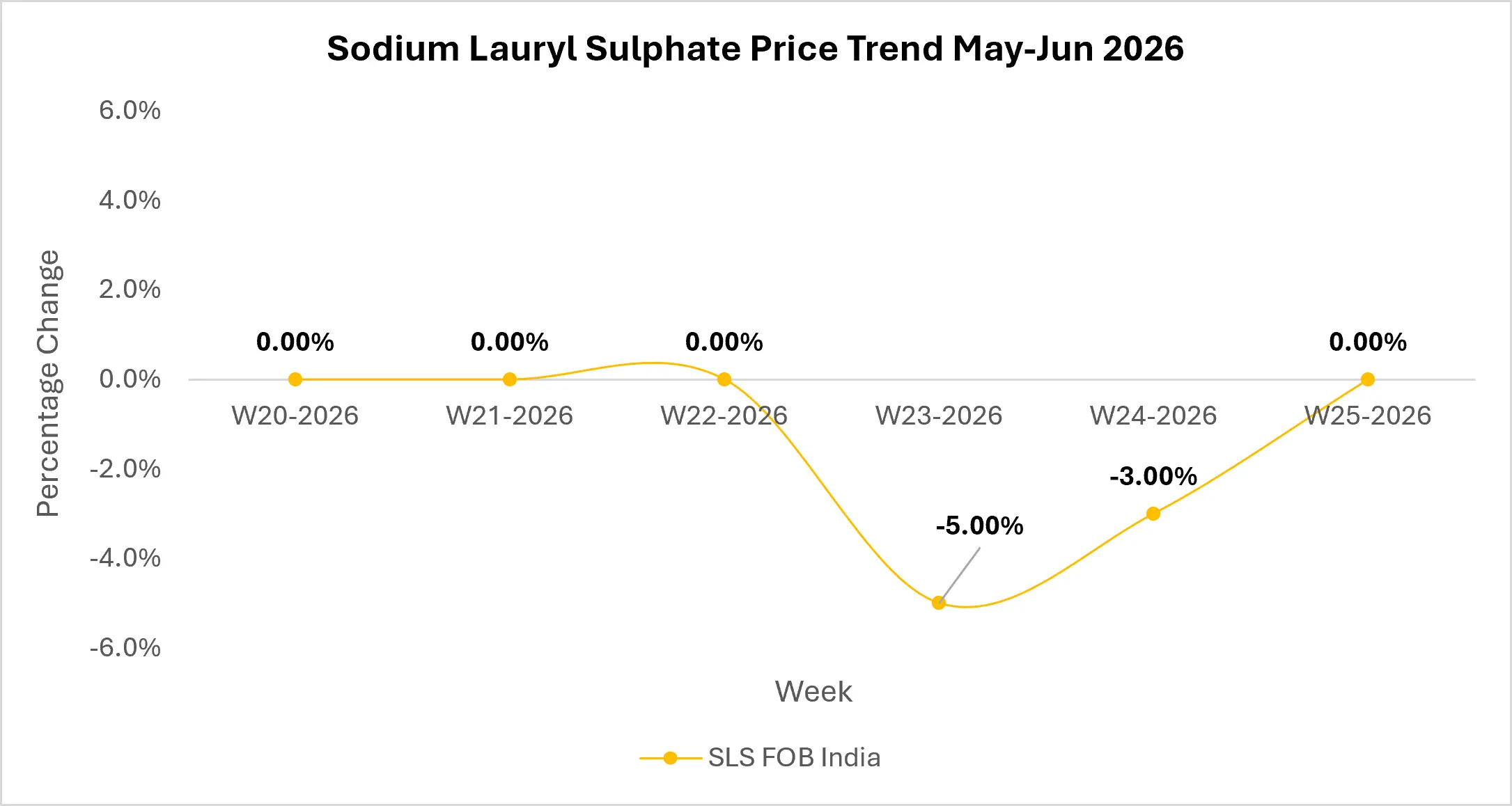
Three flat weeks followed by two sharp cuts. That is the story of India FOB Sodium Lauryl Sulphate prices from W20 to W25 2026, and it tells you more than just a number. The market held firm throughout May as producers kept offers steady despite the post-Hormuz freight relief.
Then W23 and W24 arrived with consecutive price reductions totaling nearly 7.3% in just two weeks. The signal is clear: cost pressure has eased and sellers are adjusting.
India Sodium Lauryl Sulphate Feedstock Costs Move Lower
India is the primary SLS exporting nation supplying Bangladesh, Egypt, Sri Lanka, Saudi Arabia, UAE, and the USA. The feedstock chain runs from coconut oil and palm kernel oil to fatty alcohols, specifically lauryl alcohol, which is then sulfated to produce SLS.
Palm kernel oil prices softened through May and June 2026 as supply from Malaysia and Indonesia recovered after the Hormuz-related logistics disruption earlier in the year. That feedstock relief is now reaching Indian producers with a typical two-to-three-week lag, and the W23 and W24 price cuts reflect exactly that transmission.
India Sodium Lauryl Sulphate Export Markets See Freight Relief
The Hormuz closure in early 2026 had pushed freight rates on India to Middle East and India to USA lanes sharply higher, adding a risk premium that inflated CIF landed costs in Saudi Arabia and UAE beyond what feedstock costs alone would have justified.
As the ceasefire was held and tanker traffic gradually returned, that premium was unwinding. CIF buyers in Saudi Arabia and UAE are now seeing modest relief on their landed cost, while Bangladesh and Sri Lanka, which rely on shorter shipping lanes, are benefitting faster from the normalization.
Source: Price Watch™ Sodium Lauryl Sulphate Prices
- India FOB SLS prices declined approximately 7.3% between W22 and W24 2026, driven by palm kernel oil feedstock softness and easing post-Hormuz freight premiums on export lanes.
- CIF destinations in the Middle East, particularly Saudi Arabia and UAE, are seeing faster freight cost normalization compared to transatlantic routes serving the USA, creating temporary regional price divergence.
Value Chain Impact and CIF Destination Update
Two value-chain effects stand out. First, Galaxy Surfactants and other Indian SLS producers were running at high utilization rates through Q1 2026, building inventory that is now being cleared at slightly softer prices. Second, demand from the personal care sector across all six CIF destinations remains structurally intact.
Shampoo and body wash consumption in Egypt and Saudi Arabia is growing, textile processing SLS demand from Bangladesh and Sri Lanka is stable, and US buyers are maintaining baseline procurement. The correction is supply-driven, not demand-driven.
Sodium Lauryl Sulphate Market Outlook
The near-term direction for India FOB SLS is rangebound to slightly soft, with W25 already showing stabilization. If palm kernel oil holds at current levels and freight rates continue to ease toward pre-war norms, further downward pressure is limited.
A meaningful recovery would need either a feedstock cost spike or a demand surge from seasonal personal care restocking ahead of Q3 festival season consumption in South Asia and the Middle East.
The USA market, which typically runs on quarterly contracts, may not see the full benefit of the correction until Q3 pricing cycles open.
- Palm kernel oil and lauryl alcohol direction: Any renewed tightness in Malaysian or Indonesian palm supply would reverse the current feedstock relief within weeks and push Indian SLS offers back up.
- Freight rate normalization on India to Middle East lanes: Saudi Arabia and UAE CIF prices are the most sensitive to shipping cost changes. Watch these markets as the leading indicator of how fast landed costs are correcting.
Lauryl alcohol costs have eased and prices have corrected. But if palm tightens again in August, will Indian exporters be able to pass the cost back to buyers who just locked in lower rates?
Follow Price Watch™ on LinkedIn for real-time raw material insights, pricing trends, supply chain intelligence, and market updates shaping global commodity markets.