

A major downstream shutdown in Europe and a sudden geopolitical breakthrough in the Middle East are simultaneously reshaping the global cumene market.
Why is the INEOS Phenol closure significant for cumene?
The planned shutdown removes one of Europe’s largest consumers of cumene feedstock. INEOS Phenol announced its intention to cease production at its Gladbeck, Germany facility, which operates approximately 650,000 metric tons/year of phenol and 400,000 metric tons/year of acetone capacity.
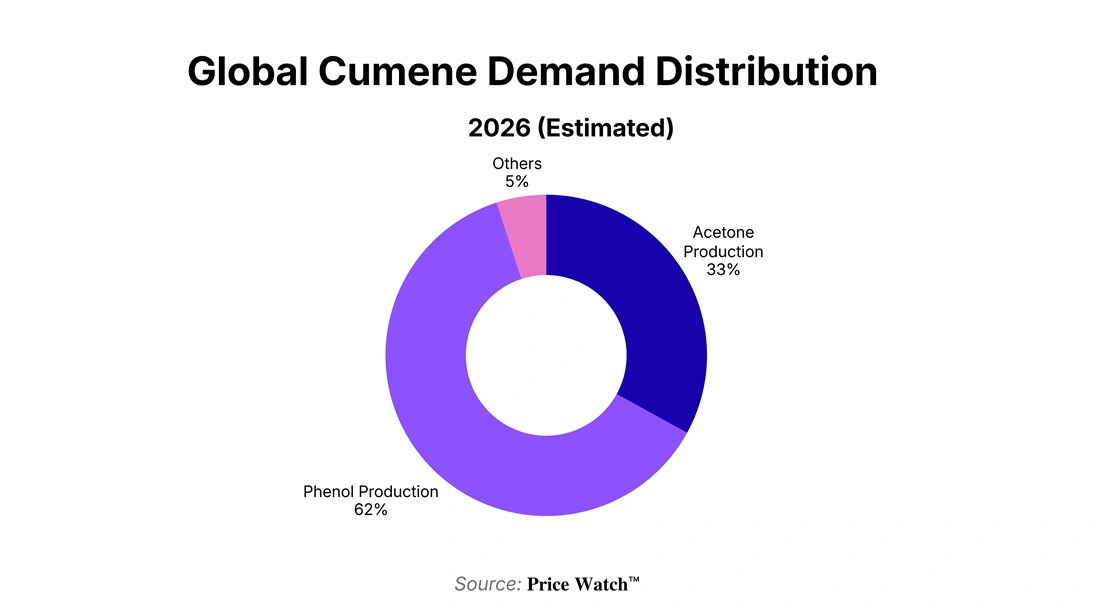
Since more than 95% of global cumene demand is tied to phenol and acetone production, the closure could significantly reduce regional cumene consumption while increasing Europe’s dependence on imported derivatives.
How is the Middle East ceasefire influencing the value chain?
Improved geopolitical conditions have eased feedstock concerns but not logistical uncertainty. Following the preliminary US-Iran peace agreement and the reopening of the Strait of Hormuz, global crude oil benchmarks declined by approximately 4%.
The Strait handles nearly 20% of global oil trade, making it critical for Benzene and Propylene production economics. While lower energy costs improved sentiment across the aromatic value chain, shipping companies remained cautious.
What does this mean for global cumene demand?
Demand remains stable globally, but regional consumption patterns are shifting. The automotive, construction, electronics, and polycarbonate sectors continued supporting phenol and acetone demand in Asia.
However, the reduction of more than 1 million metric tons/year of downstream capacity at Gladbeck is expected to redirect trade flows toward Asia, particularly China, where integrated phenol production continues expanding.
Key Market Signals
- Europe loses over 1.05 million MT/year of phenol-acetone capacity.
- Crude oil benchmarks fell approximately 4% after the ceasefire agreement.
- Around 20% of global oil trade still depends on Hormuz stability.
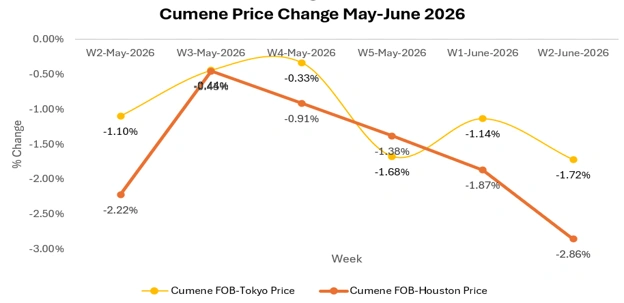
Source: Price Watch™ Cumene Prices
Cumene Market Outlook
Over the next 1–3 months, cumene market direction will likely depend on European operating rates, benzene cost movements, and geopolitical developments affecting energy trade routes.
With real-time intelligence, forecasting models, and regional market coverage, Price Watch™ helps businesses track Cumene, Benzene, Phenol, and Acetone developments before supply-chain shifts become market disruptions, Price Watch™ delivers the regional market intelligence and data precision this evolving Cumene industry demands.
Follow Price Watch™ on LinkedIn for real-time raw material insights, pricing trends, supply chain intelligence, and market updates shaping global commodity markets.