

Unprecedented naphtha supply disruption triggers production curtailments, price surges, and a fundamental reassessment of feedstock security across the global petrochemical industry.
When US–Israeli airstrikes closed the Strait of Hormuz on February 28, 2026, the shockwaves travelled far beyond crude oil, reaching deep into the petrochemical supply chain and reshaping ethylene pricing dynamics across Asia, Europe, and North America.
Why did the Strait of Hormuz closure hit petrochemicals so hard?
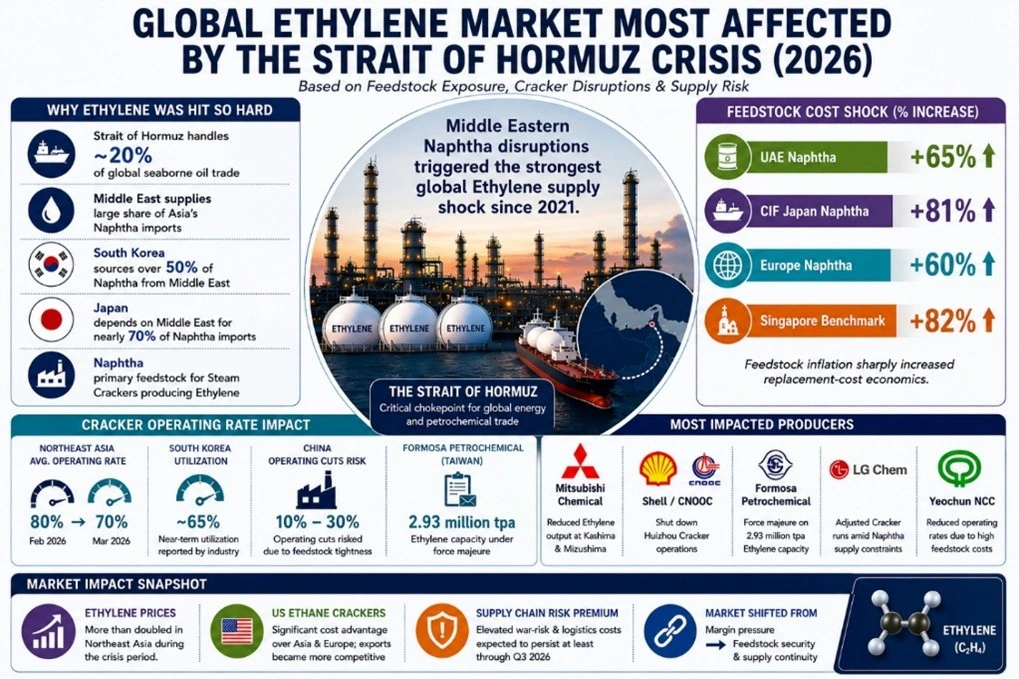
The Strait of Hormuz handles roughly 20% of global seaborne oil trade and a significant share of LNG exports. For the petrochemical industry, its closure triggered a direct feedstock crisis centred on naphtha, the primary feedstock for steam crackers across Asia and Europe. The Middle East supplies a disproportionate share of global naphtha exports, nearly all of which transits through the Strait. South Korea sources over 50% of its naphtha from the Middle East, while Japan depends on Middle Eastern suppliers for approximately 70% of its imports.
Coordinated strikes on Iran under Operation Epic Fury on February 28 triggered retaliatory blockades. By March 4, Iran officially declared the waterway closed, and insurance providers withdrew war-risk coverage, making transit economically unviable. The IEA later described the disruption as the largest supply disruption in the history of the global oil market.
Ethylene Price Shock and Production Curtailments
Global naphtha benchmarks witnessed unprecedented volatility. UAE naphtha prices surged approximately 65%, CIF Japan benchmarks climbed nearly 81%, European naphtha gained around 60%, and Singapore benchmarks rose by nearly 82% at peak disruption. Cracker margins came under severe pressure across all major hubs.
| Region/Benchmark | Increase |
|---|---|
| UAE Naphtha | +~65% |
| CIF Japan Naphtha | +~81% |
| Singapore Naphtha | +~82% |
| European Naphtha | +~60% |
Average ethylene operating rates in Northeast Asia dropped from around 80% in February to nearly 70% in March, with several South Korean crackers falling to approximately 65%. Major curtailments followed: Mitsubishi Chemical reduced output at Kashima and Mizushima from March 6; Shell and CNOOC shut their Huizhou cracker entirely; and Formosa Petrochemical declared force majeure on approximately 2.93 million tonnes per year of ethylene capacity in Taiwan. Ethylene prices across Northeast Asia more than doubled, reaching levels unseen since the post-pandemic supply squeeze of 2021.
North American ethane-based producers remained relatively insulated, as ethane pricing tracks natural gas rather than crude oil, widening their export competitiveness during the crisis.
What Comes Next
Once Strait of Hormuz logistics normalise, the broader ethylene oversupply cycle linked to China’s aggressive 2024–2025 capacity additions may gradually reassert itself. However, the 2026 crisis has already accelerated critical conversations around feedstock diversification, strategic naphtha reserves, and supply-chain resilience.
With its real-time spot market intelligence, forecasting models, and in-depth market analysis, Price-Watch™ helps businesses monitor pricing trends, track supply disruptions, and make informed procurement decisions. Covering key ethylene markets across China, South Korea, Japan, Taiwan, Europe, and the USA, Price-Watch delivers the regional intelligence and pricing precision required in today’s evolving petrochemical industry.
Follow Price Watch™ on LinkedIn for real-time raw material insights, pricing trends, supply chain intelligence, and market updates shaping global commodity markets.