

India has spent decades as one of the world’s largest sugar exporters. This month it opened the door to imports instead, and the scale of the price move behind that reversal is extraordinary even by commodity standards.
Three Benchmarks, One Warning Sign
Weekly data tells the story better than any single headline. Refined sugar ex-Sangli in Maharashtra jumped 35.56% in a single week, after five prior weeks of far milder gains between roughly 1 and 6%. Ex-Hapur in Uttar Pradesh moved even further, up 38.30% the same week, following a similarly muted run beforehand.
Compare that to the Brazil FOB Santos benchmark, the reference point for global raw sugar, which rose a comparatively modest 4.2% over the same week after climbing roughly 6 to 7% across the two weeks before that. India’s domestic market is not simply tracking a firm global trend. It has decoupled from it entirely, moving in a different order of magnitude.
Mills in Maharashtra and Karnataka have pushed offers to levels buyers describe as historically elevated, and the message is consistent everywhere: supply is tight, and buyers are worried about availability heading into the country’s biggest consumption months. Major consumption centers including Delhi, Kanpur, and Kolkata saw M-30 sugar prices jump roughly 7 to 8% in a single trading day, even as the government kept intervening to cool the market.
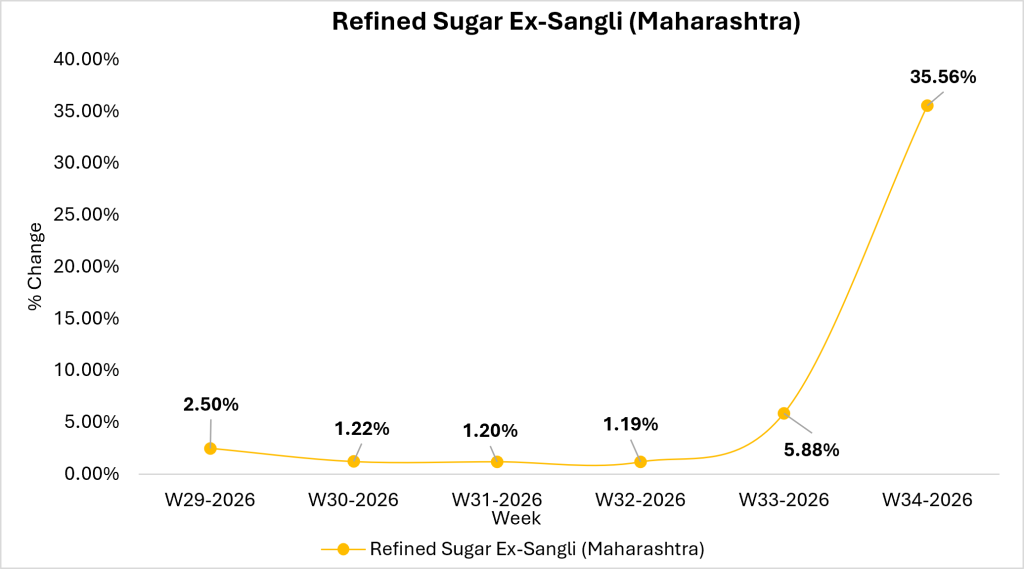
Source: 𝐏𝐫𝐢𝐜𝐞 𝐖𝐚𝐭𝐜𝐡™ Sugar Prices
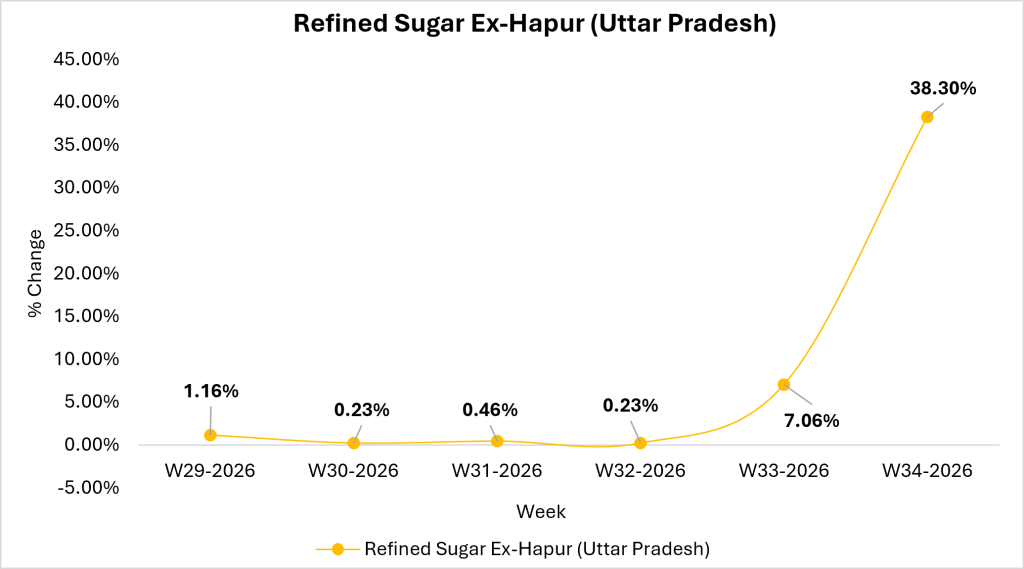
Source: 𝐏𝐫𝐢𝐜𝐞 𝐖𝐚𝐭𝐜𝐡™ Sugar Prices
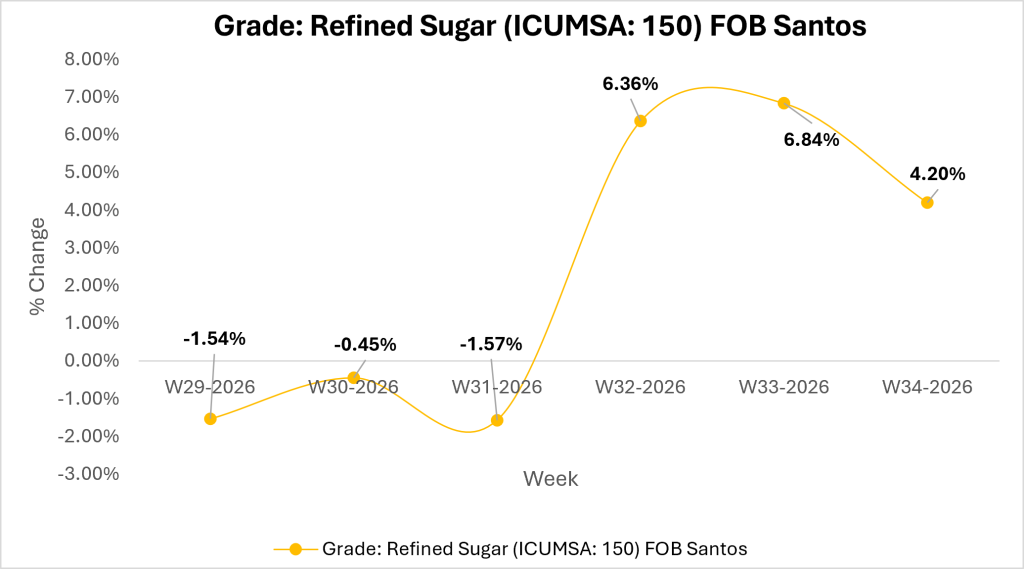
Source: 𝐏𝐫𝐢𝐜𝐞 𝐖𝐚𝐭𝐜𝐡™ Sugar Prices
Why Is India’s Sugar Market So Tight?
Three forces are compounding at once. First, inventories are thinning as the crushing season winds down, prompting New Delhi to cap bulk consumers using over 10 metric tonnes a month to just 15 days of stock through September and November, with dealers already capped at 30 days of sales. Second, festive demand is building fast, with Raksha Bandhan, Janmashtami, Ganesh Chaturthi, Dussehra, and Diwali all landing in quick succession, and confectioners and food processors say they are receiving noticeably less sugar than they need.
Third, ethanol blending has quietly pulled cane juice and sugar streams away from food production for years, and policymakers are now weighing whether to moderate that diversion to protect domestic sugar availability, a genuine trade off between energy security and food inflation.
New Delhi has approved duty free imports of up to 1 million tonnes of raw sugar through October 31, under a framework requiring refiners to turn every 1.05 kilograms of imported raw sugar into 1 kilogram of refined sugar sold domestically. Industry estimates put actual import demand closer to 700,000 tonnes. Tellingly, prices barely reacted to the announcement, a sign traders are not yet convinced imports alone fix the shortfall.
Coastal refiners are the real swing factor here, if they move quickly to process incoming cargo, availability could improve within weeks, if they hesitate, domestic buyers keep competing for the same shrinking pool.
Pakistan’s sugar industry has asked its own government for permission to export up to 1.2 million tonnes to India, arguing proximity to northern Indian markets gives it a freight advantage, a genuinely striking reversal for two countries that rarely trade agricultural staples directly.
The Bigger Risk May Be Next Season
While the market fixates on this season’s shortage, a quieter risk is building for the next one. Adsali cane planting in parts of Maharashtra has fallen well below typical levels, tied to delayed and uneven monsoon rainfall, and reservoir conditions in Marathwada remain a genuine concern even where other parts of the state look healthier.
If water stress persists, farmers may shift acreage toward less water intensive crops, setting up a supply risk for the 2027-28 season that has nothing to do with this year’s ethanol diversion or festive demand spike.
India Sugar Market Outlook
Sugar stocks have rallied hard on the news, with Balrampur Chini up nearly 18%, Dwarikesh Sugar and Bajaj Hindusthan both up more than 14%, and Shree Renuka Sugars and Dalmia Bharat Sugar also higher. Uttar Pradesh farmer groups are separately pushing for a meaningfully higher cane procurement price for the 2026-27 season, citing rising input costs and mills’ growing ethanol and bagasse power revenues.
Two questions are worth sitting with. If Indian prices are rising this fast even after stock limits, duty free imports, and active government intervention, what does that say about how tight the real balance sheet actually is.
And if coastal refiners are slow to act on imported cargo, does the festive season pass before relief ever reaches the shelf. For the full weekly breakdown across Indian and global benchmarks, Price Watch keeps a live tracker.
For procurement teams exposed to India’s sugar, confectionery, or beverage supply chains, Price-Watch.ai tracks the regional benchmarks, import flows, and policy shifts behind this story as they develop, worth having on your radar heading into a volatile festive season.
Follow 𝐏𝐫𝐢𝐜𝐞 𝐖𝐚𝐭𝐜𝐡™ on LinkedIn for weekly Sugar price trends, regional benchmarks, import-flow intelligence, policy developments, and global commodity market updates.