

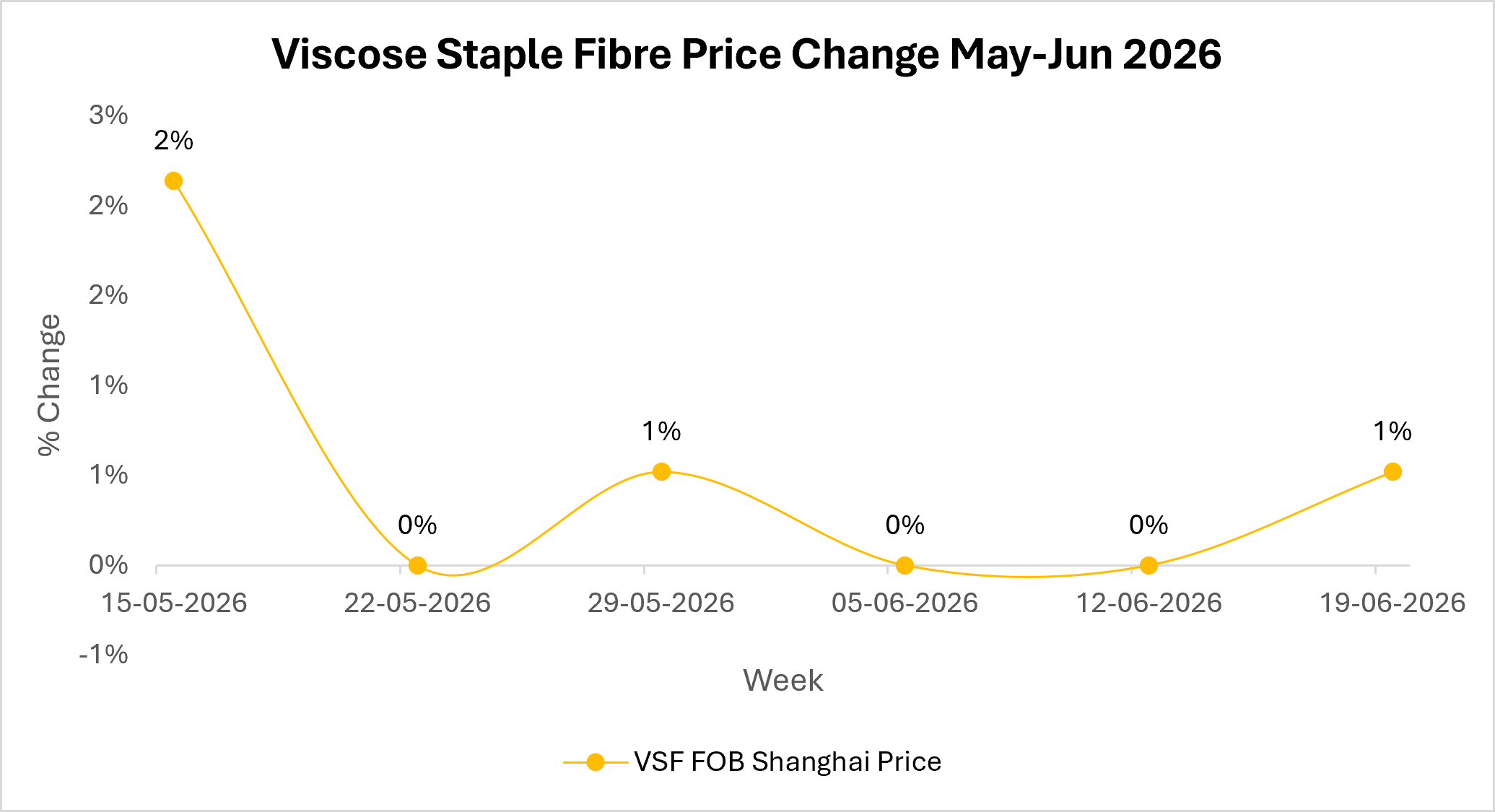
China’s Viscose Staple Fibre (VSF) market has entered a phase of relative stability after recovering during May 2026. Prices for the benchmark 1.2D × 38mm grade strengthened through May before holding steady in early June, reflecting a market supported by disciplined supply management rather than a significant improvement in downstream demand.
The current pricing environment suggests that producers have regained confidence, but the market remains balanced by controlled production and healthy inventory management rather than aggressive buying activity.
Controlled Supply Keeps VSF Prices Firm
One of the primary factors supporting China’s VSF market is the industry’s disciplined approach to production. Producers continue to maintain low inventory levels, reducing the need for price concessions and limiting competitive selling.
With supply largely aligned with consumption, manufacturers have been able to maintain stable quotations despite only moderate growth in downstream demand. This balanced supply-demand equation has created a solid pricing base across the domestic market.
Source: Price Watch™ Viscose Staple Fibre Prices
Stable Feedstock Costs Support VSF Production Economics
Feedstock conditions have also contributed to market stability. Dissolving pulp, the key raw material used in VSF production, has remained relatively stable, providing consistent cost support for manufacturers.
While feedstock prices have not risen enough to trigger another round of price increases, they have also prevented any significant downside in the market. As a result, future price movements are expected to depend more on changes in supply and downstream demand than on fluctuations in raw material costs.
Downstream Demand Remains Steady
Demand from rayon yarn manufacturers continues to provide stable support for the VSF market. Most buyers are purchasing according to immediate production requirements rather than rebuilding inventories, reflecting a cautious but consistent procurement strategy.
Market participants are increasingly watching the upcoming autumn and winter textile season, which could stimulate additional orders and improve fibre consumption. A stronger recovery in textile demand would provide the next meaningful catalyst for higher VSF prices.
VSF Export Market Maintains Stability
China’s FOB VSF export market has also remained stable, supported by firm domestic pricing and limited inventory pressure. Exporters have largely maintained their offers, while buyers across key destinations, including Egypt and other textile-producing markets, continue purchasing cautiously.
Meanwhile, higher freight costs have increased landed prices in import-dependent regions such as the United States, providing additional support to international VSF pricing. China’s stable production base and reliable export availability continue to reinforce its competitive position in the global fibre market.
Viscose Staple Fibre Market Outlook
Over the next three months, China’s VSF market is expected to remain stable with a modest upward bias. Controlled supply, healthy inventory levels, and steady downstream demand should continue supporting prices. However, any significant appreciation will likely depend on stronger textile orders and broader recovery across downstream manufacturing.
For now, the market appears to be transitioning from price recovery to consolidation, with supply discipline continuing to play a more influential role than demand growth in shaping the next phase of the VSF market.
Follow Price Watch™ on LinkedIn for real-time raw material insights, pricing trends, supply chain intelligence, and market updates shaping global commodity markets.