

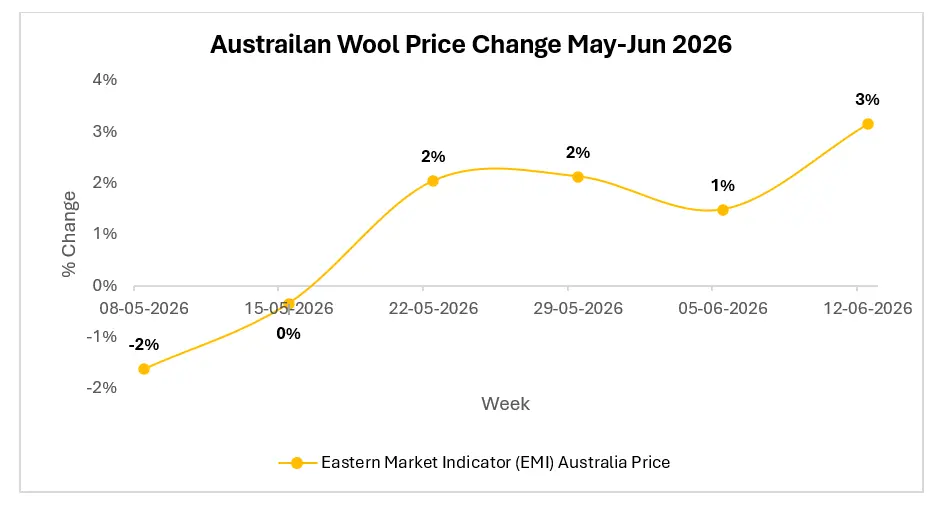
The Australian wool market continued its strong upward move through June 2026. Prices stayed firm across most auction weeks. The Eastern Market Indicator moved closer to levels last seen around 2018. The trend is not mainly demand led. It is more linked to low supply and steady buying. This gap is keeping the market strong.
Even with some week-to-week changes, the broader direction stays upward. Buyers are active in auctions and competing for limited wool. Supply remains the main factor shaping price movement. Recent auction weeks also showed strength across more wool types, which is supporting the overall tone.
Even as currency fluctuations created short-term volatility in USD terms, underlying AUD pricing stayed resilient, signaling that the rally is fundamentally supply-led rather than purely demand-driven.
Source: Price-Watch™ | Wool Prices
Why is Tight Wool Supply Continuing to Push Prices Higher in Australia?
A major reason behind the price rise is tight wool supply from Australia. Auction offerings stayed low through June 2026. Weekly volumes mostly stayed around 25,000 to 35,000 bales. Some weeks were even lower due to holidays and short selling schedules. This reflects a smaller national flock and slow production recovery.
Wool supply cannot adjust quickly. Sheep rebuilding takes time. So even when prices rise, output does not respond fast. This keeps the market tight. Low supply means buyers face strong competition at every auction. Mills need wool for regular processing, so they cannot delay buying for long. This keeps bidding active and supports higher prices.
Low stock outside auctions is also important. There is limited wool in the pipeline. So, every sale becomes critical for buyers. This is keeping supply pressure high across June sessions.
Is Buyer Competition Expanding Beyond Fine Merino Wool in 2026?
Yes, demand is clearly widening across wool categories in June 2026. Earlier gains were mostly in fine Merino wool around 17 to 19 microns. Now the strength is more balanced.
Medium Merino wool is seeing steady demand. Crossbred wool is also gaining interest. Carding wool is improving as well. This shows buyers are not only focusing on premium quality.
Medium Merino has in some weeks moved better than fine wool. This shows a shift in buying behavior. Mills are focusing more on securing stable supply rather than only top-end wool.
Crossbred wool is supported by blending needs and lower cost usage. Carding wool is also in demand for mixed production. This is helping broader categories stay firm.
Pass in rates remain low in recent auctions. Sellers are mostly accepting market prices. This reduces available supply further and adds strength to the rally.
Is Demand Recovery Supporting the Wool Market in 2026?
Demand from major importing markets, especially China, has shown a mild improvement. Seasonal production activity and controlled inventory levels have encouraged selective restocking by mills. While demand is not strongly growing, it is stable enough to absorb limited supply.
This steady but cautious buying is helping support prices without requiring a strong consumption rebound. It is adding balance to the market alongside tight supply conditions.
Short Term Outlook for Australian Wool Market
The wool market is expected to see steady movement in the coming months. Prices may increase by around 1 to 2 % supported by tight supply and low auction volumes, which are keeping competition strong among buyers. Currency movements may create short term fluctuations, but the overall trend remains supported.
For more insights, pricing updates, and real time data, please visit our website Price-Watch™ for detailed market tracking and analysis. Stay updated with wool price trends across South Africa and New Zealand markets for clearer global comparison and better understanding of supply shifts.
Follow Price-Watch™ on LinkedIn for real-time raw material insights, pricing trends, supply chain intelligence, and market updates shaping global commodity markets.