

The global Styrene Butadiene Rubber (SBR) market remains on a bearish trajectory as weak demand from the tire and automotive sectors continues to limit procurement activity. Buyers have largely adopted a hand-to-mouth purchasing approach, while ample material availability and competitive offers across Asia have intensified pricing pressure. Despite occasional support from feedstock fluctuations, subdued downstream consumption and limited restocking activity have constrained any meaningful price recovery.
Feedstock Dynamics Continue to Shape Global SBR Market Fundamentals
While weak downstream demand has remained, the primary drag on the global SBR market, developments in the upstream feedstock chain continue to play a critical role in shaping pricing dynamics. Naphtha, the key cracking feedstock for the production of both butadiene and styrene monomer, remains at the centre of the cost structure.
Following the de-escalation of Middle East tensions, concerns surrounding crude oil supply disruptions and regional logistics bottlenecks have eased, resulting in greater stability across naphtha and derivative markets.
This has moderated feedstock volatility; however, fluctuations in butadiene and styrene fundamentals driven by operating rates, cracker economics, and supply-demand balances continue to influence SBR production margins.
Demand-Side Challenges Persist
Despite stable production activity across major manufacturing hubs, demand for SBR has struggled to gain meaningful momentum due to slower-than-expected growth in the tire, automotive, and industrial rubber sectors.
Export-oriented manufacturers have also faced pressure from weak global trade flows and heightened macroeconomic uncertainty, limiting raw material purchasing interest. Consequently, the market participants have remained focused on optimizing inventories rather than expanding stock positions, resulting in restrained demand across the SBR value chain.
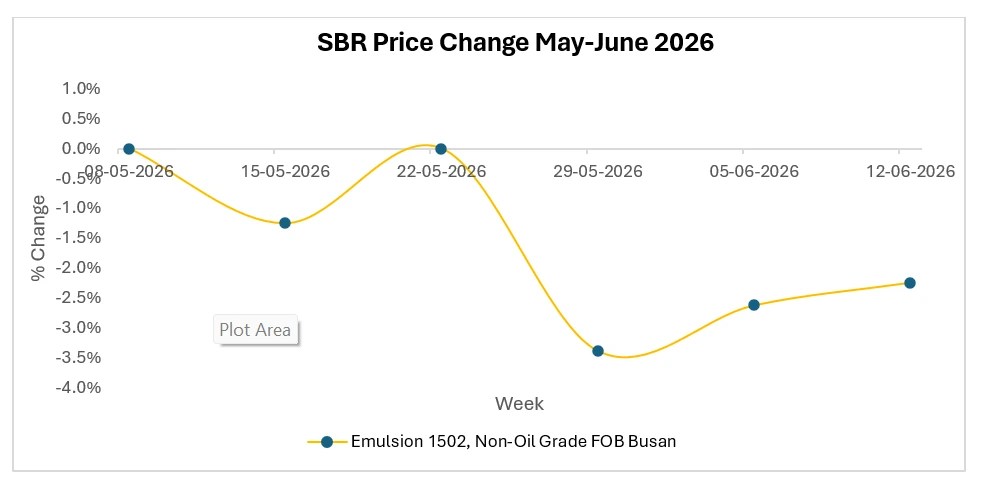
Source: Price-Watch™ | SBR
The Next Move: Where Is the SBR Market Headed?
The global SBR market is expected to navigate a challenging environment in the near term, with market participants balancing weak demand fundamentals against evolving feedstock dynamics. Demand from the tire, automotive, and industrial rubber sectors has yet to demonstrate a sustained recovery, limiting the likelihood of a strong price rebound in the near term.
At the same time, developments across the naphtha-butadiene-styrene value chain will remain critical to market sentiment. Any unexpected feedstock supply disruptions, production cutbacks, or increases in upstream costs could provide temporary support to SBR prices.
Market participants should closely monitor procurement patterns, inventory movements, operating rates, and macroeconomic indicators, as these factors will determine whether the SBR market continues to face downward pressure or gradually transitions toward a more balanced pricing environment.
Follow Price-Watch™ on LinkedIn for real-time raw material insights, pricing trends, supply chain intelligence, and market updates shaping global commodity markets.