Propionic Acid Price Trend and Forecast

UNSPC code: 12352100
|
Weekly Update
|
Historical Data Since 2015
|
Forecast for 2026

propionic acid Price Trends by Country

usUnited States
cnChina
vnVietnam
inIndia
brBrazil
coColombia
caCanada
krSouth Korea

Global propionic acid Spot Market Prices, Trend Analysis and Forecast

Price-Watch™ provides price assessments for Propionic Acid across top trading regions:

Asia-Pacific

  • Propionic Acid Industrial Grade (99.5%) FOB Shanghai, China
  • Propionic Acid Industrial Grade (99.5%) CIF Busan (China), South Korea
  • Propionic Acid Industrial Grade (99.5%) CIF Haiphong, Vietnam
  • Propionic Acid Industrial Grade (99 %) CIF Busan (USA), South Korea
  • Propionic Acid Industrial Grade (99.5%) CIF Nhava Sheva (South Korea), India
  • Propionic Acid Industrial Grade (99.5%) Ex-Kandla, India


North America

  • Propionic Acid Industrial Grade (99 %) FOB Houston, USA
  • Propionic Acid Industrial Grade (99 %) CIF Montreal (USA), Canada


South America

  • Propionic Acid Industrial Grade (99 %) CIF Santos (USA), Brazil
  • Propionic Acid Industrial Grade (99 %) CIF Barranquilla (USA), Colombia


Propionic Acid Price Trend Q1 2026

For Q1 2026, Propionic Acid prices have seen considerable variations, especially noticeable price hikes in March. With demand being steady, geopolitical issues like the ongoing Iran–Israel crisis have interfered with the movement of crude oil, causing higher energy costs and increased cost variability for feedstocks like acetic acid. In turn, the higher production costs have caused higher prices.

Prices in March have risen significantly, with price hikes ranging up to 50% in certain regions due to logistical concerns and supply chain constraints. While there is slight price growth during the earlier part of the quarter, the effect of externalities like geopolitical uncertainty and feedstock pricing has led to a substantial price hike by the end of March 2026.

USA: Propionic Acid Export prices FOB Houston, USA; Grade- Industrial Grade (99 %)

During the first quarter of 2026, Propionic Acid price in the USA fell by 4%, although demand remained unchanged. However, the Propionic Acid price in the USA rose sharply by 9% during March relative to the previous month. This rise has been mainly due to the current conflict between Iran and Israel, which affected the availability of crude oil. The price hike for the energy source, in turn, resulted in rising prices for the raw materials used to produce Propionic Acid, specifically, the prices of acetic acid increased.

Besides energy cost growth, the availability issues caused by the disruptions in transportation led to supply constraints. Thus, companies have to restock more often, which pushed up prices. In the USA, the Propionic Acid price in March 2026 showed that geopolitical unrest, increasing costs of key feedstocks, and logistical problems resulted in the rise in prices at the end of the quarter.

China: Propionic Acid Export prices FOB China, China; Grade- Industrial Grade (99.5%)

Propionic Acid price trend in China for Q1 2026, there has been a decrease of 1.62% compared to last quarter since the demand for Propionic Acid in various industries such as food preservatives, coating, and solvents remains constant with no increase at all. On the other hand, Propionic Acid price in China rose by 23% in March compared to February, largely due to disruptions in global supplies. The continuing conflict between Iran and Israel continues to affect the availability of crude oil and its supply routes, causing the rise in energy prices.

The increase in crude prices further leads to increased prices for feedstocks, such as acetic acid, which is essential in producing Propionic Acid. Other problems that contribute to the shortage in Propionic Acid supply include logistical problems and bottlenecks, among others. In China, Propionic Acid in March 2026 demonstrates how geopolitical unrest and increased feedstock prices, as well as shortages in supplies, result in increased prices.

Brazil: Propionic Acid Import prices CIF Santos, Brazil; Grade- Industrial Grade (99 %)

Propionic Acid price in Brazil for Q1 2026 has been bearish and has seen a decline of 3% when compared to the price of the chemical in the last quarter. The demand for Propionic Acid from industrial applications, including the food preservation industry, coating industries, and chemicals, remains constant but fails to create enough upward traction in the market to push the prices up. Nonetheless, Propionic Acid price trend in Brazil witnessed a substantial jump in March of 8% compared to the preceding month.

In Brazil, Propionic Acid price in March 2026 sharp increase in the price of Propionic Acid is driven by a range of external factors, including the ongoing conflict between Iran and Israel in the Middle East. The conflict has created issues regarding the distribution of crude oil supplies, creating ripples within energy markets and increasing crude prices.

With increased crude prices, there has also been an increase in the price of raw materials used in producing Propionic Acid, such as acetic acid. Moreover, logistics issues have hindered the import of the chemical in the country.

Canada: Propionic Acid Import prices CIF Montreal, Canada; Grade- Industrial Grade (99.5%)

Propionic Acid price trend in Canada, Q1 2026 has reported to have gone down by 3% due to average demand in the form of applications that include food preservatives, coatings, and solvents. On the other hand, Propionic Acid price trend in Canada have experienced an outstanding growth by 8% in March 2026 compared to the previous month. The spike in prices of Propionic Acid has been caused by several factors.

Geopolitical tensions caused by conflicts in foreign countries and the resultant disruption in crude oil supplies into various industries, including transportation industries, have made crude oil prices shoot up. Since Propionic Acid production involves acetic acid as a raw material for manufacturing, high crude oil prices have affected its feedstock cost, making its production expenses escalate.

This has occurred concurrently with increased shipping rates and restricted logistics. In summary, factors like geopolitical tension, feedstock costs, and limited product supply chain have resulted in the upward shift in Canada, Propionic Acid price in March 2026.

Colombia: Propionic Acid Import prices CIF Barranquilla, Colombia; Grade- Industrial Grade (99%)

In Q1 2026, the Propionic Acid price trend in Colombia decreased by 3% compared to the previous quarter, reflecting steady but subdued demand from sectors like food preservatives, coatings, and solvents. Despite this soft start to the year, the Propionic Acid price in Colombia jumped by 8% in March compared to previous month, driven by a combination of global supply challenges and geopolitical tensions.

The ongoing Iran–Israel conflict has disrupted crude oil supply routes, causing volatility in energy markets and pushing crude prices higher. As crude prices surged, feedstock costs, including acetic acid, also rose, placing pressure on production costs for Propionic Acid.

Additionally, logistical issues and tightening supply chains contributed to further price increases. In Colombia, Propionic Acid price in March 2026 highlights how geopolitical instability, rising raw material costs, and a strained supply environment have contributed to the sharp price increase toward the end of the quarter.

South Korea: Propionic Acid Import prices CIF Busan, South Korea; Grade- Technical Grade (99%)

In Q1 2026, the Propionic Acid price trend in South Korea has decreased by 4% compared to the previous quarter, mainly due to steady demand across industries like food preservatives, coatings, and solvents, without significant spikes in activity. However, compared to February, the Propionic Acid price in South Korea experienced a sharp increase of 8% in March, largely due to ongoing global supply challenges.

The Iran-Israel conflict in the Middle East has disrupted crude oil supply routes, caused energy market volatility and pushed crude prices higher. This surge in crude prices has increased the cost of feedstocks, particularly acetic acid, which directly impacted the production costs for Propionic Acid.

Additionally, supply chain constraints and logistical issues further tightened the availability of the product, exacerbating the supply crunch. In South Korea, Propionic Acid price in March 2026 clearly reflects how external geopolitical factors, rising feedstock costs, and a strained supply chain have driven prices higher toward the end of the quarter.

Vietnam: Propionic Acid Import prices CIF Haiphong, Vietnam; Grade- Industrial Grade (99.5%)

In Q1 2026, the Propionic Acid price trend in Vietnam decreased by 2% compared to the previous quarter, as demand remained relatively steady but do not see the significant growth that would drive prices higher. However, compared to February, in March, the Propionic Acid price in Vietnam saw a sharp increase of 22%. This sudden rise is largely driven by external factors, particularly the Iran–Israel conflict, which has disrupted crude oil supply routes and caused volatility in energy markets.

As crude oil prices increased, so do the cost of essential feedstocks like acetic acid, which directly affects the production costs of Propionic Acid. Additionally, logistical issues and supply chain disruptions have exacerbated the situation, leading to tighter availability. In Vietnam, Propionic Acid price in March 2026 shows how a combination of geopolitical events, rising feedstock prices, and global supply challenges has contributed to a significant price hike at the end of the quarter.

India: Propionic Acid Import prices CIF Nhava Sheva, India; Grade- Industrial Grade (>99.5%)

According to Price-Watch™, in Q1 2026, the Propionic Acid price trend in India increased by 3% compared to the previous quarter, as demand across industries like food preservatives, coatings, and solvents showed signs of recovery. However, the most notable shift occurred in March when the Propionic Acid price in India surged by 35% compared to February.

This sharp increase can be attributed to a combination of global supply disruptions and geopolitical factors, particularly the Iran–Israel conflict in the Middle East. The conflict has created instability in crude oil supply routes, leading to higher crude prices. This, in turn, raised the costs of feedstocks such as acetic acid, which are essential for producing Propionic Acid.

On top of this, logistics disruptions and a tightening supply chain in global markets have led to reduced availability, prompting restocking activity in India. In India, Propionic Acid price in March 2026 demonstrates how geopolitical events, rising feedstock costs, and strained supply chains have converged to push prices higher in the final month of the quarter.

Propionic Acid Price Trend Analysis: Q4 2025

For Q4 2025, the prices of Propionic Acid have been generally falling owing to weak demand and unchanged supply in different markets. Most of end-users preferred dealing with their current inventory rather than replenishing their stocks through fresh purchase, which has brought about price decline in Propionic Acid. Nevertheless, during December, certain regions experienced an increase in prices due to year-end restocking amid expected supply chain challenges in the coming year. Restocking has helped stabilize prices. Overall, there has been a trend of market slowing characterized by careful buying and inventory management, which ensured price stability and even reduction, although there have been moderate price rises at the end of the quarter.

USA: Propionic Acid Export prices FOB Houston, USA; Grade- Industrial Grade (99 %)

During Q4 of 2025, Propionic Acid price trend in the United States has fallen by 4 percent against the backdrop of weak demand for the product, although the market has been stable in terms of supply factors. This quarter, consumer activity has been restrained, which reduced the intensity of purchases and puts pressure on prices. In December of the reporting year, Propionic Acid price in the US has not changed compared to the previous month, remaining at the same level due to the traditional holiday season slowdown. Many companies preferred to reduce their stock instead of replenishing stocks, which helped keep the prices steady. In the USA, Propionic Acid price in December of 2025 has shown typical dynamics characteristic of the holiday season.

China: Propionic Acid Export prices FOB China, China; Grade- Industrial Grade (99.5%)

Propionic Acid price trend in China in Q4 2025, it has declined by 9.67% against the previous quarter, mostly due to reduced demand and favourable supply conditions. The buying activity has been rather low throughout the period, while most consumers chose to refrain from purchases, causing a price decline. However, in December 2025, Propionic Acid price in China went up by 1%, influenced by typical end-of-year stocking activity. Given that holidays, some businesses have decided to stock up to prevent any possible disruption in supplies in 2026. In China, Propionic Acid price in December 2025, it has shown typical seasonal dynamics.

Brazil: Propionic Acid Import prices CIF Santos, Brazil; Grade- Industrial Grade (99 %)

In the fourth quarter of 2025, the Propionic Acid price trend in Brazil fell by 4% in comparison with the third quarter due to lower demand and sufficient supply via imports. During this quarter, most firms in Brazil preferred to concentrate on managing their stock instead of acquiring new materials, which resulted in low price growth. In December 2025, the Propionic Acid price in Brazil saw no increase, dropping by 1% relative to November. This tendency is common for this time of the year when purchasing becomes less frequent because business entities prefer not to sign new agreements before Christmas. In Brazil, Propionic Acid price in December 2025 has been characterized by this seasonal pattern of price behaviour.

Canada: Propionic Acid Import prices CIF Montreal, Canada; Grade- Industrial Grade (99.5%)

The Propionic Acid price trend in Canada for Q4 2025 has experienced a drop by 3% from the previous quarter, mainly due to low demand and constant supply. During the period under review, there has been a more prudent attitude towards purchase decisions, with consumers being more concerned with managing their inventories than acquiring fresh batches. This behavior has caused a decrease in procurement operations, causing price drops. During the month of December, the Propionic Acid price in Canada has shown no change relative to the previous month. This is due to the usual annual slowdown, as the holiday season approaches. Companies tend to be more preoccupied with managing their inventories instead of procuring new batches. In Canada, Propionic Acid price in December 2025 has followed a similar pattern.

Colombia: Propionic Acid Import prices CIF Barranquilla, Colombia; Grade- Industrial Grade (99%)

In Q4 2025, the Propionic Acid price trend in Colombia declined by 3% compared to the previous quarter, driven by a slowdown in demand and stable supply conditions. As we moved into December compared to November, the Propionic Acid price in Colombia held steady with no significant change, which is typical for the year-end period when businesses tend to slow down their purchases. Companies focused on managing their current inventories instead of placing new orders, leading to limited market activity. In Colombia. Propionic Acid price in December 2025 reflects this seasonal behavior, where the market usually experiences a lull as businesses prepare for the holidays and anticipate any potential supply disruptions in the new year. Despite the softer demand, prices remained stable as supply conditions are not strained.

South Korea: Propionic Acid Import prices CIF Busan, South Korea; Grade- Technical Grade (99%)

In Q4 2025, the Propionic Acid price trend in South Korea declined by 3% compared to the previous quarter, driven by softer demand and stable supply conditions. Throughout the quarter, many companies in South Korea focused on managing their inventories rather than placing new orders, resulting in a decrease in procurement activity and a slight dip in prices. In December, the Propionic Acid price in South Korea remained flat compared to November, showing no significant change, as is typical during the holiday season when businesses prioritize inventory management over new purchases. In South Korea, Propionic Acid price in December 2025 highlights the seasonal slowdown, where reduced demand and cautious buying behavior led to stable prices despite the overall softer market conditions in Q4.

Vietnam: Propionic Acid Import prices CIF Haiphong, Vietnam; Grade- Industrial Grade (99.5%)

In Q4 2025, the Propionic Acid price trend in Vietnam dropped by 9% compared to the previous quarter, as demand softened and the supply of imported materials remained comfortable. Throughout the quarter, many buyers took a cautious approach, managing their existing inventories instead of making new purchases, which kept prices under pressure. In December, the Propionic Acid price in Vietnam rose by 1%, driven by typical year-end restocking activity as compared to November month. Companies prepared for the holidays by securing supplies ahead of the new year, helping to keep prices stable despite the quieter market conditions. In Vietnam, Propionic Acid price in December 2025 reflects this seasonal behavior, where businesses adjust their buying patterns to prepare for potential disruptions and shifts in supply chains at the start of the new year.

India (China): Propionic Acid Import prices CIF Nhava Sheva, India; Grade- Industrial Grade (>99.5%)

In Q4 2025, the Propionic Acid price trend in India fell by 9% compared to the previous quarter, as demand from key sectors like food preservatives and coatings softened, and supply remained steady with ample imports from China. However, in December, the Propionic Acid price in India saw a slight increase of 2% compared to November, driven by typical year-end restocking as businesses prepared for the holiday season and anticipated potential supply challenges in the new year. Many companies opted to secure inventory to avoid shortages in early 2026, which helped to stabilize prices for the month. In India, Propionic Acid price in December 2025 reflects this seasonal shift, where a slight uptick in demand for inventory replenishment temporarily countered the broader downward price trend of the quarter.

In the third quarter of 2025, Propionic Acid pricing showed fluctuations due to mixed market sentiments. Price increases were reported in the USA, Brazil, Canada, Colombia, and South Korea due to high demand influenced by the need for applications in food, agriculture, and animal feed. Logistics and raw material pricing were also factors in the overall increase.

However, there were price drops in China, Vietnam, India, and South Korea due to weakening demand in agriculture, food, and some other markets combined with the rising logistics cost and port shuttering. As for a forecast for quarter four of 2025, there are many uncertainties, with price recovery depending on the industry’s recovering demand, and if global supply chains are stable.

USA: Propionic Acid Export prices FOB Houston, USA, Grade- Industrial Grade (99 %).

Propionic Acid price in the U.S. rose 5.39% in Q3 2025, including a rise of 4.67% in Q2. The U.S. Propionic Acid price trend was positively impacted by stronger demand from food preservation, and the agriculture industry which saw an uptick in activity latter part of the quarter. Additionally, disruptions in the supply chain and increased feedstock costs, such as acetic acid, resulted in increased cost of production, which helped lead to the price increase.

Although import prices from China remained competitive, logistical difficulties during the third quarter, coupled with a weakening of the U.S. dollar, resulted in higher import prices. September 2025 Propionic prices were higher relative to the second quarter.

China: Propionic Acid Export prices FOB China, China, Grade- Industrial Grade (99.5%).

According to Price-Watch, in the third quarter of 2025, Propionic Acid prices in China saw a decline of 3.47%, following a reduction of 2.95% in the second quarter. The downward Propionic Acid price trend in China was affected by weaker demand coming from the agriculture and food industry, where both production and consumption had slowed down. We also saw slower export demand, which contributed to downward pricing pressure in important markets such as Southeast Asia and Europe.

Additionally, higher raw material and logistics costs put pressure on prices. Propionic Acid prices in September of 2025 were lower than prices in the second quarter. The outlook for the fourth quarter of 2025 is cautious, with the expectation of a continued downward price trend unless there is a recovery in agricultural and food demand.

Brazil: Propionic Acid Import prices CIF Santos, Brazil, Grade- Industrial Grade (99 %).

In the third quarter of 2025, Propionic Acid prices in Brazil rose 5.26% following a 4.39% increase in the second quarter. Propionic Acid price trend in Brazil was positively influenced by the recovery of demand from the agricultural and food sectors, which had steady consumption patterns over the quarter.

In addition, the rise in logistics and freight costs for imported Propionic Acid from the USA exerted upward pressure in prices. The depreciation of the Brazilian Real against the US dollar raised the cost of imports, which also impacted pricing for Propionic Acid. Propionic Acids in September 2025 were higher than during the second quarter.

Canada: Propionic Acid Import prices CIF Montreal, Canada, Grade- Industrial Grade (99.5%).

Propionic Acid prices in Canada rose by 5.31% during Q3 2025, following an increase of 3.75% in Q2. The bearish Propionic Acid price trend in Canada can be attributed to strong demand from the food and animal feed sectors, which saw increased consumption levels, as well as higher transportation costs of imports from the USA and a weaker Canadian Dollar relative to the US Dollar.

Furthermore, supply chain and logistics issues and elevated feedstock costs led to higher prices. September 2025 Propionic Acid prices were higher than in Q2 2025, and the market is expected to maintain its strength into Q4 2025, supported by continued strength in demand.

Colombia: Propionic Acid Import prices CIF Barranquilla, Colombia, Grade- Industrial Grade (99%).

In Q3 2025, Propionic Acid prices in Columbia increased 4.94%, following a 4.21% increase in Q2. Propionic Acid price trend in Columbia was influenced by additional increased demand from sectors that utilize Propionic Acid to preserve food and for agriculture. Overall strong consumption, particularly in the agricultural chemicals segment contributed to the price increases.

With increased freight costs from the U.S.A. and the devaluation of the Colombian Pesos versus the U.S. Dollar pressure was added to price increases of imported product as well during September 2025. Propionic Acid prices in September 2025 were higher than the prices reported in Q2. The outlook for Q4 2025 is stable as well, with demand for Propionic Acid from agricultural and food industries is expected to continue to support pricing.

South Korea: Propionic Acid Import prices CIF Busan, South Korea, Grade- Technical Grade (99%).

In Q3 2025, Propionic Acid prices in South Korea experienced an increase of 3.92%, following a further increase of 5.60% in Q2. Propionic Acid price trend in South Korea \reflected steady demand from the animal feed and food industries to which demand from those sectors remained consistent during Q3. However, global Propionic Acid prices have been impacted, as a result of higher import prices from the USA due to increased transportation costs as well as a weakening South Korean Won.

The Propionic Acid price in September was also higher than during Q2. Looking forward, Q4 2025 has a positive outlook for Propionic Acid prices, with continued price firmness anticipated, based on expected ongoing demand for food and agricultural products.

Vietnam: Propionic Acid Import prices CIF Haiphong, Vietnam, Grade- Industrial Grade (99.5%).

In Vietnam, Propionic Acid prices abated 3.24% in Q3 2025, following a decline of 4.30% in Q2, as soft demand in the food and agricultural sectors hindered production timelines. Supply chain challenges and increased import costs from China (driven by rising freight rates), along with a softening of production in the food and agricultural sectors, added to the price pressure.

Nevertheless, pharmaceutical and chemical sector demand provided support for pricing. Propionic Acid price trend in September 2025 remain lower relative to Q2 2025 prices. Weak market fundamentals and deterred purchasing activities remain the major reasons for declining price trends.

India (China): Propionic Acid Import prices CIF Nhava Sheva, India, Grade- Industrial Grade (>99.5%).

According to Price-Watch, in Q3 2025, Propionic Acid price in India fell by 1.14%, after a decline of 4.41% in Q2. An overall decline in Propionic Acid price trend can be attributed to slower demand from most key consuming sectors, particularly agriculture and food processing, which notably experienced more prolonged production cycles. Correspondingly, Ex-Mumbai price levels saw a steep decline of 10.61%, preceded by a smaller decline of 2.75% in Q2.

Additionally, weakness of the Indian Rupee and related higher import prices from Chinese manufacturers exerted undue pressure on prices, while similar transportation costs and logistical barriers added to the downward pressure. Overall, Propionic Acid prices in September 2025 were higher than they were during Q2.

According to the PriceWatch, In Q2 2025, the Propionic Acid market showed a mixed price trend across major exporting countries. In China, the FOB price fell to 921 USD per metric ton, a 2.95% decrease from Q1 2025, following a 13.38% increase. This drop was driven by reduced demand from CIF countries like South Korea and Vietnam, along with fluctuations in feedstock prices.

In contrast, the USA saw a 4.67% increase in Q2 2025, with prices rising to 808 USD per metric ton, recovering from a 2.20% decrease in Q1 2025. The rise in the US market is due to steady demand from South Korea, Brazil, Canada, and Colombia. The price trend shows a positive adjustment in the US, driven by stable market conditions.

The price trend reveals contrasting trends, with the US market remaining resilient while China adjusts after a significant increase. The global market remains volatile with shifting demand patterns.

According to the PriceWatch, In Q2 2025, India’s CIF prices for Propionic Acid decreased to 980 USD per MT, down by 4.41% from Q1 2025, which saw prices at 1025 USD per metric ton. This correction follows an 11.97% rise in the previous quarter. The decline is attributed to lower demand from downstream industries in India, particularly from food, pharmaceuticals, and chemicals.

Feedstock prices from China remained stable, though global fluctuations affected overall pricing. The price trend for India reflects this shift in market dynamics, with the price trend showing a downward trend in Q2.

In the domestic market, Ex-Mumbai prices fell by 2.75%, reaching 1336 USD per metric ton from 1374 USD per metric ton in Q1 2025. Despite the decrease, the market remains stable, and prices are expected to stabilize as demand picks up in the coming months.

In Q1 2025, diverging market dynamics became more pronounced. Propionic Acid prices in the USA declined further by 2.26% to $771/MT, continuing a trend of softening demand, especially from agricultural sectors during the off-season. The U.S. chemical market also faced increased competition from Asian producers, limiting pricing power.

In contrast, China’s prices surged by 13.45% to $949/MT, driven by strong pre-Lunar New Year restocking, robust demand from the pharmaceutical and food sectors, and tightening domestic supply due to scheduled plant maintenance. Moreover, the potential for export restrictions amid trade policy shifts contributed to bullish sentiment, pushing prices sharply higher in the Chinese market.

Q1 2025 saw a renewed uptrend in import-driven pricing, while domestic prices remained relatively steady. CIF Nhava Sheva prices for China-origin Propionic Acid jumped by 11.96% to $1,030/MT, fueled by tight supply conditions in China due to planned plant maintenance, coupled with increased export demand ahead of the Lunar New Year.

Despite this import cost surge, Ex-Mumbai prices rose only slightly by 0.74% to $1,370/MT, as Indian suppliers absorbed part of the import pressure to maintain competitive pricing amid still-moderate domestic demand. The widening gap between import and local prices could pose challenges for Indian traders in the coming quarters if global tightness persists.

Propionic Acid Price Trend Analysis: Q4 2024

In Q4 2024, Propionic Acid prices softened in the USA, falling by 2.96% to $789/MT, while China experienced a modest increase of 1.15%, reaching $837/MT. The U.S. market saw weaker pricing due to subdued demand from key end-use industries such as animal feed additives and herbicides, combined with stable raw material (propylene) costs and improved supply chain fluidity.

Meanwhile, Chinese prices edged higher as domestic consumption picked up ahead of seasonal production cycles in the food preservation and pharmaceutical sectors. Additionally, limited imports and environmental inspections led to temporary supply constraints in some regions of China, supporting the mild price rebound.

In Q4 2024, Propionic Acid prices in India reflected a steady market dynamic. CIF Nhava Sheva prices from China increased slightly by 2.22% to $920/MT, amid marginally higher freight rates and seasonal tightening in Chinese supply due to environmental regulations.

Ex-Mumbai prices responded with a 2.26% increase to $1,360/MT, driven by continued steady demand from pharmaceutical and food preservation sectors as year-end production cycles ramped up. The narrow movement in both import and domestic prices suggests a balanced market environment, with India maintaining a consistent import flow while local producers met internal demand without significant disruption.

In Q3 2024, several factors are expected to influence the Propionic Acid market across different regions. In North America, prices saw a modest increase of 2.79% in August and are expected to follow this upward trend, despite the negative impact of anti-dumping duties on demand. This rise will be primarily supported by increased demand from the food and beverage sector, which is expected to counterbalance the challenges posed by the duties.

Meanwhile, the Asia-Pacific region is projected to maintain its upward trend, with prices rising by 2.07%. This growth is largely attributed to protectionist policies from China, the region’s largest supplier, which has a significant market share and is shaping the pricing dynamics within the region.

In Q3 2024, the Propionic Acid market in India showed signs of stabilization after previous sharp increases. CIF Nhava Sheva prices for China-origin material rose modestly by 3.45% to $900/MT, largely due to seasonal demand and slight logistic disruptions in Chinese ports.

On the other hand, Ex-Mumbai prices experienced a mild correction, declining by 2.21% to $1,330/MT, as improved import flow and a slight dip in domestic industrial demand helped ease supply pressures. This quarter reflected a rebalancing between international sourcing and domestic supply, with buyers leveraging competitive import options to manage costs.

In Q2 of 2024, several factors impacted the Propionic Acid market in different regions. In the USA, prices fell by 11.55% due to the stabilization of ethylene-feedstock prices, which had previously caused volatility. The ongoing Israel-Hamas conflict created new risks for shipping in the region, leading states to implement measures to protect cargo from Houthi rebel attacks in the Red Sea, further influencing market uncertainty.

Speculation regarding the potential imposition of anti-dumping duties by China on US Propionic Acid also weighed on market sentiment, reducing demand for US products and making Chinese alternatives more attractive. Meanwhile, the Asia Pacific region saw a rebound in Q2, with prices rising by 6.5% compared to the previous quarter, driven by renewed demand from the food and beverage sector.

Q2 2024 marked a sharp uptick in both import and domestic Propionic Acid prices in India. CIF Nhava Sheva prices for Chinese-origin product rose by 6.10% to $870/MT, driven by increased global demand and rising raw material costs, especially for propylene. This cost pressure was more strongly reflected in Ex-Mumbai prices, which surged by 25.93% to $1,360/MT.

Domestic price escalation was also fueled by reduced inventory levels and increased consumption across food-grade and chemical sectors preparing for monsoon stockpiling. The sharp divergence between domestic and imported pricing underscored India’s sensitivity to international cost fluctuations and the strain on local supply during demand peaks.

In Q1 2024, several factors contributed to the 10.69% rise in Propionic Acid prices in North America. A significant increase in demand from the food industry in January and February put upward pressure on prices. At the same time, surging feedstock ethylene prices, driven by global plant shutdowns, led to a scarcity of Propionic Acid, further pushing up costs.

A winter storm disrupted power supplies and production, exacerbating the shortage. Export challenges, such as redirected shipping routes, increased transportation costs, and delays, added to the upward price movement, while geopolitical tensions created market uncertainty, intensifying price fluctuations.

These factors also led to higher costs in South America. Conversely, the Asia Pacific region saw a 5% decrease in prices, primarily due to low demand from the food and beverage sector and security issues at the Red Sea, which disrupted trade and affected supply chains.

In Q1 2024, Propionic Acid prices in India remained relatively stable on the import front but showed notable domestic movement. CIF Nhava Sheva prices for China-origin material stayed flat at $820/MT, indicating steady global supply and minimal change in freight or feedstock costs.

However, Ex-Mumbai prices rose by 5.88% to $1,080/MT, primarily due to increased domestic demand from food preservation, animal feed, and pharmaceutical sectors as industrial activity picked up post-winter. The widening gap between import and domestic prices suggests that Indian buyers leaned more heavily on local sources amid logistical uncertainties and longer lead times from overseas suppliers.

Technical Specifications of Propionic Acid Price Trends

Product Description

Propionic Acid (C₃H₆O₂) is a short-chain fatty acid used in preservatives, plastics, and herbicides. It is primarily produced from petroleum-based feedstocks, through the oxidation of propylene or microbial fermentation. Known for its antimicrobial properties, Propionic Acid helps extend the shelf life of food products and is a key ingredient in various chemical and agricultural formulations.

Identifiers and Classification:

  • CAS No – 79-09-4
  • HS Code – 29155000
  • Molecular Formula – C₃H₆O₂
  • Molecular Weight (in gm/mol) – 74.08


Propionic Acid Synonyms:

  • Propanoic acid


Propionic Acid Grades Specific Price Assessment:

  • Industrial Grade (99 %), Industrial Grade (99.5 %) Price Trend


Propionic Acid Global Trade and Shipment Terms

  • Quotation Terms (Product & Country Specific): 25-28 MT
  • Packaging Type (Product & Country Specific): Iso Tank,180 kg Drum


Incoterms Referenced in Propionic Acid Price Reporting

Shipping Term  Location  Definition 
FOB USA  Houston, USA  Propionic Acid Export price from USA 
FOB China  Shanghai, China  Propionic Acid Export price from China 
CIF Santos (USA)  Sants, Brazil  Propionic Acid Import price in Brazil from USA 
CIF Montreal (USA)  Montreal, Canada  Propionic Acid Import price in Canada from USA 
CIF Barranquilla (USA)  Barranquilla, Colombia  Propionic Acid Import price in Colombia from USA 
CIF Busan (China)  Busan, South Korea  Propionic Acid Import price in South Korea from China 
CIF Haiphong (China)  Haiphong, China  Propionic Acid Import price in Taiwan from China 
CIF Nhava Sheva (India)  Nhava Sheva, India  Propionic Acid Import price in India from China 
Ex- Mumbai  Mumbai, India  Domestically Traded Propionic Acid price in Mumbai 

*Quotation Terms refers to the quantity range specified for the Propionic Acid being quoted or offered in a commercial transaction.

**Packaging Type refers to standard packaging size commonly used for Propionic Acid packing, ease of handling, transportation, and storage in industrial and commercial applications.

Key Propionic Acid Manufacturers

Manufacturer 
Eastman Chemicals 
Dow Chemicals 
Luxi Chemicals 
Shandong Aojin Chemical Technology Co., Ltd 
Zibo Anquan Chemical Co., Ltd 
Fengchen Group. 

Propionic Acid Industrial Applications

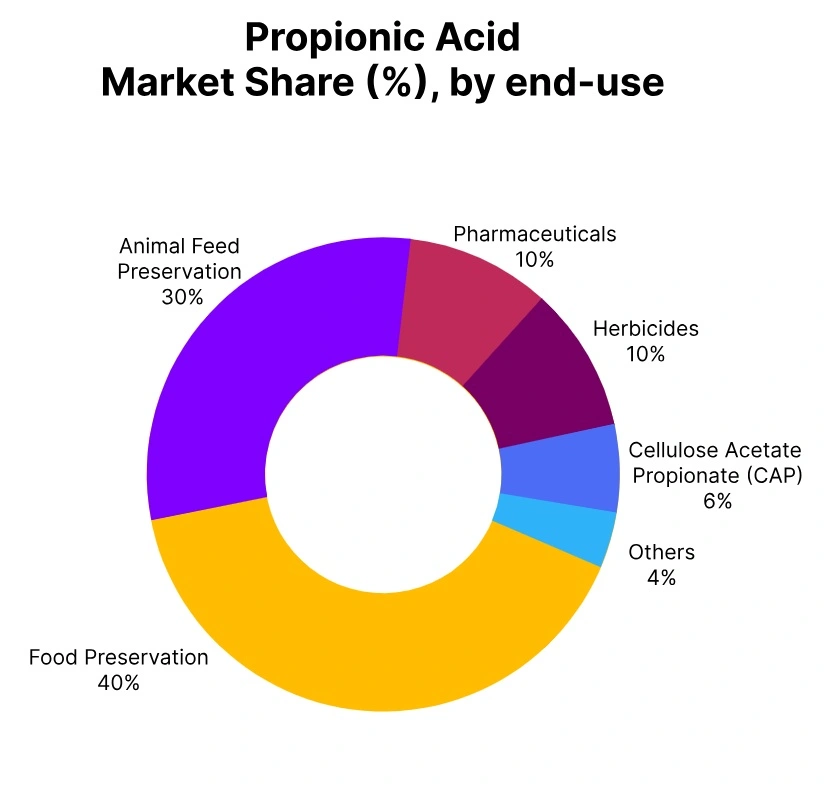
propionic acid market share end use

Historically, several events have caused significant fluctuations in Propionic Acid prices

  • Russia-Ukraine Conflict (2022-Present): The Russia-Ukraine war has disrupted supply chains and increased energy costs, leading to higher raw material prices and volatility in Propionic Acid pricing due to geopolitical instability and market uncertainty.
  • Geopolitical Tensions (2024): The increasing unrest, war in West Asia and U.S.-China trade wars levying duties on chemicals have caused price Fluctuations due to disrupted supply chains. For instance, tariffs on ethylene have impacted the cost structure for Propionic Acid production.
  • COVID-19 Pandemic (2020): The COVID-19 pandemic disrupted supply chains and decreased demand in key sectors like food service and pharmaceuticals, while rising production costs and market volatility further impacted Propionic Acid prices for producers and consumers. Demand plummeted initially but rebounded as needs surged.

These events underscore the Propionic Acid market’s vulnerability to global disruptions and highlight the need for continuous monitoring of supply-demand dynamics.

Why Price Watch™?

Price Watch™ is your trusted resource for tracking global propionic acid price trends. Our platform delivers real-time data and expert analysis, offering deep insights into the key factors driving price fluctuations in the propionic acid market. By monitoring critical events such as geopolitical tensions, supply chain disruptions, and economic shifts, Price Watch™ keeps you fully informed of market dynamics.

In addition, Price Watch™ provides detailed forecasts and updates on production capacities, enabling you to anticipate market changes and make well-informed decisions. With Price Watch™, you gain a competitive edge in understanding all the elements that influence propionic acid prices worldwide. Stay ahead of the curve with Price Watch’s™ reliable, accurate, and timely propionic acid market data.

Track Price Watch's™ propionic acid price assessment on a weekly basis since 2015 onwards, along with short-term forecasts, and get access to the detailed report in a downloadable format.

Propionic Acid Market Price Trend published by Price Watch™ reflect prevailing spot market conditions, derived from independent research, verified trade inputs, and proprietary market intelligence as of the publication date. Prices are published on the specified Incoterm and represent indicative base market levels, exclusive of applicable taxes, VAT, duties, tariffs, and other statutory charges. Actual transaction values may vary depending on volume, credit terms, contractual structure, and other negotiated conditions. Market prices are inherently subject to volatility, liquidity dynamics, regulatory changes, and evolving trade activity. The information provided is for reference and benchmarking purposes only and does not constitute an offer, recommendation, or guarantee of transactional outcomes. Users should exercise independent commercial judgment and assess their specific contractual, regulatory, tax, and application requirements before making business decisions. Price Watch™ assumes no liability for decisions taken based on this information.

The pricing of Propionic Acid is influenced by several key factors. First, raw material costs, particularly those of ethylene and other inputs used in its production, are crucial. Any fluctuations in the prices of these materials can directly impact the overall cost of Propionic Acid. Additionally, market demand plays a significant role; high demand in sectors such as agriculture, pharmaceuticals, and food preservation can drive prices up. Supply chain dynamics, including production capacity and transportation costs, also affect pricing. Lastly, global economic conditions and trade policies can create additional volatility in pricing, making it essential for procurement heads to stay informed about these variables.

To ensure competitive pricing for Propionic Acid, procurement heads should adopt a multi-faceted approach. First, building relationships with multiple suppliers can create a competitive landscape, allowing for better negotiations and more favorable pricing terms. Conducting regular market analysis to understand current trends and pricing benchmarks is also vital, as this information can provide leverage in negotiations. Additionally, considering long-term contracts can help lock in prices and provide stability against market fluctuations. Finally, exploring alternative sourcing strategies, such as purchasing from emerging markets, can also yield cost advantages.

Fluctuations in Propionic Acid pricing pose several risks, including budget overruns and increased production costs that can affect overall profitability. To mitigate these risks, procurement heads should implement strategic measures such as hedging contracts to protect against price spikes in raw materials. Additionally, maintaining a flexible inventory strategy can help buffer against sudden price increases, allowing companies to take advantage of lower prices when they occur. Establishing strong relationships with suppliers and diversifying the supply base can also reduce dependence on any single source, enhancing resilience against market volatility. Finally, ongoing monitoring of market conditions and economic indicators will enable proactive adjustments to procurement strategies.

Propionic Acid is a naturally occurring carboxylic acid used in various applications, including as a preservative in food and animal feed, as well as in the production of herbicides, plastics, and pharmaceuticals. It is also important in the manufacturing of propionate salts, used in synthetic lubricants and plasticizers. The price of Propionic Acid directly impacts industries like food production, agriculture, and chemicals. Fluctuations in its price can significantly affect the production costs of end products, making it essential for businesses to stay updated on market trends. Price-Watch™ tracks Propionic Acid prices to help businesses manage procurement effectively.

The price of Propionic Acid typically varies by region, influenced by factors such as feedstock costs, demand from the agricultural and food industries, and global market conditions. Prices are generally quoted per metric ton and fluctuate according to production capacity, supply chain dynamics, and energy costs. Price-Watch™ provides real-time price assessments to help businesses make informed decisions regarding procurement.

Propionic Acid prices are impacted by several key factors, including the cost of raw materials such as acetic acid, demand from sectors like food preservation and animal feed, and global production capacity. Energy prices, transportation costs, and seasonal demand from agricultural applications also contribute to price fluctuations. Additionally, supply disruptions due to plant shutdowns or feedstock shortages can drive up prices. Price-Watch™ closely tracks these factors to provide accurate insights into the market trend.

The largest consumers of Propionic Acid are the food and feed industries, where it is used as a preservative to inhibit mold growth and improve shelf life. It is also widely used in the production of herbicides and as a chemical intermediate in the manufacture of plastics, pharmaceuticals, and plastics. Additionally, Propionic Acid is used in industrial applications, including in the production of lubricants and plasticizers. Price-Watch™ tracks demand across these sectors to assess market dynamics.

Propionic Acid is produced by the oxidation of propylene or as a by-product of the fermentation of carbohydrates. The chemical synthesis of Propionic Acid typically involves the oxidation of propylene in the presence of oxygen, or through a variety of catalytic processes. It is manufactured in chemical plants by large chemical producers, particularly in regions with a strong petrochemical industry.

The largest exporters of Propionic Acid are countries with established chemical industries, such as the United States, Germany, and China. These countries have significant production capacities and serve as key suppliers to global markets. Price-Watch™ tracks export flows to provide insights into global supply chains and help businesses understand the international market.

Supply generally meets global demand, but localized shortages can occur due to factors such as feedstock constraints, production disruptions, or sudden spikes in demand, particularly in the food preservation and animal feed sectors. Seasonal demand fluctuations and supply chain issues can also affect availability. Price-Watch™ monitors supply-demand dynamics and alerts businesses to potential imbalances.

Propionic Acid is typically available in industrial grades, but higher-purity grades used in food preservation and pharmaceuticals command higher prices due to stringent quality standards. The price can also differ based on packaging and handling requirements, as well as the scale of production. Price-Watch™ provides price assessments for each grade to ensure transparency and help businesses make informed decisions.

A sudden increase in demand, often due to growth in the food or animal feed sectors, can lead to higher prices for Propionic Acid. Suppliers may prioritize long-term contract customers, while spot buyers might face limited availability and premium pricing. Production flexibility can be constrained by feedstock availability and production capacity. Price-Watch™ captures these shifts in demand and provides real-time insights to help businesses adapt to market changes.

Energy is a significant cost component in the production of Propionic Acid, particularly for processes that require high temperatures or specialized catalysts. When energy prices, such as natural gas or electricity, rise, production costs increase, which is typically passed on to consumers in the form of higher prices for Propionic Acid. Price-Watch™ tracks energy price trends and integrates them into its pricing assessments.

Regional price differences are driven by factors such as local production capacity, feedstock availability, energy costs, and transportation expenses. Regions with limited local production or high transportation costs tend to have higher prices, while areas with well-established chemical plants and favorable feedstock economics tend to experience lower prices. Price-Watch™ tracks these regional variations to provide a comprehensive view of the market.

The forecast for Propionic Acid prices depends on factors such as raw material costs, energy prices, production capacity changes, and demand from key industries like food and feed. Additionally, market fluctuations, seasonal demand cycles, and supply disruptions can impact pricing. Price-Watch™ provides regular price forecasts based on these key drivers to help businesses plan for future market conditions.

Yes, accurate price forecasts can help businesses time their purchases better, negotiate contracts more effectively, and budget more accurately. For example, if a forecast predicts a price increase due to higher feedstock or energy costs, businesses may choose to secure material in advance at current rates. Price-Watch™ provides actionable insights that assist businesses in making strategic procurement decisions.

Global events such as natural disasters, geopolitical tensions, or feedstock supply disruptions can affect production and supply chains, leading to price volatility. For example, disruptions in the supply of raw materials or energy can lead to higher production costs, which are reflected in the price of Propionic Acid. Price-Watch™ provides real-time updates on how such events influence the market.

Price-Watch™ gathers data from manufacturers, distributors, and buyers globally to provide accurate, transparent price assessments. Our detailed market reports and forecasts make us a trusted source for understanding Propionic Acid pricing trends, helping businesses make informed purchasing and production decisions.