

Copper is increasingly catching market attention as its price continues to trend upward on strong structural demand and tightening supply. Often called the “metal of electrification,” copper sits at the heart of modern infrastructure from power grids and construction to electric vehicles and renewable energy systems.
With global energy transition accelerating and mining output struggling to keep pace, the imbalance between demand and supply is pushing prices higher and keeping copper firmly in a bullish spotlight.
What Is Happening Right Now in Copper Cathode prices?
The biggest single event of the week is the interim US-Iran peace agreement, announced on June 14-15, 2026, which sent copper prices climbing 1.4% in a single session.
The deal which includes reopening the Strait of Hormuz and a ceasefire has directly eased fears of global growth disruption that had weighed on industrial metals since April.
For copper, this removes a major downside risk at a moment when the market was already under significant bullish pressure.
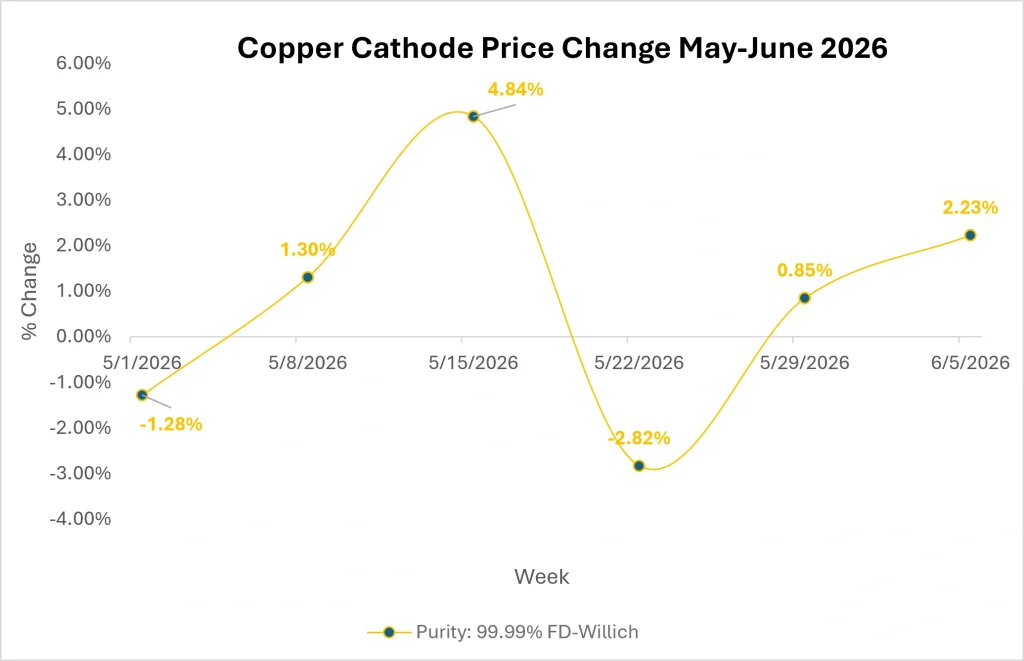
Source: Price Watch™ Copper Cathode Prices
Simultaneously, the market is on edge about a critical policy deadline on June 30. The US Commerce Secretary must deliver a recommendation to President Trump on whether to impose phased tariffs on refined copper 15% starting January 2027, rising to 30% by 2028.
In anticipation, traders have been aggressively stockpiling copper in American warehouses, widening the COMEX-LME price spread to around $400 per tonne. The tariff outcome alone could reshape global copper trade flows for years ahead.
Why Are Copper Cathode Prices Rising?
The core driver is a worsening supply deficit, now forecast at 600,000 tonnes for 2026. At Grasberg in Indonesia the world’s second-largest copper mine, a 2025 mudslide wiped out 70% of output, with full recovery now pushed to 2028. Chile’s copper output fell 9% year-on-year in March 2026.
Kamoa-Kakula in the DRC faces flooding and sulfuric acid shortages, compounded by China’s recent halt on sulfuric acid exports affecting roughly 15% of global copper processing. Treatment and refining charges have collapsed to near zero, squeezing smelters worldwide.
On the demand side, AI infrastructure and electrification continue to consume copper at an unprecedented pace. Data centres alone are expected to add 110,000 additional tonnes of copper demand in 2026. Electric vehicles require three to four times more copper than conventional cars, and global power grid expansion shows no signs of slowing.
What Could Impact Copper Cathode Prices Next?
Several variables could swing prices meaningfully in either direction:
- US tariff decision (June 30): Confirmation of phased tariffs would further tighten US supply and push both COMEX and LME higher. A rejection or delay would trigger a sharp correction.
- China demand signals: Chinese buyers have been opportunistically buying on price dips. Any significant demand slowdown from China which consumes over 50% of global copper remains the biggest downside risk.
- Fed interest rate policy: Stronger-than-expected US inflation data in May 2026 has raised expectations of rate hikes, which could slow industrial activity and dampen copper demand.
- Grasberg recovery timeline: Any further delays at Freeport’s Grasberg mine beyond the current 2028 estimate would deepen the supply deficit and add further upward pressure.
Copper Cathode Market Outlook
Copper in mid-2026 is not simply a commodity, it is a strategic barometer of global economic and technological ambition. With supply structurally constrained, demand growing across electrification and AI, and the US tariff decision imminent, the market is primed for continued volatility.
The short-term direction will be determined by trade policy headlines and macro signals, but the medium-term trajectory remains firmly supported by fundamentals that cannot be resolved overnight. For businesses and investors exposed to copper, the message is clear: this elevated price environment is not transitory it is structural.
Follow Price Watch™ on LinkedIn for real-time raw material insights, pricing trends, supply chain intelligence, and market updates shaping global commodity markets.