

For decades, Canada’s crude oil exports have been overwhelmingly dependent on the United States, with most production from Alberta flowing south through established pipeline networks.
That long-standing trade pattern could begin to shift with the proposed Northern Shield Energy Corridor, a pipeline connecting Hardisty, Alberta, to Sarnia, Ontario with an initial capacity of 500,000 barrels per day, expandable to 800,000 barrels per day.
Alongside continued expansion of westbound export infrastructure, the project reflects Canada’s broader strategy to diversify market access, strengthen energy security, and reduce reliance on a single export destination.
New Crude oil Export Routes Could Strengthen Producer Leverage
Today, much of Canada’s production growth continues to move through Enbridge’s Mainline into the U.S. Midwest, supplying heavy crude refiners that have traditionally benefited from discounted Canadian barrels.
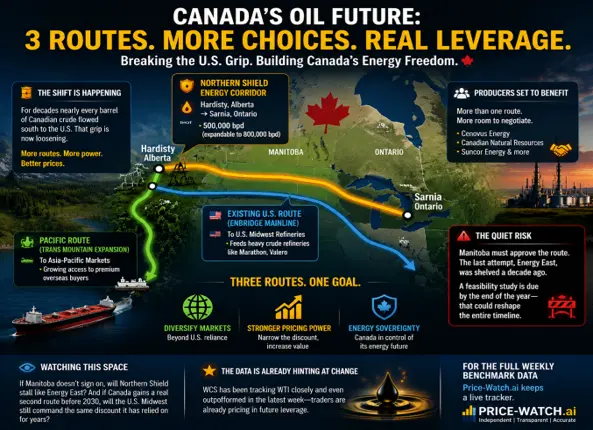
If completed, the Northern Shield Corridor would create an additional domestic transportation route while existing west coast infrastructure provides greater access to Asian markets. Together, these projects would give Canadian producers greater flexibility in directing crude to multiple markets rather than relying primarily on U.S. demand.
Greater market optionality could improve pricing power for producers by reducing transportation bottlenecks and increasing competition for Canadian crude.
Markets Are Already Responding
Recent price movements suggest traders are beginning to factor in the potential for improved market access.
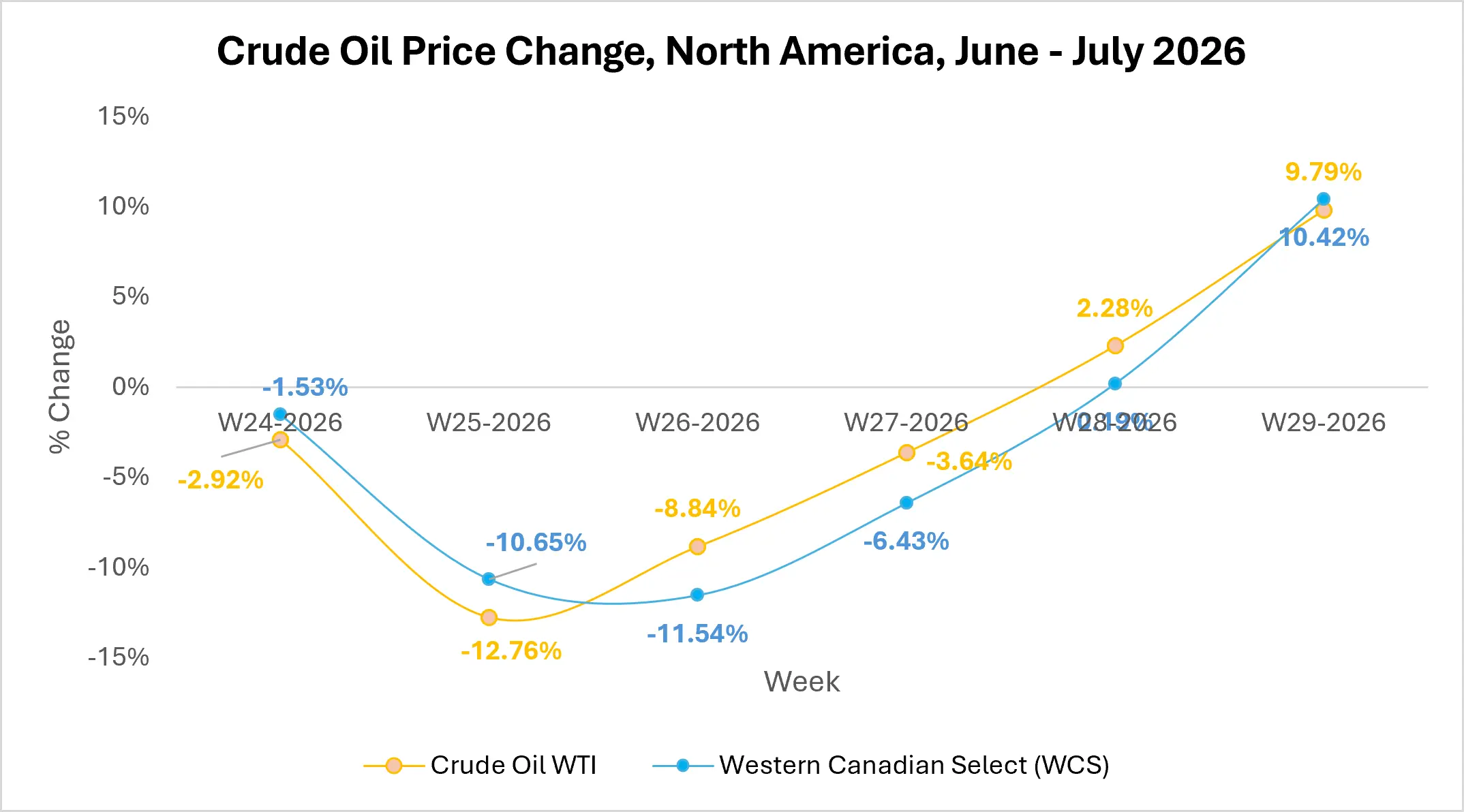
Source: Price Watch™ Crude Oil Prices
Western Canadian Select (WCS) and WTI both recovered during July after weakening earlier in the summer, with WCS posting a particularly strong rebound. The narrowing price differential indicates growing expectations that future pipeline capacity could improve market access and reduce the structural discount historically applied to Canadian heavy crude.
While current fundamentals continue to influence prices, infrastructure expectations are increasingly becoming part of market sentiment.
Project Execution Remains the Key Risk
Despite the strategic potential, significant uncertainties remain. The proposed corridor would require support from multiple provinces, including Manitoba, which has yet to formally endorse the project.
Previous pipeline proposals have faced political and regulatory challenges, demonstrating that infrastructure development remains as much a policy issue as an economic one.
A forthcoming feasibility study is expected to provide greater clarity on project viability, timelines, and commercial prospects.
Crude Oil Market Outlook
Looking ahead, the Northern Shield Energy Corridor has the potential to reshape Canadian crude oil trade by expanding domestic transportation capacity and reducing dependence on the U.S. Midwest as the primary export market.
If additional pipeline capacity is successfully developed alongside expanding Pacific export routes, Canadian producers could gain greater pricing flexibility while reducing long-standing transportation constraints.
Until then, project approvals, regulatory progress, and provincial support will remain the key variables determining whether this proposal becomes a transformative piece of North American energy infrastructure or joins earlier projects that failed to move beyond the planning stage.
Follow Price Watch™ on LinkedIn for real-time energy market insights, crude oil trends, supply chain intelligence, and global commodity updates.