

A synchronized price recovery does not always indicate a synchronized improvement in demand. Across the Asian Epichlorohydrin market, the transition from sharp June declines to renewed July increases reflects a broader shift from inventory led pricing to logistics and risk led behavior.
Epichlorohydrin Price Trend in Asia (June–July 2026)
Between W1 June and W3 July 2026, FOB China and FOB Thailand moved through similar correction cycles, but the strength and timing of their recoveries reveal growing differences in export availability, contract exposure, and geopolitical sensitivity.
The most important development is not simply that prices increased, but that the rebound emerged while downstream demand remained selective, indicating that supply-chain risk and procurement protection are becoming more influential than immediate consumption fundamentals.
Source: Price Watch™ Epichlorohydrin Prices
Fragmentation of a Previously Coordinated Asian Market
Epichlorohydrin pricing is normally influenced by propylene, chlorine economics, plant operating rates, and demand from epoxy resin manufacturers.
However, the latest cycle shows that geopolitical freight risks, producer export allocation, and inventory strategies are increasingly overriding conventional feedstock signals.
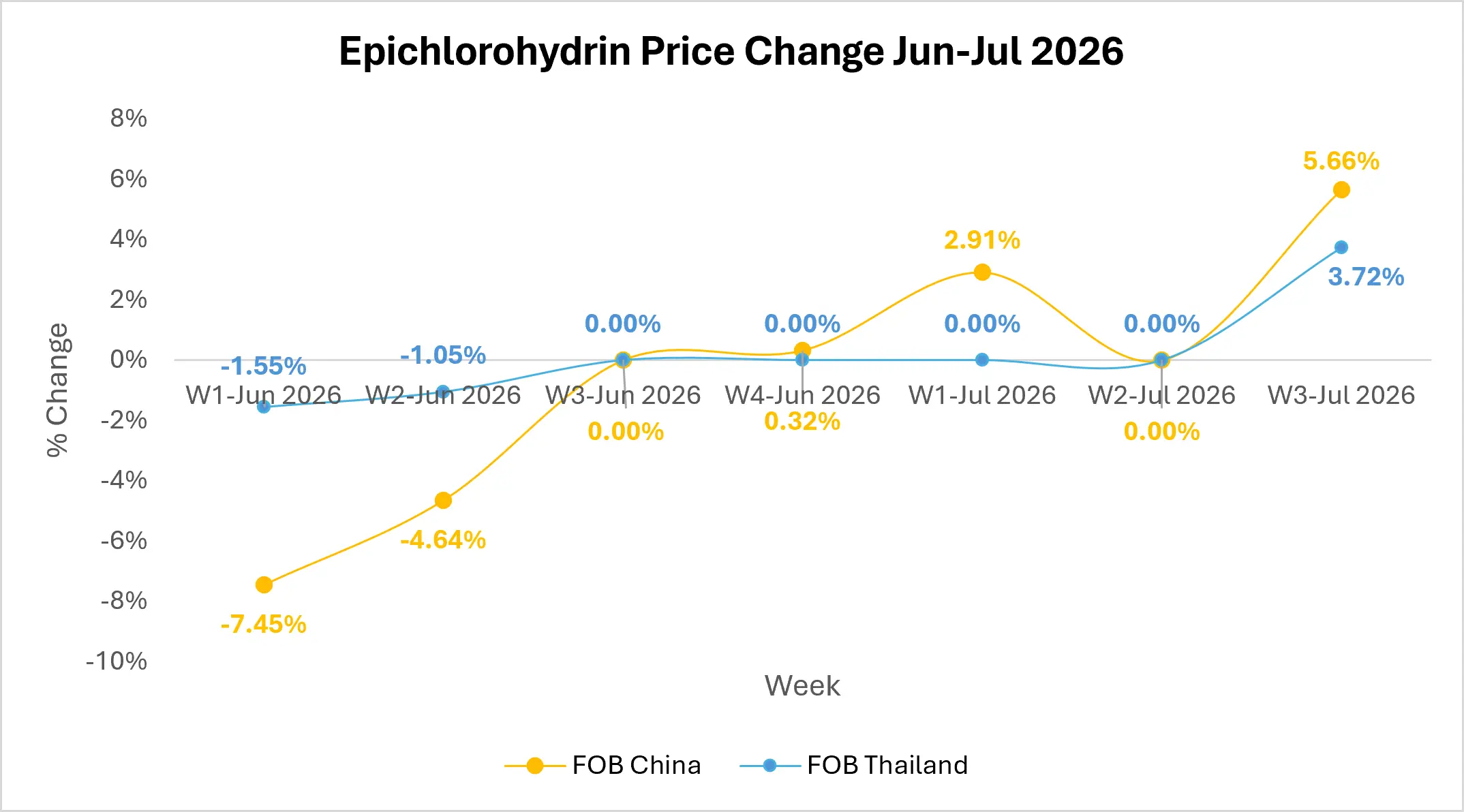
FOB China recorded a steep correction of 7% in W1 June, followed by another 5% decline in W2 June, as producers reduced inventories and overseas buyers delayed purchases.
Prices stabilized during W3 and W4 June before increasing by 3% in W1 July and accelerating to 6% by W3 July.
FOB Thailand followed a less volatile pattern, declining by 2% and 1% during the first two weeks of June before remaining unchanged through W2 July. A 4% increase in W3 July suggests that regional buyers eventually shifted toward Thailand as Chinese availability tightened and replacement costs increased.
Regional and Route Dislocation
- China Export Chain
China’s stronger rebound reflects tighter spot availability and greater domestic absorption by epoxy resin producers.
Exporters became less willing to offer discounted cargoes as replacement costs rose and buyers began securing volumes against possible shipping delays.
- Thailand Export Corridor
Thailand remained relatively insulated during early July because of existing contractual commitments and steadier producer operating rates.
However, the W3 July increase indicates that geopolitical and freight-related cost pressures eventually moved beyond China and into Southeast Asian export negotiations.
US–Iran War and the Return of the Freight Risk Premium
A less visible but increasingly important factor behind the recent increases is the escalation of the US–Iran war and renewed disruption around the Strait of Hormuz.
By mid-July, vessel traffic through the strait had fallen sharply as attacks, naval restrictions, and security concerns discouraged tanker movements. War-risk insurance premiums also increased, while crude oil prices briefly moved above USD 90 per barrel.
Epichlorohydrin cargoes from China and Thailand do not necessarily pass through Hormuz. Nevertheless, the conflict tightened global tanker availability, increased fuel and insurance costs, and encouraged buyers to advance procurement.
The July price increases therefore reflect a geopolitical risk premium alongside tighter Asian export availability rather than a straightforward downstream demand recovery.
Epichlorohydrin Market Outlook
The Epichlorohydrin market is entering a risk-led pricing phase. China may remain the leading regional price driver if domestic epoxy demand and restricted export offers continue, while Thailand could strengthen further as buyers diversify procurement.
A reduction in US–Iran hostilities could remove part of the freight premium, but prolonged disruption would reinforce precautionary buying and shorter contract windows.
Will continued restrictions around the Strait of Hormuz convert Asia’s temporary freight premium into a sustained Epichlorohydrin price floor? And could buyers shifting volumes from China to Thailand create a broader regional shortage even without a major recovery in global epoxy resin demand?
For deeper insights, data-driven updates, and continuous tracking of geopolitical, logistics, and cross-regional Epichlorohydrin price signals, visit Price-watch.ai.
Follow Price Watch™ on LinkedIn for real-time chemical market insights, epoxy value chain trends, supply chain intelligence, and global commodity updates.