

Conventional wisdom suggests that weak rainfall is bad for agriculture and, by extension, bad for fertilizer demand. However, the relationship is often more complex.
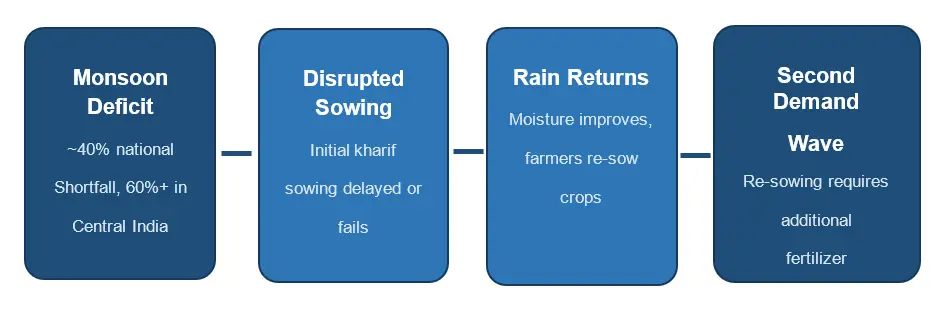
India’s monsoon deficit had widened to roughly 40% nationally by mid-June, with Central India facing deficits exceeding 60%. These figures have understandably raised concerns about kharif sowing and agricultural output. Yet history suggests that a delayed or patchy monsoon can sometimes support fertilizer demand rather than suppress it.
The reason lies in re-sowing activity. When initial sowing is disrupted by inadequate rainfall, farmers may need to replant crops once moisture conditions improve. Re-sowing often requires additional fertilizer applications, creating a second wave of demand that would not occur during a smooth monsoon season. In such situations, fertilizer consumption can rise even as weather conditions remain challenging.
For fertilizer producers, traders, and distributors, the key question is therefore not whether demand will weaken, but where additional demand could emerge and whether inventories are positioned to meet it.
The Supply Challenge
Demand strength is only beneficial if sufficient product is available.
India remains heavily dependent on West Asia for sulphur, a critical raw material used in phosphate fertilizer production. With ongoing geopolitical tensions affecting the region, supply-chain risks remain elevated. At the same time, concerns regarding DAP and urea availability during peak sowing periods continue to influence farmer purchasing behavior.
The government has attempted to mitigate these risks by accelerating imports and maintaining substantial buffer stocks. Approximately 1.35 million tonnes of urea imports have been fast-tracked, while inventories are reported to be at historically high levels.
However, national stock figures do not necessarily guarantee local availability. The more important question is whether sufficient material is positioned near deficit-affected regions such as West and Central India where demand could accelerate if rainfall returns after delayed sowing.
Single Super Phosphate (SSP) Price Highlights
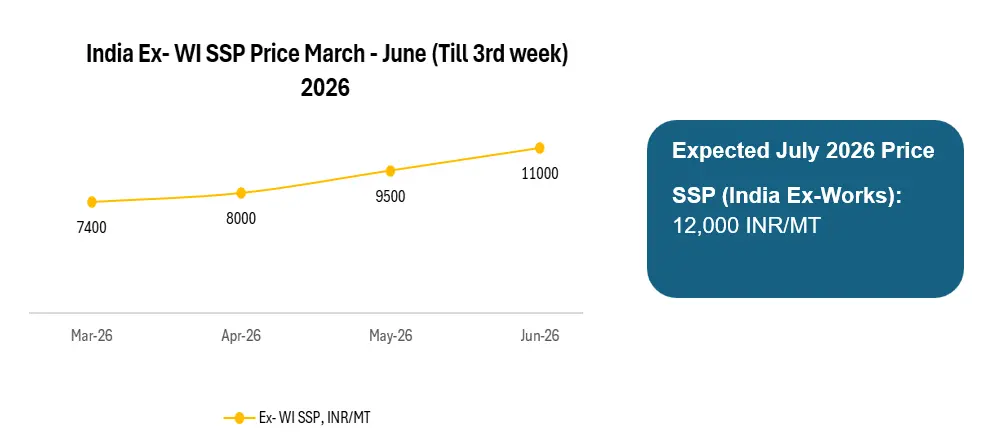
Source: Price-Watch™ Single Superphosphate (SSP) Prices
For more such details visit Price-Watch™. Our platform delivers real-time data and expert analysis, offering deep insights into the key factors driving price fluctuations in the fertilizer (DAP, Ammonia, Sulphur, Ammonium Nitrate, SSP, Urea, TSP etc) market.
By tracking critical events such as geopolitical tensions, supply chain disruptions, and economic shifts, Price-Watch™ keeps you fully informed of market dynamics. Track Price-Watch™ fertilizer price assessment on a weekly basis from 2015 onwards along with short term forecasts and get access to the detailed report in downloadable format.
The Subsidy Angle
The fiscal implications are also significant. The government’s fertilizer subsidy allocation for the current kharif season has already increased to approximately INR 41,534 crore, representing an increase of around 11–12%. If global fertilizer prices remain firm while weather-driven demand rises, the subsidy burden could increase further.
Historically, fertilizer subsidy expenditure has exceeded initial budget estimates by substantial margins during periods of market stress. This creates the possibility of payment delays and working-capital pressures across the value chain.
Companies assuming a normal subsidy cycle may therefore face greater risk than anticipated.
Fertilizer Market Outlook
Market attention is now focused on weather developments expected around 25 June. If rainfall returns to southern and northeastern regions and extends into Central India, re-sowing activity could accelerate, creating localized demand spikes.
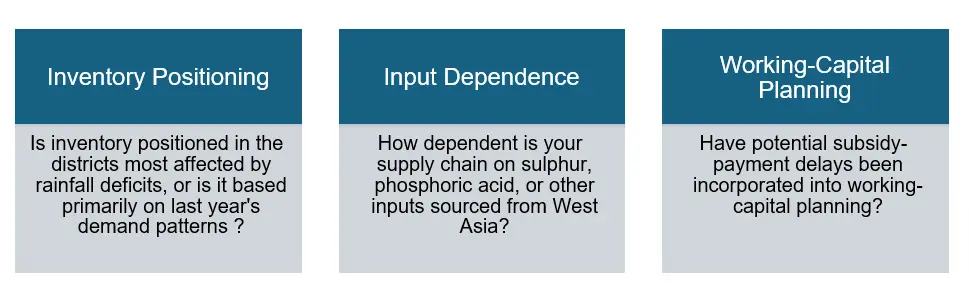
The outcome will likely determine whether the season experiences a manageable increase in fertilizer consumption or a sharper scramble for product availability in deficit-affected regions.
For now, the most important metric may not be India’s national rainfall figure, but regional rainfall distribution and how quickly fertilizer inventories can be moved to areas where demand emerges.
Those monitoring district-level weather trends and proactively repositioning stocks may be better placed to benefit from the weeks ahead than those relying solely on the assumption that a weak monsoon automatically translates into weaker fertilizer demand.
Follow Price-Watch™ on LinkedIn for real-time raw material insights, pricing trends, supply chain intelligence, and market updates shaping global commodity markets.