

Abstract: The global green energy transition has been severely disrupted by an immediate clash between climate idealism and physical reality. Recent geopolitical supply-chain crises, alongside the exponential, 24/7 power demands of Artificial Intelligence data centres, have forced nations back to foundational baseload security. Serving as the ultimate economic buffer fuel, coal has re-emerged to prove that national security will always override transition goals.
Global Energy Dynamics: The Transition Blueprint vs. Macro Realities
| Catalyst Pillar | The Transition Blueprint (UN SDGs) | The Structural Reality (Current Market) | Grid Impact & Backstop |
| Geopolitical Security | Global cooperation; uninterrupted maritime and pipeline supply chains. | Fractured shipping lanes; active conflict zones; localized energy nationalism. | Thermal Coal Pivot: Out-of-service coal assets restarted to secure national grid survival. |
| Industrial Scale | Linear phase-out of fossil baseloads as renewables scale sequentially. | Exponential manufacturing growth in developing economies creating power deficits. | Parallel Expansion: Record deployment of solar and wind capacity paired with sustained thermal coal additions. |
| Technological Evolution | Decarbonization via digitization; efficiency gains reduce net grid load. | Hyper-scale Artificial Intelligence deployment requiring massive power surges. | Non-Negotiable Load: High-density data centres default to coal for uninterrupted 24/7 power. |
The Illusion of Progress
For years, the world followed a clean, hopeful plan. Under the guidance of the United Nations Sustainable Development Goals, the strategy was straightforward: slowly phase out coal, use natural gas as a cleaner temporary option, and quickly build up wind and solar power.
It was an elegant roadmap that assumed the world would remain peaceful and cooperative. Coal-the dirty fuel that powered the 1800s was finally on its way out. However, this entire plan relied on a fragile assumption: that global politics would remain stable.
The Fractured Bridge
That stability broke apart with unexpected speed. The war and unrest in Europe and the Middle East had an instant effect on the shipping lines that carried oil and natural gas across the globe. As a result of the shortage of natural gas, which became extremely costly, there were urgent problems that needed solving winters became cold, factories had to shut down, and the power grid failed.
When forced to choose between keeping the lights on or meeting environmental goals, governments chose survival. They turned back to a reliable, familiar safety net.
In contrast to natural gas, which needs an elaborate pipeline system that can be easily disrupted, coal was cheap, abundant, and easy to store for long periods. In Europe, governments were scrambling to start up old coal-powered plants that had been out of service for years.
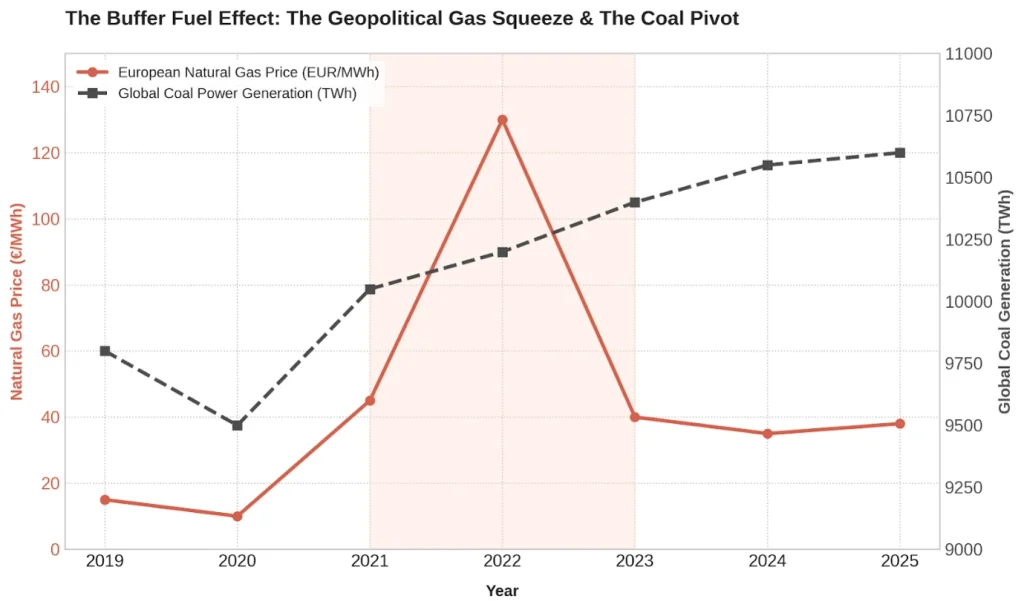
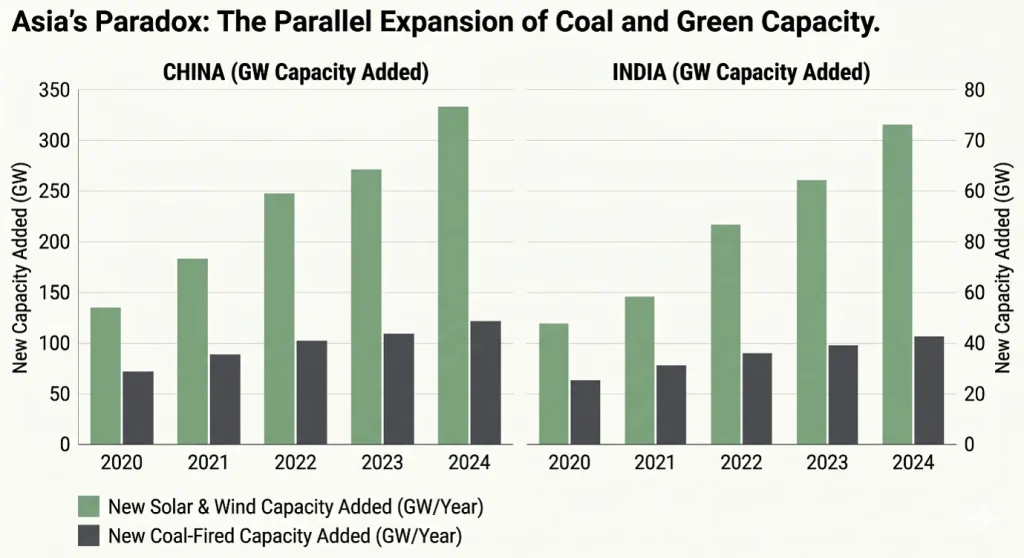
This shift was even more dramatic in India and China. In India, massive heatwaves and a growing manufacturing sector caused a historic surge in power demand. As blackouts are potentially disastrous to the growth of an economy, the government turned to their abundant domestic deposits of coal to ensure that power would never be cut off from the millions of Indians who were rising into the middle class. This produced a bizarre dichotomy in which India was producing solar power at a greater rate than almost any other nation while mining record amounts of coal.
Meanwhile, China has been practicing a strategy of constructing the new system of green energy before destroying the old system that relies on fossil fuels. Despite being the top producer of solar panels and electric cars in the world, China still permits new coal-powered plants.
To shield itself against the global shortage of oil and gas, China is using coal as its economic bedrock. From North America to Africa, national survival has pushed climate ideals to the backseat. Yet, leaders still hoped this coal comeback was just a temporary wartime fix.
The Silicon Irony
The biggest twist in this story did not happen on a battlefield; it happened in Silicon Valley. While war started the coal comeback, the explosion of Artificial Intelligence (AI) is making it permanent. The data centres needed to run AI require a massive, non-negotiable amount of power that can never turn off, not even for a millisecond.
Because today’s batteries cannot store enough wind or solar power to back up an entire country when the sun goes down, the tech sector’s futuristic expansion has run straight into a wall.
To keep their powerful computers running, tech companies are forced to rely on utility companies that burn coal. The great irony is absolute: the world’s most advanced digital future is currently being powered by burning the oldest fossil fuel on Earth.
The Shattered Equation
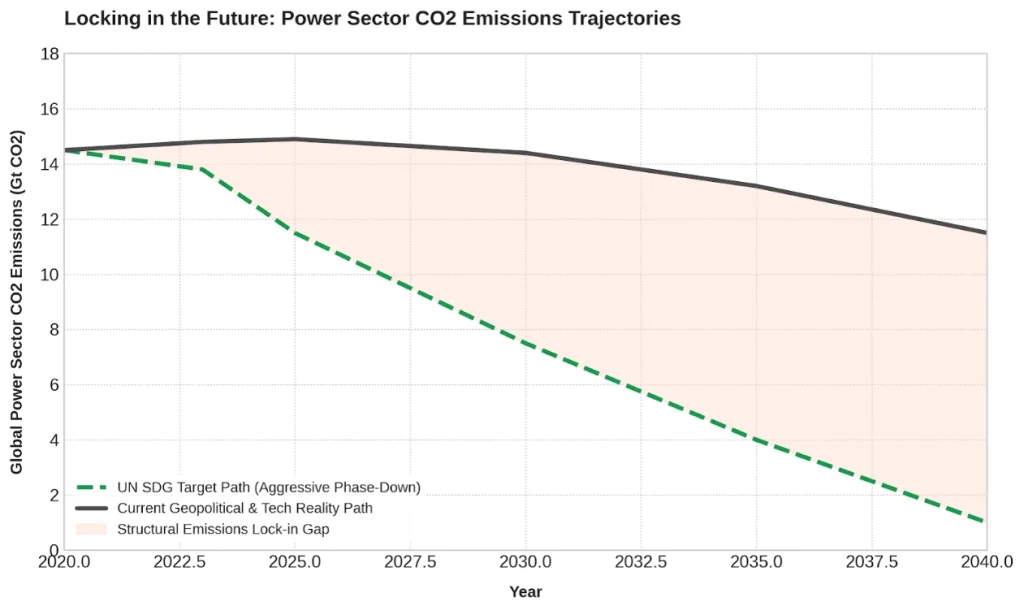
This technological boom has completely broken the world’s climate math. The comfortable belief that green energy would naturally replace fossil fuels has proven incorrect. Simply put, solar and wind energy cannot match the dual challenge of war-time apprehension and artificial intelligence data centres.
Climate deadlines set on an international level, which used to be taken seriously, are now postponed. The schedule for reducing global emissions has been totally altered since the need for energy grows faster than the availability of renewable sources.
The New Reality
Ultimately, the return of coal reveals a harsh truth: when national security and technological progress clash with climate goals, climate goals lose. When the modern world panics, it defaults to what is certain and available. For global leaders, the challenge is no longer just about building more wind turbines or solar farms.
It is about building an international energy system that is stable enough that countries never feel the need to use coal as a safety net. Until that system is built, Coal will remain key in the long-term global energy equation.