

From LPG-paralysed container yards to a Rs 3.4 lakh crore fertiliser subsidy shock, a perfect storm of geopolitical fire and infrastructure failure is tearing apart India’s logistics backbone.

THE ANATOMY OF A COLLAPSE
India’s largest container port, the Jawaharlal Nehru Port Authority (JNPT) on the outskirts of Mumbai, handles roughly 5.6 million TEUs (twenty-foot equivalent units) annually – nearly a quarter of all containerised cargo moving in and out of the country. But in 2026, this gateway to the world is showing dangerous cracks.
Truck drivers went hungry for days waiting in queues. LPG prices spiked, cutting deep into container freight economics. Yards designed for efficiency became choke-points of delay. And at the centre of it all, exporters are bleeding cash.
Port congestion at JNPT has pushed up export costs by as much as Rs 30,000 per container – a seismic hit for small and medium exporters who operate on wafer-thin margins.
What began as an infrastructure stress is now an economic emergency with cascading effects across India’s fertiliser supply, holiday-season textile exports, FTA competitiveness, and the national fiscal balance.
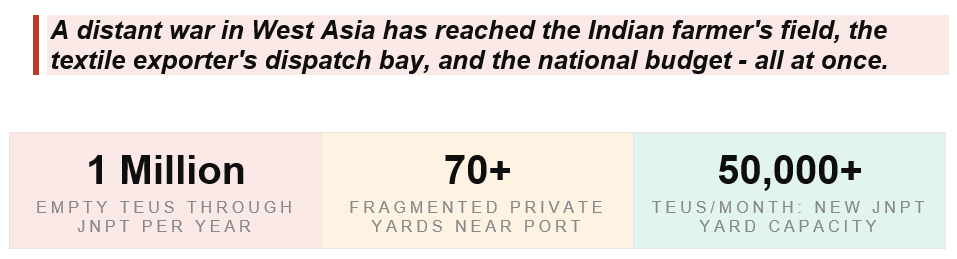
Roughly 1 million TEUs of empty containers move through JNPT every year nearly one-fifth of total throughput. These are managed through a fragmented web of more than 70 privately operated container yards around Nhava Sheva.
Many lack road access, truck parking, and systematic stacking infrastructure, creating a slow, expensive, and congestion-prone system. Trucks queue for hours. Turnaround times balloon. The costs travel down the chain and land on the exporter’s desk.
FIGURE 1 – Export Cost Escalation at JNPT per Container (RS)
| Cargo Segment | Baseline Cost (RS) | Congestion Surcharge (RS) |
| Textiles | 62,000 | 28,000 |
| Engineering Goods | 68,000 | 30,000 |
| Chemicals | 71,000 | 25,000 |
| Pharmaceuticals | 65,000 | 22,000 |
| Agri Products | 58,000 | 18,000 |
Source: Price Watch™ Research estimates based on industry data, June 2026
THE RS 2,580 CRORE BET ON EMPTY BOXES
A dramatic infrastructural response to this chronic problem came in June 2026 when RSA Global and the Maharashtra government announced an MoU for a Rs 2,580 crore automated container depot on a 62-acre site within the JNPT estate at Uran. This is not just a warehouse – it is a paradigm shift in how India handles the empty-container problem.
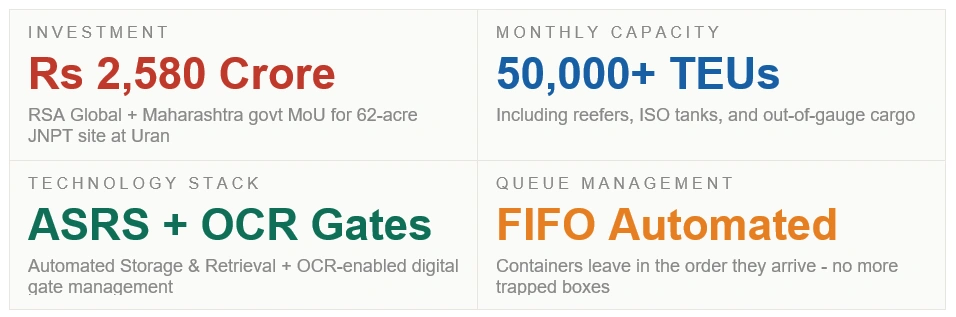
The facility will replace the fragmented private-yard ecosystem with a single integrated, FIFO-automated hub inside the port. It features Automated Storage and Retrieval Systems (ASRS) and Electric Overhead Travel (EOT) cranes, OCR-enabled gates for digital processing, and dedicated truck parking to eliminate congestion that currently spills onto public roads.
THE FERTILISER SUBSIDY
The West Asia conflict has simultaneously detonated a fertiliser price crisis that is directly exposing India’s fiscal fragility. About one-third of the world’s traded fertiliser moves through the Strait of Hormuz.
With Iran-linked restrictions effectively closing this corridor, global urea prices have surged from a pre-war range of $300–$420 per tonne to $935–$959 per tonne in India’s recent import tenders an increase of more than 120% in under three months.
FIGURE 2 – International Urea Price Trajectory ($/tonne)
| Period | Import Price | Change |
| Pre-conflict benchmark (2024–25 avg) | $300 – $420/t | Baseline |
| Early 2026 (post-conflict onset) | $510 – $650/t | +52% |
| June 2026 import tenders | $935 – $959/t | +120 – 140% |
Source: Government import tenders; Price Watch™ analysis, June 2026
The arithmetic is brutal. The actual delivered cost of a 45-kg bag of urea has climbed to approximately Rs 3,500 (roughly Rs 78,000 per tonne). The farmer pays just Rs 242 per bag – a price frozen since 2018.
The government quietly pays more than 90% of the true cost. That subsidy burden, budgeted at Rs 1.7 lakh crore, is now projected to nearly double to Rs 3.4 lakh crore in 2026 alone.

HOLIDAY SEASON EXPORTS UNDER SIEGE
For India’s apparel and home textile exporters, the timing of this crisis could not be worse. Between June and September, Indian suppliers ship large volumes of Christmas-season orders to the United States and Europe. This year, that predictable rhythm of trade is under severe stress.
FIGURE 3 – Shipping Metrics: India-Europe Corridor Before & After Crisis
| Metric | Before (NORMAL) | After (CRISIS) |
| Transit time to Europe | 24 – 40 days | ~60 days (+50–100%) |
| Sea freight cost increase | Baseline (0%) | 15 – 30% higher |
| JNPT container turnaround | 6 – 10 hours | 18 – 24+ hours |
| War risk insurance premium | Minimal | Sharp increase |
Source: FIEO submissions; industry reports; Price Watch™ analysis, June 2026
Christmas retail cycles operate with near-mechanical precision: products are planned months in advance, shelf space is pre-booked, and seasonal collections are timed to the week. Transit times ballooning from 24–40 days to nearly 60 days is catastrophic – turning full-price seasonal sales into heavy markdowns or outright cancellations.
Home textile exporters – bed linens, towels, curtains, furnishing fabrics are among the hardest hit, as their entire business model depends on catching the holiday window precisely.
The Federation of Indian Export Organisations (FIEO) has formally written to the Ministries of Ports, Shipping and Waterways, and Commerce and Industry, flagging opportunistic pricing by foreign shipping lines and non-transparent detention and demurrage charges, seeking urgent regulatory intervention.
Price Watch™ FORWARD VIEW
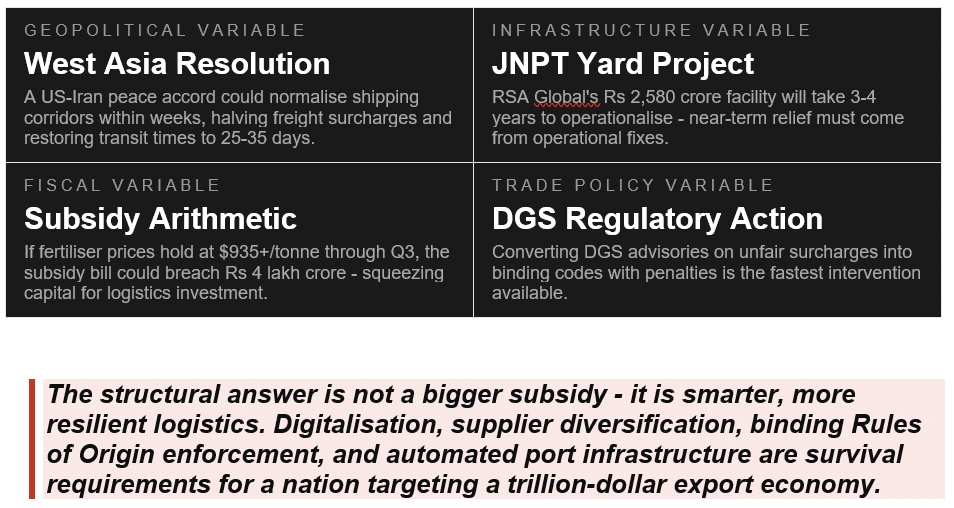
The convergence of port congestion, geopolitical freight disruption, a doubling fertiliser subsidy burden, and structural FTA readiness gaps is not a temporary shock – it is a stress test of India’s logistics architecture. The coming 6 -12 months will be defined by four critical variables:
How Price Watch™ Helps You Navigate This Crisis
In a market where a distant conflict can double fertiliser costs overnight, where a port backlog can add Rs 30,000 to a single container, and where holiday-season export windows can close in weeks, the difference between a profitable trade and a loss-making one is real-time price intelligence.
Price Watch™ tracks commodity prices, freight rates, port congestion indices, and logistics cost structures across India’s major trade corridors – giving exporters, importers, manufacturers, and logistics providers the data they need to act before costs escalate.
Our coverage spans fertiliser import tender prices, container shipping rates by corridor, War Risk Surcharge movements, JNPT and Mundra congestion status, and FTA compliance benchmarks – updated in near real-time.
COVERAGE AREAS: Fertiliser Import Prices | Container Freight Rates | Raw Material Prices | Port Driven Offered CIF Rates
Follow Price Watch™ on LinkedIn for real-time raw material insights, pricing trends, supply chain intelligence, and market updates shaping global commodity markets.