

Steel remains one of the most important industrial commodities in the world, forming the backbone of construction, infrastructure, automotive manufacturing, machinery, and energy projects. As a result, trends in the steel market often reflect the overall health of the global economy.
During the past week, the global steel market exhibited a slightly bearish to neutral trend. While prices faced some downward pressure in major producing regions, underlying demand from infrastructure and industrial projects continued to provide support.
Chinese Demand Continues to Shape Market Sentiment
China remains the dominant force in the global steel industry, accounting for more than half of worldwide steel production and consumption. However, ongoing weakness in the country’s real estate sector has reduced demand for construction steel, affecting market sentiment globally.
At the same time, concerns over excess steel production continue to weigh on prices. With supply exceeding demand in several markets, steel producers are finding it difficult to push prices higher despite stable production costs.
India’s Growth Story Supports Steel Consumption
While China remains a challenge, India continues to emerge as a bright spot for the steel sector. Government investments in highways, railways, smart cities, renewable energy projects, and industrial development are driving strong steel consumption.
Rapid urbanization and manufacturing expansion have positioned India as one of the key contributors to future global steel demand, helping balance weakness in other regions.
Raw Material Costs and Trade Policies Remain Key Drivers
The steel industry is heavily influenced by the cost of raw materials such as iron ore and coking coal. During the past week, iron ore prices remained relatively stable, while coking coal and freight costs experienced some fluctuations. These factors supported steel prices by increasing production costs, although they also put pressure on manufacturers’ profit margins.
Trade policies also played an important role. Several countries continue to impose tariffs and import restrictions on low-cost steel products, helping domestic producers maintain competitiveness and supporting regional pricing.
Hot Rolled Coil Reflects the Current Market Trend
A good example of the recent market direction can be seen in Hot Rolled Coil (HRC), one of the most widely traded steel products globally. HRC is commonly used in construction, automotive manufacturing, industrial machinery, and infrastructure development.
Last week, HRC prices witnessed a modest downward trend, primarily due to weaker construction demand in China and concerns surrounding global oversupply.
However, the decline remained limited because of steady buying activity from infrastructure and manufacturing sectors, particularly in India. This suggests that while short-term sentiment remains cautious, demand fundamentals continue to provide support.
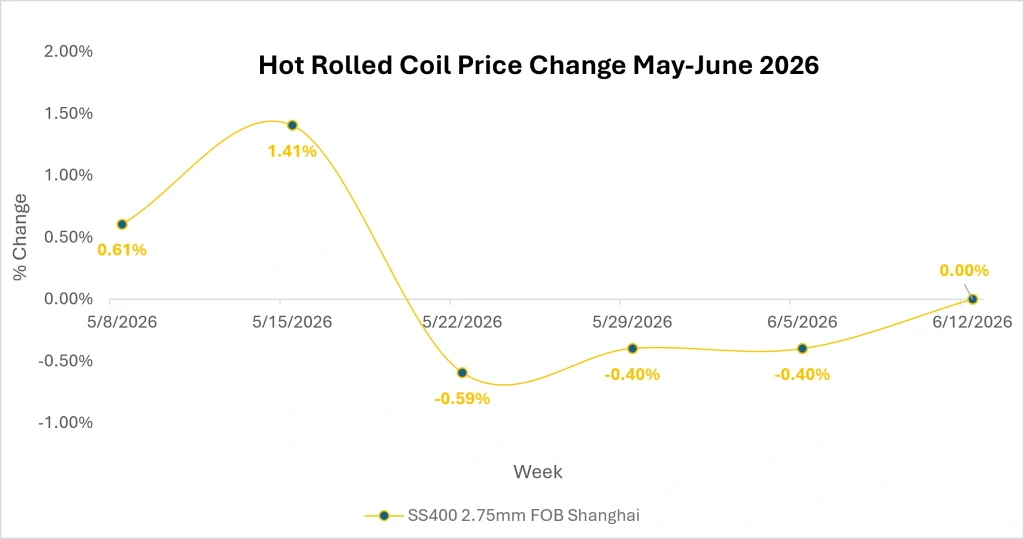
Source: Price Watch™ HRC Prices
What Lies Ahead for the Steel Market?
Looking forward, the steel market is expected to remain influenced by two opposing forces. On one hand, weak Chinese demand and global overcapacity could continue to create downward pressure on prices.
On the other hand, infrastructure spending, industrial expansion, and the global transition toward renewable energy are expected to sustain long-term steel demand.
Steel Market Outlook
Overall, last week’s steel market leaned slightly downward, reflecting cautious sentiment among buyers and producers. Nevertheless, strong infrastructure investments, manufacturing growth, and rising demand from emerging economies continue to provide a solid foundation for the industry.
While short-term volatility may persist, the long-term outlook for steel remains positive as global development projects and industrial expansion continue to drive consumption.
Follow Price Watch™ on LinkedIn for real-time raw material insights, pricing trends, supply chain intelligence, and market updates shaping global commodity markets.