

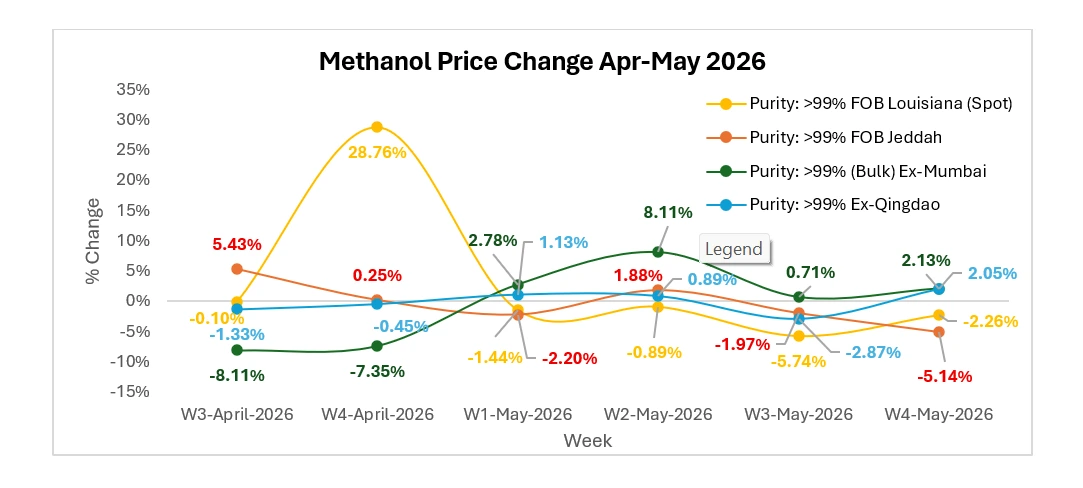
The global methanol market shifted from balanced fundamentals into an extreme regional divergence cycle between January and April 2026. FOB Jeddah prices surged from USD 180/MT to USD 420/MT as escalating geopolitical tensions around the Strait of Hormuz disrupted traditional Middle Eastern export flows, inflated marine insurance costs, and triggered sharp freight premium escalation.
Simultaneously, FOB Louisiana Spot prices climbed from $300/MT to $650/MT due to Henry Hub linked feedstock inflation, tightening terminal availability, and aggressive export demand from Asia. The most dramatic rally emerged in India, where Bulk Ex Mumbai prices skyrocketed from $330/MT to a blistering peak of $800/MT by mid April.
Tight vessel availability, delayed cargo arrivals, and panic replenishment buying from downstream formaldehyde, refinery, and chemical intermediate sectors created one of the sharpest regional methanol shortages globally.
How Did Freight and Geopolitics Reshape Arbitrage?
The Middle Eastern supply corridor became the center of global methanol volatility during Q1 and early Q2 2026. Freight rerouting, shipping congestion, and geopolitical uncertainty tightened prompt cargo availability across Asia, fundamentally reshaping global arbitrage economics.
Despite the turmoil, FD Rotterdam Spot prices remained relatively stable between $280–310/MT due to stronger inland inventory structures and lower dependence on prompt seaborne imports.
Source: Price-Watch™ Methanol Prices
| Market Vector | Q1 2026 Reality | Forward Outlook |
| FOB Louisiana | Rose from $300 to $650/MT | Export tightness may sustain prices below $600/MT |
| Ex-Mumbai | Stable near $330–800/MT before March spike | Import shortages may continue supporting elevated premiums |
| Ex-Qingdao | Controlled rise from $300 to $460/MT | MTO margins and coal economics remain critical |
| FOB Jeddah | Climbed from $180 to $420/MT | Strait of Hormuz risks may structurally support prices above $450/MT |
Methanol Market Outlook Divergence is the New Normal
The 2026 methanol cycle confirms that freight exposure, geopolitical bottlenecks, MTO economics, and supply chain resilience are now outweighing traditional feedstock-based pricing mechanisms.
Additionally, the accelerating adoption of dual fuel vessels and renewable e-methanol is creating a new structural demand layer within global marine fuel markets.
Price-Watch.ai enables procurement teams, commodity traders, and hedge funds to navigate this volatility through real-time spot tracking, freight-adjusted arbitrage analysis, MTO margin monitoring, and forward forecasting models that identify supply disruptions and pricing risks before they fully emerge in physical markets.
Follow Price-Watch™ on LinkedIn for real-time raw material insights, pricing trends, supply chain intelligence, and market updates shaping global commodity markets.