

China’s Propionic Acid market experienced a sustained downward trend, with prices declining in four of the six assessed weeks despite the broader petrochemical sector having previously faced significant cost pressures.
Chinese Exporters Lower Offers to Boost Sales
Following the sharp correction in W24, the market saw only a brief stabilization in W26 before another notable decline in W27.
This sequence indicated that the weakness was not a one-time correction; instead, exporters repeatedly lowered offer prices to stimulate buying interest, accelerate cargo movement, and prevent inventory accumulation.
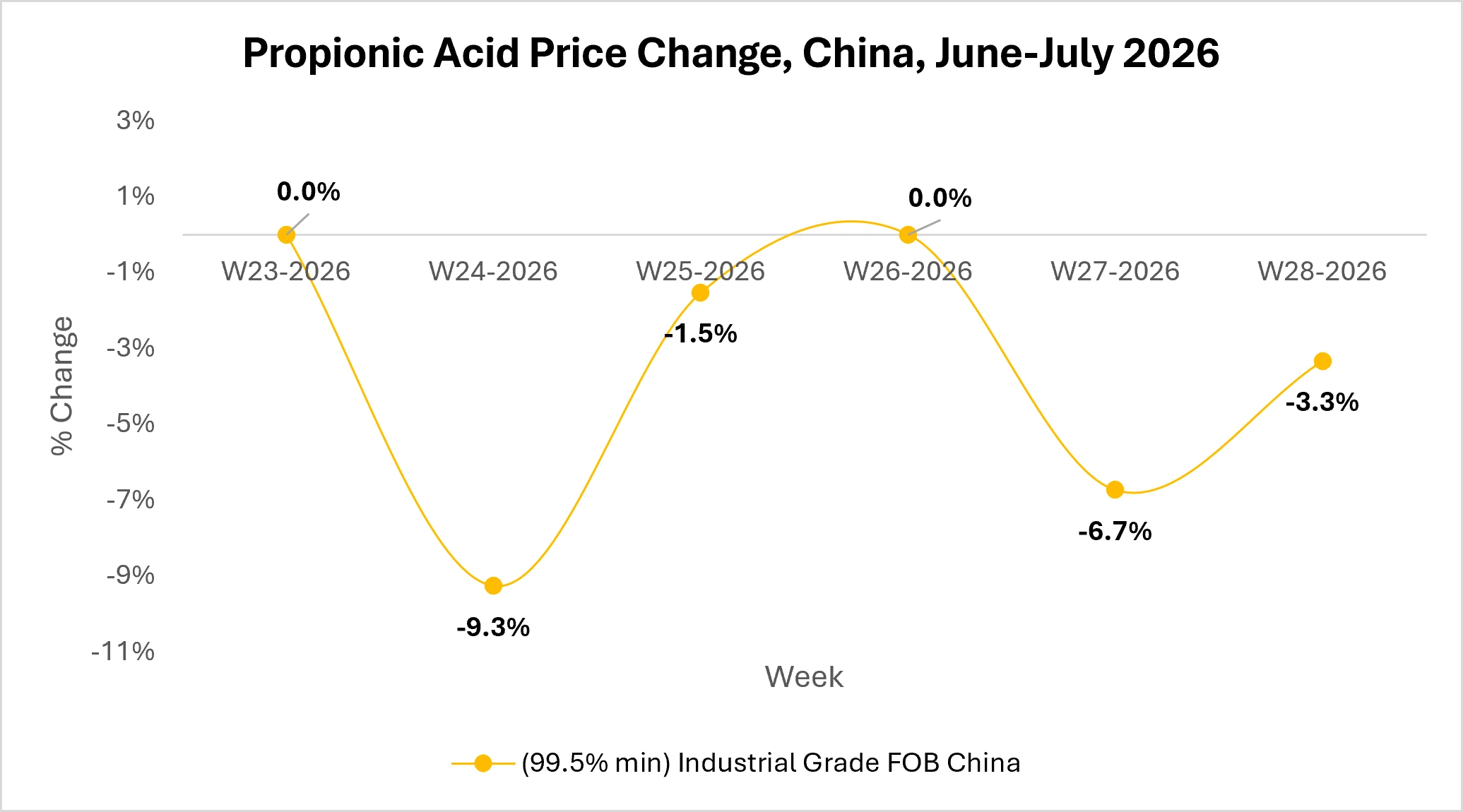
Source: 𝐏𝐫𝐢𝐜𝐞 𝐖𝐚𝐭𝐜𝐡™ Propionic Acid Prices
A notable feature of the period was the growing divergence between the propionic acid market and broader upstream petrochemical sentiment.
Weaker Feedstock Sentiment Reinforces Market Pressure
Earlier in 2026, China’s propylene oxide market had surged by more than 20% amid tighter supply conditions, but Northeast Asian propylene oxide prices reversed sharply during June.
Although propylene oxide is not a direct feedstock for propionic acid production, its decline reflected a broader deterioration in cost sentiment across China’s oxygenated chemicals sector.
At the same time, Crude Oil Prices weakened in late June as concerns over potential supply disruptions in the Middle East subsided. The softer crude market weighed on Chinese petrochemical futures, reducing replacement cost expectations across the value chain.
By July 2026, the availability of heavily discounted Middle Eastern crude, coupled with China’s renewed fuel export activity, further reinforced expectations of improved refinery operating conditions and adequate upstream supply, adding to the bearish outlook for export-oriented propionic acid prices.
A key feature of the market during the period was the divergence between relatively stable propionic acid pricing and the softer sentiment prevailing across segments of the upstream chemical value chain in US.
North America Propionic Acid Prices Remain More Stable
In North America, Popylene Oxide Prices faced downward pressure through mid 2026, reflecting weaker global chemical market conditions and lower replacement-cost expectations.
Despite this broader weakness, propionic acid producers did not immediately mirror upstream price declines.
Stable domestic supply-demand fundamentals, long-term customer agreements, and resilient demand from feed preservation and food preservation applications helped support pricing. Additionally, steady consumption from the agrochemical and pharmaceutical sectors continued to underpin the market, limiting the impact of weaker upstream sentiment on propionic acid values.
- Export impact: Overseas buyers had delayed commitments because repeated weekly reductions rewarded hand-to-mouth purchasing.
- Downstream impact: Food-preservative, feed-additive and chemical users appeared insufficiently active to absorb readily available Chinese material, extending the oversupply conditions already reported during Q1.
Propionic Acid Market Outlook
Over the next three months, prices were likely to remain exposed to further negotiated declines unless producers reduced operating rates or seasonal feed and food-preservation demand improved.
The main upside risk remained an unexpected logistics disruption or renewed energy volatility.
With FOB values having fallen in consecutive waves rather than one clean correction, would buyers secure volumes now?
Follow Price Watch™ for the latest insights and market developments.
Follow Price Watch™ on LinkedIn for real-time raw material insights, pricing trends, supply chain intelligence, and market updates shaping global commodity markets.