

India’s steel market has opened September 2026 on a distinctly bullish note, with Hot-Rolled Coil (HRC) prices moving sharply higher and mill offers strengthening across the market. The rally is also spreading beyond finished steel, with billet, sponge iron, scrap and key raw materials all recording upward momentum.
HRC benchmark prices have reached around ₹62,000 per tonne, while sponge iron has increased by roughly 12% month-on-month and billet by around 4%. Scrap has risen close to ₹1,100 per tonne week-on-week, while coking coal and iron ore are also firming. CRC, TMT rebar and pig iron are following the broader upward trend.
| Product / Raw Material | Recent Market Movement | Direction |
| HRC | ↑ ~₹2,600/t WoW | Bullish |
| CRC | ↑ Firming | Positive |
| TMT (Steel Rebar) | ↑ Firm | Positive |
| Billet | ↑ ~4% MoM | Bullish |
| Sponge Iron | ↑ ~12% MoM | Strong Bullish |
| Pig Iron | ↑ ~2% MoM | Positive |
| Scrap | ↑ ~₹1,100/t WoW | Bullish |
| Iron Ore | ↑ Firm | Positive |
| Coking Coal | ↑ Higher | Cost Pressure |
Source: Price Watch™
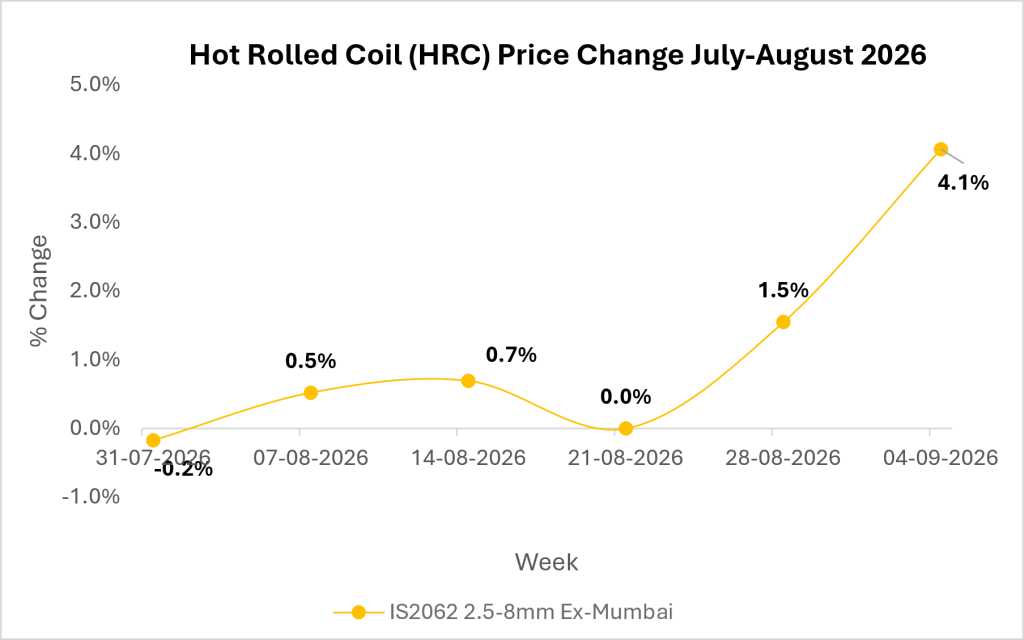
Source: Price Watch™ HRC Prices
The breadth of the move is important. This is not simply an HRC rally driven by short-term speculation. Higher raw-material costs, tighter spot availability, stronger exports, limited import pressure and improving domestic demand expectations are all contributing to the increase.
The key question now is whether these factors can sustain prices once buyers begin testing the higher levels.
Indian Steel Prices Rise as the Rally Spreads Across the Value Chain
The current steel rally is moving through the entire value chain rather than remaining concentrated in one product.
Higher coking-coal prices are raising blast-furnace production costs, while firmer iron ore and pellet prices are increasing the cost base for integrated producers. Sponge iron has responded strongly, followed by billet and finished steel.
The transmission is therefore increasingly visible:
Coking coal → Iron ore → Sponge iron → Billet → HRC / TMT
This matters because a rally originating from higher input costs tends to be more persistent than one driven purely by speculative buying. Mills are increasingly passing higher production costs downstream rather than absorbing them through lower margins.
The market is therefore showing evidence of genuine cost pressure, although the extent to which downstream buyers can continue absorbing higher prices remains the critical question.
Tighter Availability and Weaker Import Pressure Support Domestic Prices
India’s steel production continues to increase, but higher production does not necessarily mean greater availability in the spot market.
A significant portion of current output is already committed to automotive, industrial and infrastructure customers. Exports are also absorbing additional material, while maintenance shutdowns and controlled distributor allocations have reduced immediate availability in selected segments.
This has created an important distinction between production growth and spot-market availability.
Imports would normally provide a ceiling to domestic steel prices. When domestic prices rise significantly above international alternatives, buyers can turn to imported material. However, firmer international prices, freight costs, duties and other landed expenses are reducing the attractiveness of that arbitrage.
As a result, imports are currently providing less resistance to domestic mill price increases.
Exports are reinforcing the same dynamic. Stronger export economics mean that every tonne shipped overseas reduces material available for the domestic market.
The combination of higher production, stronger domestic consumption, increased exports and reduced import pressure is therefore producing a tighter effective supply-demand balance than headline production numbers alone would suggest.
Raw-Material Costs Remain a Major Price Driver
Coking coal has emerged as one of the most important variables for the near-term steel market.
Higher coking-coal prices directly increase blast-furnace steel production costs, while firmer iron ore and pellet prices are simultaneously raising the raw-material burden for integrated producers.
When these costs increase together, mills have two broad choices: absorb the pressure and allow margins to contract or pass the increase through to customers.
Recent market behaviour indicates that producers are increasingly choosing the second option.
That is significant because it suggests mills believe current demand conditions can support higher selling prices, at least for now.
Stronger End-User Demand still missing
The main question surrounding the rally is demand.
Domestic steel consumption is improving, but the current move does not yet resemble an uncontrolled demand boom. Instead, prices are being supported by a combination of higher input costs, tighter availability, stronger exports, weaker import pressure and inventory replenishment.
That distinction will determine how durable the rally becomes.
If buyers continue accepting higher prices and downstream consumption strengthens, the market could sustain its upward trajectory. If end-users begin resisting higher offers, purchasing could slow quickly, allowing inventories to accumulate through the distribution channel and putting pressure on spot prices.
TMT rebar is particularly important to watch.
The post-monsoon period is traditionally an important window for construction and infrastructure activity. If construction demand accelerates, long steel could develop its own demand-driven momentum, broadening the rally beyond HRC into billet and TMT.
A simultaneous strengthening across flat steel, long steel and semi-finished steel would provide a considerably stronger signal of a sustained steel upcycle.
Buyer Resistance Remains the Key Downside Risk
The biggest near-term risk is not necessarily additional supply; it is buyer resistance.
A sharp price increase can initially encourage buyers to replenish inventories ahead of further increases. But once prices move beyond levels downstream customers can comfortably absorb, purchasing behaviour can reverse quickly.
The potential sequence is straightforward:
Prices rise → buyers delay purchases → spot demand weakens → channel inventories build → discounts return → prices correct
This makes the next few weeks particularly important.
The market still needs to demonstrate that higher prices are being supported by actual steel consumption rather than expectations of continued tightness.
Indian Steel Market Outlook
India’s steel market is expected to remain firm to bullish over the next two to four weeks, with further upside possible if raw-material costs remain elevated, mill availability stays controlled, post-monsoon demand improves, import pressure remains limited and export economics continue to favour Indian producers.
Three scenarios are worth monitoring.
Bullish scenario: HRC moves further above current levels while billet and TMT follow, confirming that the rally is broadening across the value chain.
Base scenario: Prices remain firm with selective increases, but periodic buyer resistance limits the pace of the rally.
Bearish scenario: Supply availability improves while downstream buyers resist additional increases, triggering inventory accumulation and a subsequent correction.
The key variables to monitor are coking coal, iron ore, sponge iron, billet, mill offers, import parity, export economics, post-monsoon construction demand and distributor inventories.
What This Means for Steel Buyers
For procurement teams, distributors and downstream manufacturers, a wait-and-see strategy carries increasing risk in the current market.
Delaying purchases entirely in anticipation of a correction could leave buyers exposed if the rally extends. At the same time, aggressive stockpiling at elevated prices creates risk if demand fails to validate current levels.
A more balanced approach is to:
- Cover near-term requirements rather than remaining completely exposed.
- Stagger additional purchases instead of committing the entire requirement at once.
- Monitor mill price announcements and raw-material movements closely.
- Track the relationship between domestic prices and import parity.
- Reassess procurement positions weekly, rather than relying on historical price assumptions.
In a rising market, replacement cost matters more than historical purchase cost. Procurement decisions should therefore be based on what it will cost to replace the material, not simply what the existing inventory originally cost.
The Bottom Line
The Indian steel market has clearly changed tone.
The current rally has a broad foundation: higher raw-material costs, tighter spot availability, stronger export economics, weaker import pressure and improving domestic demand expectations are all supporting prices.
But this is not yet a guaranteed one-way bull market.
The decisive test will be demand. If post-monsoon consumption accelerates while raw-material costs remain elevated, the current rally could develop into a broader and more sustained steel upcycle. If demand fails to keep pace with higher prices, supply could normalise and trigger a correction.
For now, the signal is clear: steel prices are moving higher, but the real question is whether buyers are willing to follow.
The next two to four weeks should reveal whether September’s rally is another temporary price spike or the beginning of India’s next sustained steel upcycle.
Follow Price Watch™ on LinkedIn for real-time steel market insights, price trends, supply-chain intelligence and global commodity updates.