

A product that surges sharply in a single week and then spends the next five weeks giving it all back is sending a clear message. The latest spike in Nylon-66 injection moulding chips FOB Shanghai ha sbeen fast, aggressive, and ultimately unconvincing.
What happened to Nylon-66 prices in China between April and May 2026
Mid-April brought a crude oil-driven rally across the polyamide chain. Geopolitical tensions lifted Brent sharply, filtering up through benzene and cyclohexane into adipic acid costs. According to Price Watch™ analysis, that cost push briefly justified aggressive offers from Chinese producers. The jump on third week of April reflected genuine replacement-cost pressure at the feedstock level.
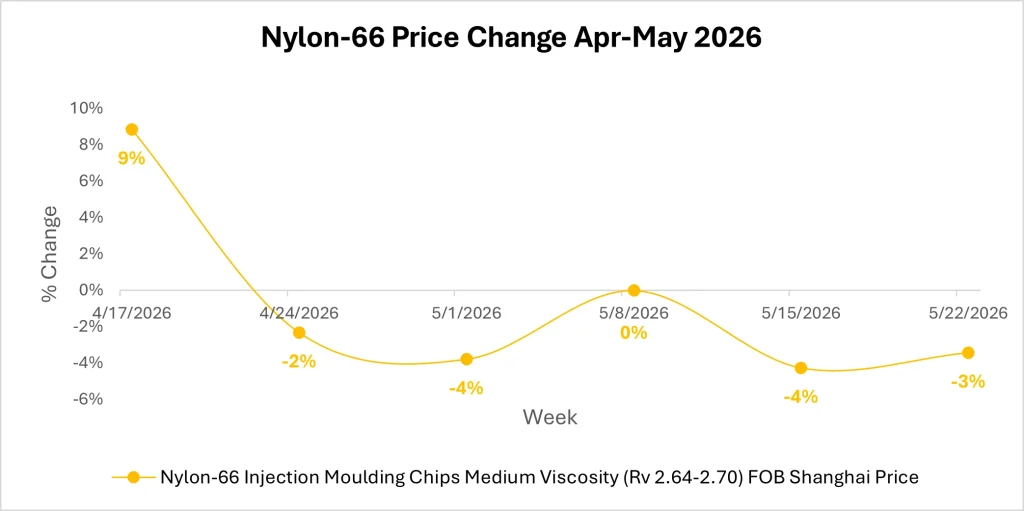
Source: Price Watch™ Nylon-66 Prices
But the market corrected almost immediately. Two forces killed the rally:
- HMDA held firm on cost grounds, yet integrated producers were already running strong HMDA margins. They discounted finished chips to keep volumes moving rather than defend the spike.
- Downstream buyers, primarily engineering plastics compounders and textile machinery parts converters, made only modest dip purchases. No restocking. No conviction.
As per the latest data monitored by Price Watch™, prices spent the following four weeks in a soft declining trend, with one brief flat week in early May before sliding again. The overall direction since late April has been consistently negative.
Value chain pressure points
A surge of new capacity led by China has pushed the Nylon-66 market into a prolonged period of oversupply. On 4 May, China Risun completed its 50,000-tonne HMDA plant in Yuncheng, breaking the long-standing foreign monopoly on adiponitrile technology. More domestic HMDA supply means less upstream cost leverage for sellers going forward. Separately, the European Commission imposed anti-dumping duties on imports of Chinese adipic acid, which may redirect volume back into the domestic chain and add further pressure on Chinese PA66 export offers.
Short-term outlook for Nylon-66 FOB China
According to Price Watch™ intelligence, it is anticipated that Nylon-66 FOB China prices may move by an exact 5% to 6% in the near short term, as new HMDA capacity, weak automotive sector demand, and buyer caution combine to sustain the correction.
Is the April spike a warning that crude-linked cost shocks can still move this market fast, even when fundamentals are structurally oversupplied?
To find out the exact direction of this price movement, and whether prices are set to rise or fall next month, subscribe to Price Watch™ today.
Follow Price Watch™ on LinkedIn for real-time raw material insights, pricing trends, supply chain intelligence, and market updates shaping global commodity markets.